

424 20 Geodetic mapping
Corollary 20.2 (Geodesics, geodesic circles).
A curve C(S) is a geodesic if and only if
U
M + {
M
KL }U
K U
L = 0 .
(20.42)
A curve C(S) is a geodesic circle if and only if
U
M + G KL U
K U
L U
M + 3{
M
KL }U
K U
L + 2G KL {
L
P Q }U
K U
P U
Q U
M +
+({
M
KL }, P +{
Q
KL }{
M
QP })U
K U
L U
P + G KL {
K
P Q }{
L
ST }U
P U
Q U
S U
T U
M = 0 .
(20.43)
End of Corollary.
In the tangent space {T U E
2
A 1 ,A 2
, G KL }, which is spanned by the two tangent vectors G 1 and G 2
(G 1 and G 2 are neither orthogonal nor normalized), C 1 and C 2 (orthonormal Cartan frame), or
D 1 and D 2 (orthonormal Darboux frame) at the point U 0 = {U
1
0 , U
2
0 } (e. g. {L 0 , B 0 } or {U 0 , V 0 }),
we define (Riemann) polar coordinates and normal coordinates by (20.44), in particular, referring to
(20.45) called {“eastern”/“right”/“horizontal”} and (20.46) called {“northern”/“up”/“vertical”}.
x = r cos α , y = r sin α ,
(20.44)
∂X
∂L
∂X
∂L
=
G 1
G 1
=: C 1 ,
(20.45)
∂X
∂B
∂X
∂B
=
G 2
G 2
=: C 2 .
(20.46)
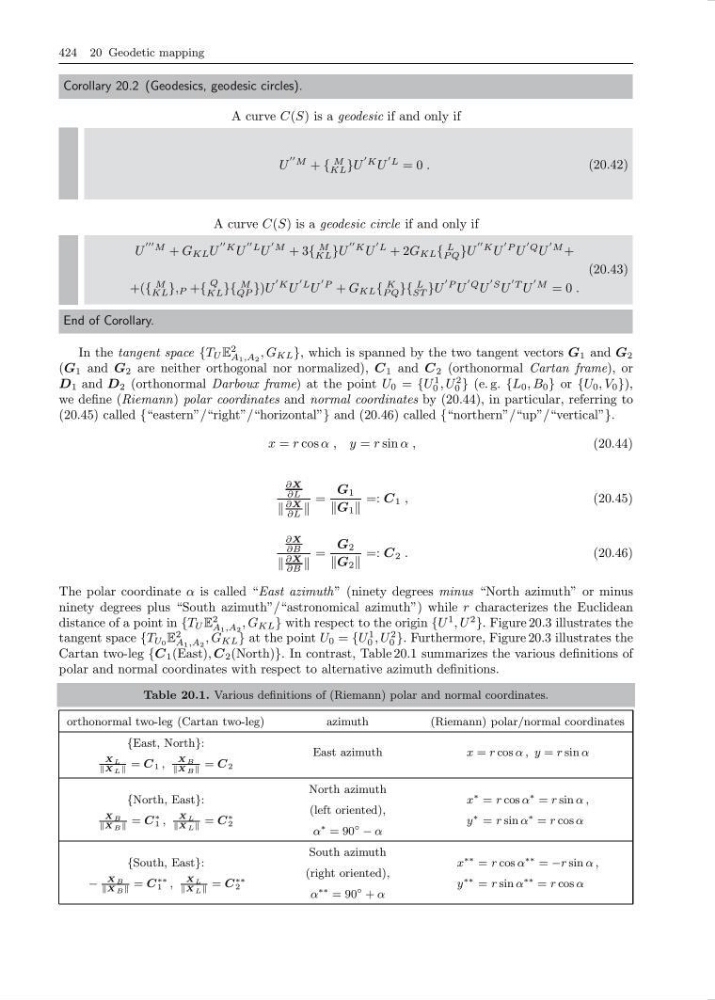
The polar coordinate α is called “East azimuth” (ninety degrees minus “North azimuth” or minus
ninety degrees plus “South azimuth”/“astronomical azimuth”) while r characterizes the Euclidean
distance of a point in {T U E
2
A 1 ,A 2
, G KL } with respect to the origin {U
1 , U
2
}. Figure 20.3 illustrates the
tangent space {T U 0 E
2
A 1 ,A 2
, G KL } at the point U 0 = {U
1
0 , U
2
0 }. Furthermore, Figure 20.3 illustrates the
Cartan two-leg {C 1 (East), C 2 (North)}. In contrast, Table 20.1 summarizes the various definitions of
polar and normal coordinates with respect to alternative azimuth definitions.
Table 20.1. Various definitions of (Riemann) polar and normal coordinates.
orthonormal two-leg (Cartan two-leg)
azimuth
(Riemann) polar/normal coordinates
{East, North}:
X L
X L
= C 1 ,
X B
X B
= C 2
East azimuth
x = r cos α , y = r sin α
{North, East}:
X B
X B
= C
∗
1 ,
X L
X L
= C
∗
2
North azimuth
(left oriented),
α
∗ = 90
◦ − α
x
∗ = r cos α
∗ = r sin α ,
y
∗ = r sin α
∗ = r cos α
{South, East}:
−
X B
X B
= C
∗∗
1 ,
X L
X L
= C
∗∗
2
South azimuth
(right oriented),
α
∗∗ = 90
◦ + α
x
∗∗ = r cos α
∗∗ = −r sin α ,
y
∗∗ = r sin α
∗∗ = r cos α
Corollary 20.2 (Geodesics, geodesic circles).
A curve C(S) is a geodesic if and only if
U
M + {
M
KL }U
K U
L = 0 .
(20.42)
A curve C(S) is a geodesic circle if and only if
U
M + G KL U
K U
L U
M + 3{
M
KL }U
K U
L + 2G KL {
L
P Q }U
K U
P U
Q U
M +
+({
M
KL }, P +{
Q
KL }{
M
QP })U
K U
L U
P + G KL {
K
P Q }{
L
ST }U
P U
Q U
S U
T U
M = 0 .
(20.43)
End of Corollary.
In the tangent space {T U E
2
A 1 ,A 2
, G KL }, which is spanned by the two tangent vectors G 1 and G 2
(G 1 and G 2 are neither orthogonal nor normalized), C 1 and C 2 (orthonormal Cartan frame), or
D 1 and D 2 (orthonormal Darboux frame) at the point U 0 = {U
1
0 , U
2
0 } (e. g. {L 0 , B 0 } or {U 0 , V 0 }),
we define (Riemann) polar coordinates and normal coordinates by (20.44), in particular, referring to
(20.45) called {“eastern”/“right”/“horizontal”} and (20.46) called {“northern”/“up”/“vertical”}.
x = r cos α , y = r sin α ,
(20.44)
∂X
∂L
∂X
∂L
=
G 1
G 1
=: C 1 ,
(20.45)
∂X
∂B
∂X
∂B
=
G 2
G 2
=: C 2 .
(20.46)
The polar coordinate α is called “East azimuth” (ninety degrees minus “North azimuth” or minus
ninety degrees plus “South azimuth”/“astronomical azimuth”) while r characterizes the Euclidean
distance of a point in {T U E
2
A 1 ,A 2
, G KL } with respect to the origin {U
1 , U
2
}. Figure 20.3 illustrates the
tangent space {T U 0 E
2
A 1 ,A 2
, G KL } at the point U 0 = {U
1
0 , U
2
0 }. Furthermore, Figure 20.3 illustrates the
Cartan two-leg {C 1 (East), C 2 (North)}. In contrast, Table 20.1 summarizes the various definitions of
polar and normal coordinates with respect to alternative azimuth definitions.
Table 20.1. Various definitions of (Riemann) polar and normal coordinates.
orthonormal two-leg (Cartan two-leg)
azimuth
(Riemann) polar/normal coordinates
{East, North}:
X L
X L
= C 1 ,
X B
X B
= C 2
East azimuth
x = r cos α , y = r sin α
{North, East}:
X B
X B
= C
∗
1 ,
X L
X L
= C
∗
2
North azimuth
(left oriented),
α
∗ = 90
◦ − α
x
∗ = r cos α
∗ = r sin α ,
y
∗ = r sin α
∗ = r cos α
{South, East}:
−
X B
X B
= C
∗∗
1 ,
X L
X L
= C
∗∗
2
South azimuth
(right oriented),
α
∗∗ = 90
◦ + α
x
∗∗ = r cos α
∗∗ = −r sin α ,
y
∗∗ = r sin α
∗∗ = r cos α