

392 17 “Sphere to cone”: polar aspect
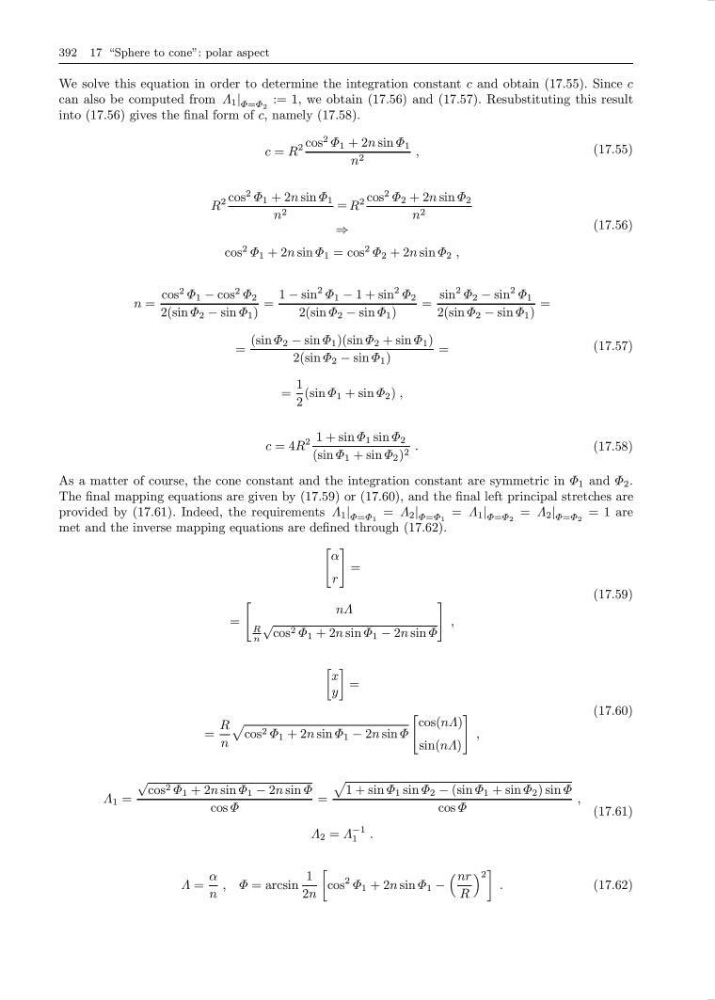
We solve this equation in order to determine the integration constant c and obtain (17.55). Since c
can also be computed from Λ 1 | Φ=Φ 2 := 1, we obtain (17.56) and (17.57). Resubstituting this result
into (17.56) gives the final form of c, namely (17.58).
c = R
2 cos
2 Φ 1 + 2n sin Φ 1
n 2
,
(17.55)
R
2 cos
2 Φ 1 + 2n sin Φ 1
n 2
= R
2 cos
2 Φ 2 + 2n sin Φ 2
n 2
⇒
cos
2 Φ 1 + 2n sin Φ 1 = cos
2 Φ 2 + 2n sin Φ 2 ,
(17.56)
n =
cos
2 Φ 1 − cos
2 Φ 2
2(sin Φ 2 − sin Φ 1 )
=
1 − sin
2 Φ 1 − 1 + sin
2 Φ 2
2(sin Φ 2 − sin Φ 1 )
=
sin
2 Φ 2 − sin
2 Φ 1
2(sin Φ 2 − sin Φ 1 )
=
=
(sin Φ 2 − sin Φ 1 )(sin Φ 2 + sin Φ 1 )
2(sin Φ 2 − sin Φ 1 )
=
=
1
2
(sin Φ 1 + sin Φ 2 ) ,
(17.57)
c = 4R
2 1 + sin Φ 1 sin Φ 2
(sin Φ 1 + sin Φ 2 ) 2 .
(17.58)
As a matter of course, the cone constant and the integration constant are symmetric in Φ 1 and Φ 2 .
The final mapping equations are given by (17.59) or (17.60), and the final left principal stretches are
provided by (17.61). Indeed, the requirements Λ 1 | Φ=Φ 1 = Λ 2 | Φ=Φ 1 = Λ 1 | Φ=Φ 2 = Λ 2 | Φ=Φ 2 = 1 are
met and the inverse mapping equations are defined through (17.62).
α
r
=
=
nΛ
R
n
√
cos 2 Φ 1 + 2n sin Φ 1 − 2n sin Φ
,
(17.59)
x
y
=
=
R
n
cos 2 Φ 1 + 2n sin Φ 1 − 2n sin Φ
cos(nΛ)
sin(nΛ)
,
(17.60)
Λ 1 =
√
cos 2 Φ 1 + 2n sin Φ 1 − 2n sin Φ
cos Φ
=
1 + sin Φ 1 sin Φ 2 − (sin Φ 1 + sin Φ 2 ) sin Φ
cos Φ
,
Λ 2 = Λ
−1
1 .
(17.61)
Λ =
α
n
, Φ = arcsin
1
2n
cos
2 Φ 1 + 2n sin Φ 1 −
nr
R
2
.
(17.62)
We solve this equation in order to determine the integration constant c and obtain (17.55). Since c
can also be computed from Λ 1 | Φ=Φ 2 := 1, we obtain (17.56) and (17.57). Resubstituting this result
into (17.56) gives the final form of c, namely (17.58).
c = R
2 cos
2 Φ 1 + 2n sin Φ 1
n 2
,
(17.55)
R
2 cos
2 Φ 1 + 2n sin Φ 1
n 2
= R
2 cos
2 Φ 2 + 2n sin Φ 2
n 2
⇒
cos
2 Φ 1 + 2n sin Φ 1 = cos
2 Φ 2 + 2n sin Φ 2 ,
(17.56)
n =
cos
2 Φ 1 − cos
2 Φ 2
2(sin Φ 2 − sin Φ 1 )
=
1 − sin
2 Φ 1 − 1 + sin
2 Φ 2
2(sin Φ 2 − sin Φ 1 )
=
sin
2 Φ 2 − sin
2 Φ 1
2(sin Φ 2 − sin Φ 1 )
=
=
(sin Φ 2 − sin Φ 1 )(sin Φ 2 + sin Φ 1 )
2(sin Φ 2 − sin Φ 1 )
=
=
1
2
(sin Φ 1 + sin Φ 2 ) ,
(17.57)
c = 4R
2 1 + sin Φ 1 sin Φ 2
(sin Φ 1 + sin Φ 2 ) 2 .
(17.58)
As a matter of course, the cone constant and the integration constant are symmetric in Φ 1 and Φ 2 .
The final mapping equations are given by (17.59) or (17.60), and the final left principal stretches are
provided by (17.61). Indeed, the requirements Λ 1 | Φ=Φ 1 = Λ 2 | Φ=Φ 1 = Λ 1 | Φ=Φ 2 = Λ 2 | Φ=Φ 2 = 1 are
met and the inverse mapping equations are defined through (17.62).
α
r
=
=
nΛ
R
n
√
cos 2 Φ 1 + 2n sin Φ 1 − 2n sin Φ
,
(17.59)
x
y
=
=
R
n
cos 2 Φ 1 + 2n sin Φ 1 − 2n sin Φ
cos(nΛ)
sin(nΛ)
,
(17.60)
Λ 1 =
√
cos 2 Φ 1 + 2n sin Φ 1 − 2n sin Φ
cos Φ
=
1 + sin Φ 1 sin Φ 2 − (sin Φ 1 + sin Φ 2 ) sin Φ
cos Φ
,
Λ 2 = Λ
−1
1 .
(17.61)
Λ =
α
n
, Φ = arcsin
1
2n
cos
2 Φ 1 + 2n sin Φ 1 −
nr
R
2
.
(17.62)