

390 17 “Sphere to cone”: polar aspect
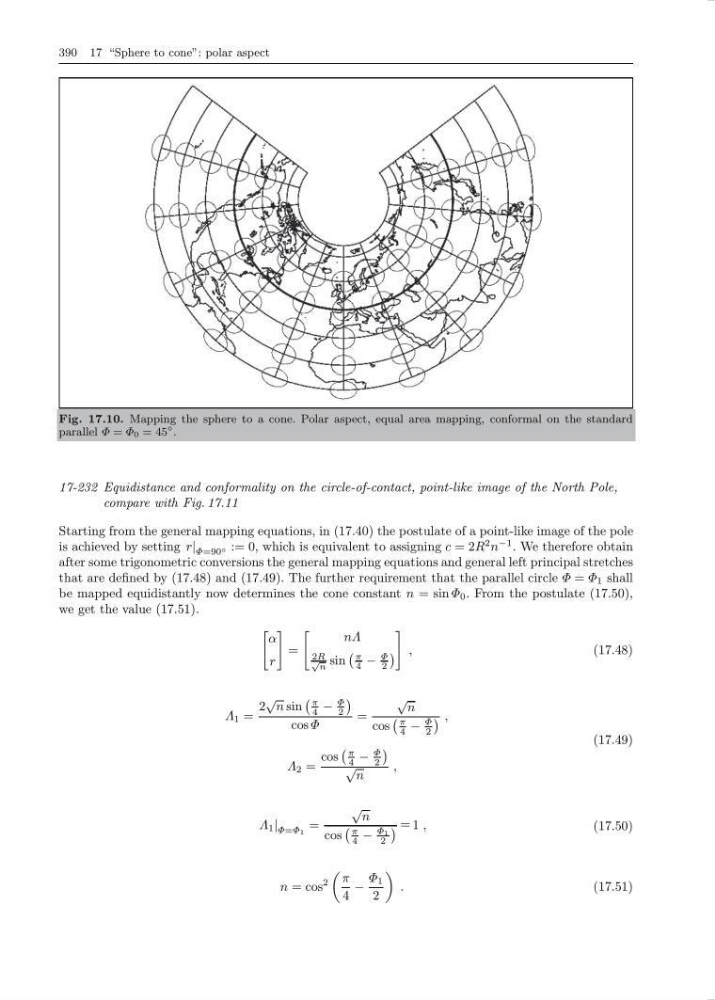
Fig. 17.10. Mapping the sphere to a cone. Polar aspect, equal area mapping, conformal on the standard
parallel Φ = Φ 0 = 45
◦ .
17-232 Equidistance and conformality on the circle-of-contact, point-like image of the North Pole,
compare with Fig. 17.11
Starting from the general mapping equations, in (17.40) the postulate of a point-like image of the pole
is achieved by setting r| Φ=90 ◦ := 0, which is equivalent to assigning c = 2R
2 n
−1 . We therefore obtain
after some trigonometric conversions the general mapping equations and general left principal stretches
that are defined by (17.48) and (17.49). The further requirement that the parallel circle Φ = Φ 1 shall
be mapped equidistantly now determines the cone constant n = sin Φ 0 . From the postulate (17.50),
we get the value (17.51).
α
r
=
nΛ
2R
√
n
sin
π
4 −
Φ
2
,
(17.48)
Λ 1 =
2
√
n sin
π
4 −
Φ
2
cos Φ
=
√
n
cos
π
4 −
Φ
2
,
Λ 2 =
cos
π
4 −
Φ
2
√ n
,
(17.49)
Λ 1 | Φ=Φ 1 =
√
n
cos
π
4 −
Φ 1
2
= 1 ,
(17.50)
n = cos
2
π
4
−
Φ 1
2
.
(17.51)
Fig. 17.10. Mapping the sphere to a cone. Polar aspect, equal area mapping, conformal on the standard
parallel Φ = Φ 0 = 45
◦ .
17-232 Equidistance and conformality on the circle-of-contact, point-like image of the North Pole,
compare with Fig. 17.11
Starting from the general mapping equations, in (17.40) the postulate of a point-like image of the pole
is achieved by setting r| Φ=90 ◦ := 0, which is equivalent to assigning c = 2R
2 n
−1 . We therefore obtain
after some trigonometric conversions the general mapping equations and general left principal stretches
that are defined by (17.48) and (17.49). The further requirement that the parallel circle Φ = Φ 1 shall
be mapped equidistantly now determines the cone constant n = sin Φ 0 . From the postulate (17.50),
we get the value (17.51).
α
r
=
nΛ
2R
√
n
sin
π
4 −
Φ
2
,
(17.48)
Λ 1 =
2
√
n sin
π
4 −
Φ
2
cos Φ
=
√
n
cos
π
4 −
Φ
2
,
Λ 2 =
cos
π
4 −
Φ
2
√ n
,
(17.49)
Λ 1 | Φ=Φ 1 =
√
n
cos
π
4 −
Φ 1
2
= 1 ,
(17.50)
n = cos
2
π
4
−
Φ 1
2
.
(17.51)