

17-2 Special mapping equations 385
17-213 Equidistance and conformality on two parallels (secant cone, J. N. de L’Isle 1745),
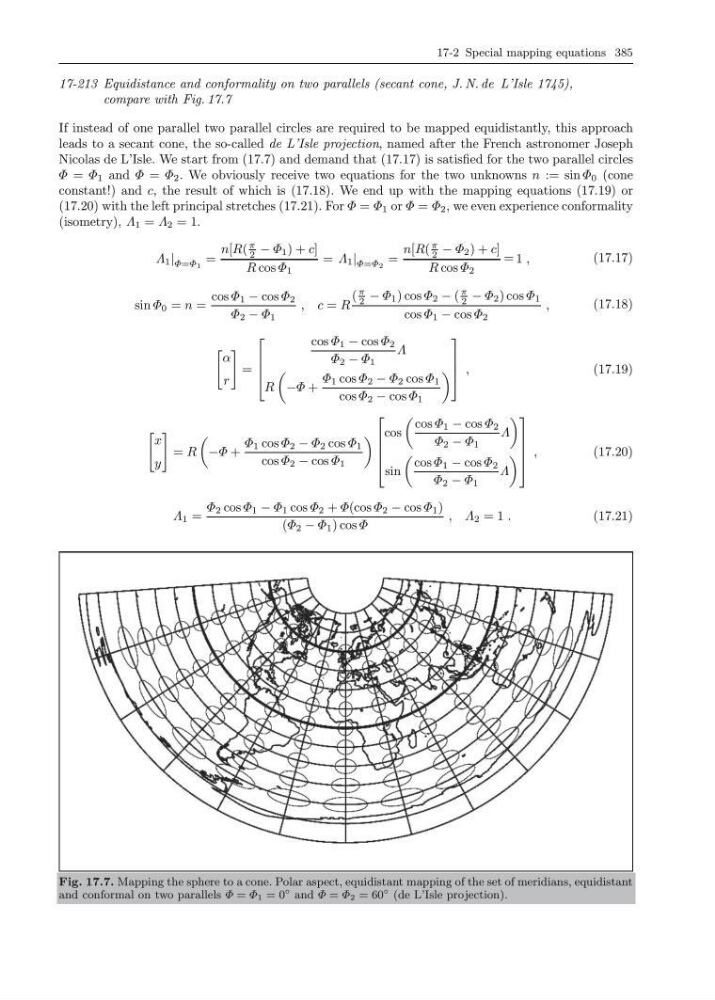
compare with Fig. 17.7
If instead of one parallel two parallel circles are required to be mapped equidistantly, this approach
leads to a secant cone, the so-called de L’Isle projection, named after the French astronomer Joseph
Nicolas de L’Isle. We start from (17.7) and demand that (17.17) is satisfied for the two parallel circles
Φ = Φ 1 and Φ = Φ 2 . We obviously receive two equations for the two unknowns n := sin Φ 0 (cone
constant!) and c, the result of which is (17.18). We end up with the mapping equations (17.19) or
(17.20) with the left principal stretches (17.21). For Φ = Φ 1 or Φ = Φ 2 , we even experience conformality
(isometry), Λ 1 = Λ 2 = 1.
Λ 1 | Φ=Φ 1 =
n[R(
π
2 − Φ 1 ) + c]
R cos Φ 1
= Λ 1 | Φ=Φ 2 =
n[R(
π
2 − Φ 2 ) + c]
R cos Φ 2
= 1 ,
(17.17)
sin Φ 0 = n =
cos Φ 1 − cos Φ 2
Φ 2 − Φ 1
, c = R
(
π
2 − Φ 1 ) cos Φ 2 − (
π
2 − Φ 2 ) cos Φ 1
cos Φ 1 − cos Φ 2
,
(17.18)
α
r
=
⎡
⎢
⎢
⎣
cos Φ 1 − cos Φ 2
Φ 2 − Φ 1
Λ
R
−Φ +
Φ 1 cos Φ 2 − Φ 2 cos Φ 1
cos Φ 2 − cos Φ 1
⎤
⎥
⎥
⎦ ,
(17.19)
x
y
= R
−Φ +
Φ 1 cos Φ 2 − Φ 2 cos Φ 1
cos Φ 2 − cos Φ 1
⎡
⎢
⎢
⎢
⎣
cos
cos Φ 1 − cos Φ 2
Φ 2 − Φ 1
Λ
sin
cos Φ 1 − cos Φ 2
Φ 2 − Φ 1
Λ
⎤
⎥
⎥
⎥
⎦
,
(17.20)
Λ 1 =
Φ 2 cos Φ 1 − Φ 1 cos Φ 2 + Φ(cos Φ 2 − cos Φ 1 )
(Φ 2 − Φ 1 ) cos Φ
, Λ 2 = 1 .
(17.21)
Fig. 17.7. Mapping the sphere to a cone. Polar aspect, equidistant mapping of the set of meridians, equidistant
and conformal on two parallels Φ = Φ 1 = 0
◦ and Φ = Φ 2 = 60
◦ (de L’Isle projection).
17-213 Equidistance and conformality on two parallels (secant cone, J. N. de L’Isle 1745),
compare with Fig. 17.7
If instead of one parallel two parallel circles are required to be mapped equidistantly, this approach
leads to a secant cone, the so-called de L’Isle projection, named after the French astronomer Joseph
Nicolas de L’Isle. We start from (17.7) and demand that (17.17) is satisfied for the two parallel circles
Φ = Φ 1 and Φ = Φ 2 . We obviously receive two equations for the two unknowns n := sin Φ 0 (cone
constant!) and c, the result of which is (17.18). We end up with the mapping equations (17.19) or
(17.20) with the left principal stretches (17.21). For Φ = Φ 1 or Φ = Φ 2 , we even experience conformality
(isometry), Λ 1 = Λ 2 = 1.
Λ 1 | Φ=Φ 1 =
n[R(
π
2 − Φ 1 ) + c]
R cos Φ 1
= Λ 1 | Φ=Φ 2 =
n[R(
π
2 − Φ 2 ) + c]
R cos Φ 2
= 1 ,
(17.17)
sin Φ 0 = n =
cos Φ 1 − cos Φ 2
Φ 2 − Φ 1
, c = R
(
π
2 − Φ 1 ) cos Φ 2 − (
π
2 − Φ 2 ) cos Φ 1
cos Φ 1 − cos Φ 2
,
(17.18)
α
r
=
⎡
⎢
⎢
⎣
cos Φ 1 − cos Φ 2
Φ 2 − Φ 1
Λ
R
−Φ +
Φ 1 cos Φ 2 − Φ 2 cos Φ 1
cos Φ 2 − cos Φ 1
⎤
⎥
⎥
⎦ ,
(17.19)
x
y
= R
−Φ +
Φ 1 cos Φ 2 − Φ 2 cos Φ 1
cos Φ 2 − cos Φ 1
⎡
⎢
⎢
⎢
⎣
cos
cos Φ 1 − cos Φ 2
Φ 2 − Φ 1
Λ
sin
cos Φ 1 − cos Φ 2
Φ 2 − Φ 1
Λ
⎤
⎥
⎥
⎥
⎦
,
(17.20)
Λ 1 =
Φ 2 cos Φ 1 − Φ 1 cos Φ 2 + Φ(cos Φ 2 − cos Φ 1 )
(Φ 2 − Φ 1 ) cos Φ
, Λ 2 = 1 .
(17.21)
Fig. 17.7. Mapping the sphere to a cone. Polar aspect, equidistant mapping of the set of meridians, equidistant
and conformal on two parallels Φ = Φ 1 = 0
◦ and Φ = Φ 2 = 60
◦ (de L’Isle projection).