

360 16 “Ellipsoid-of-revolution to cylinder”: oblique aspect
Section 1 6 - 1 .
In particular, in Section 16-1, we review the fundamental equations which govern conformal mapping of a two-dimensional Riemann manifold, namely (i) the Korn–Lichtenstein equations, (ii) the
Laplace–Beltrami equations (the integrability conditions of the Korn–Lichtenstein equations), and (iii)
the condition preserving the orientation of a conformeomorphism, for the ellipsoid-of-revolution E
2
A 1 ,A 2
parameterized by ellipsoidal longitude L and ellipsoidal latitude B. Two examples for the solution of
the fundamental equations (i), (ii), and (iii) are given, namely (1) the Universal Mercator Projection
(UMP), and (2) the Universal Polar Stereographic Projection (UPS). If the equations (i), (ii), and (iii)
of a conformeomorphism are specialized to UMP or UPS as input conformal coordinates, the equations
for output conformal coordinates of another type are obtained as (α) the d’Alembert–Euler equations
(the Cauchy–Riemann equations), (β) the Laplace–Beltrami equations (the integrability conditions
of the d’Alembert–Euler equations), (γ) the condition preserving the orientation of a conformeomorphism. A fundamental solution of the equations (α), (β), and (γ) is given in the class of homogeneous
polynomials and interpreted with respect to the two-dimensional conformal group C 6 (2) constituted
by six parameters (2 for translation, 1 for rotation, 1 for dilatation, 2 for special conformal) embedded
in the two-dimensional conformal group C ∞ (2), which is described by infinite set of parameters.
Section 1 6 - 2 ,Section 1 6 - 3 .
Section 16-2 introduces the oblique reference frame of E
2
A 1 ,A 2
, in particular, the oblique meta-equator
E
2
a ,b which is parameterized by reduced meta-longitude α. Section 16-3 determines the unknown
coefficients of the fundamental solution for the equations (α), (β), and (γ) which govern conformeomorphism by an equidistant map of the oblique meta-equator. In such a way, a boundary value problem
for the d’Alembert–Euler equations (Cauchy–Riemann equations) is defined and solved. Finally, we
show that special cases of the universal oblique Mercator projection for E
2
A 1 ,A 2
are normal Mercator
and transverse Mercator. In addition, we shortly outline the local reduction of the universal oblique
Mercator projection of E
2
A 1 ,A 2
towards S
2
r given in Box 16.1 and as an example plotted in Fig. 16.1.
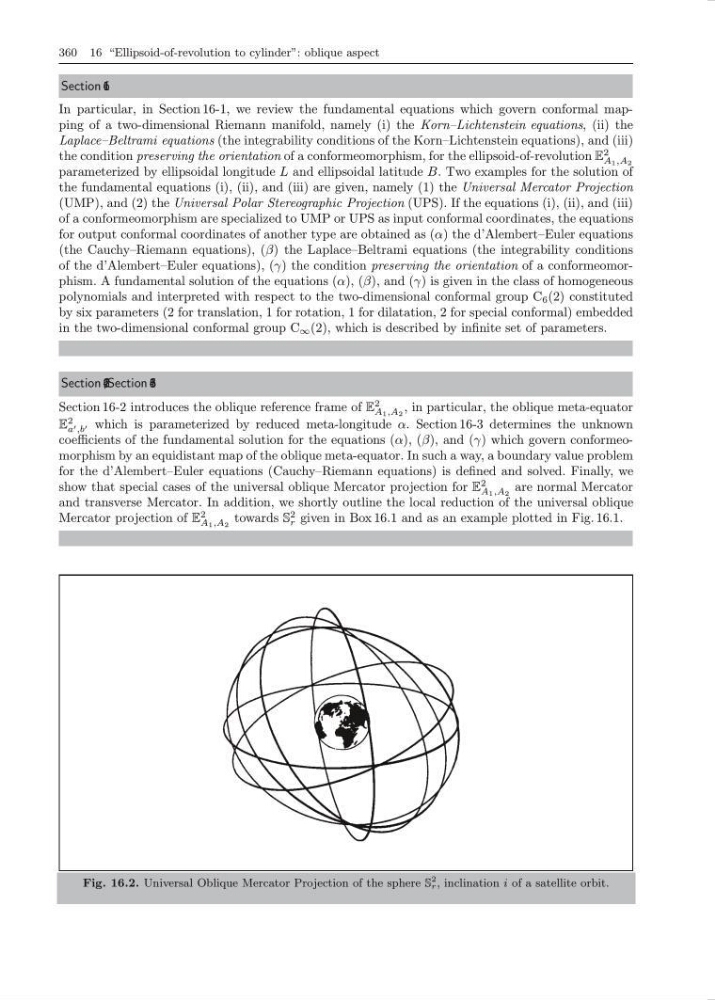
Fig. 16.2. Universal Oblique Mercator Projection of the sphere S
2
r , inclination i of a satellite orbit.
Section 1 6 - 1 .
In particular, in Section 16-1, we review the fundamental equations which govern conformal mapping of a two-dimensional Riemann manifold, namely (i) the Korn–Lichtenstein equations, (ii) the
Laplace–Beltrami equations (the integrability conditions of the Korn–Lichtenstein equations), and (iii)
the condition preserving the orientation of a conformeomorphism, for the ellipsoid-of-revolution E
2
A 1 ,A 2
parameterized by ellipsoidal longitude L and ellipsoidal latitude B. Two examples for the solution of
the fundamental equations (i), (ii), and (iii) are given, namely (1) the Universal Mercator Projection
(UMP), and (2) the Universal Polar Stereographic Projection (UPS). If the equations (i), (ii), and (iii)
of a conformeomorphism are specialized to UMP or UPS as input conformal coordinates, the equations
for output conformal coordinates of another type are obtained as (α) the d’Alembert–Euler equations
(the Cauchy–Riemann equations), (β) the Laplace–Beltrami equations (the integrability conditions
of the d’Alembert–Euler equations), (γ) the condition preserving the orientation of a conformeomorphism. A fundamental solution of the equations (α), (β), and (γ) is given in the class of homogeneous
polynomials and interpreted with respect to the two-dimensional conformal group C 6 (2) constituted
by six parameters (2 for translation, 1 for rotation, 1 for dilatation, 2 for special conformal) embedded
in the two-dimensional conformal group C ∞ (2), which is described by infinite set of parameters.
Section 1 6 - 2 ,Section 1 6 - 3 .
Section 16-2 introduces the oblique reference frame of E
2
A 1 ,A 2
, in particular, the oblique meta-equator
E
2
a ,b which is parameterized by reduced meta-longitude α. Section 16-3 determines the unknown
coefficients of the fundamental solution for the equations (α), (β), and (γ) which govern conformeomorphism by an equidistant map of the oblique meta-equator. In such a way, a boundary value problem
for the d’Alembert–Euler equations (Cauchy–Riemann equations) is defined and solved. Finally, we
show that special cases of the universal oblique Mercator projection for E
2
A 1 ,A 2
are normal Mercator
and transverse Mercator. In addition, we shortly outline the local reduction of the universal oblique
Mercator projection of E
2
A 1 ,A 2
towards S
2
r given in Box 16.1 and as an example plotted in Fig. 16.1.
Fig. 16.2. Universal Oblique Mercator Projection of the sphere S
2
r , inclination i of a satellite orbit.