

16 “Ellipsoid-of-revolution to cylinder”: oblique aspect
Mapping the ellipsoid-of-revolution to a cylinder: oblique aspect. Oblique Mercator Projection (UOM),
rectified skew orthomorphic projections. Korn–Lichtenstein equations, Laplace–Beltrami equations.
In the world of conformal mappings of the Earth or other celestial bodies, the Mercator projection
plays a central role. The Mercator projection of the sphere S
2
r or of the ellipsoid-of-revolution E
2
A 1 ,A 2
beside conformality is characterized by the equidistant mapping of the equator. In contrast, the transverse Mercator projection is conformal and maps the transverse meta-equator, the meridian of reference, equidistantly. Accordingly, the Mercator projection is very well suited for regions which extend
East–West around the equator, while the transverse Mercator projection fits well to those regions which
have a South–North extension. Obviously, several geographical regions are centered along lines which
are neither equatorial, parallel circles, or meridians, but may be taken as central intersection of a plane
and the reference figure of the Earth or other celestial bodies, the ellipsoid-of-revolution (spheroid). For
geodetic applications, conformality is desired in such cases, the Universal Oblique Mercator Projection
(UOM) is the projection which should be chosen. A study of the conformal projection of the ellipsoidof-revolution by M. Hotine (1946, 1947) is the basis of the ellipsoidal oblique Mercator projection,
which M. Hotine called the “rectified skew orthomorphic”, mainly applied in the United States (e. g.
for Alaska), for Malaysia, and for Borneo (M. Hotine 1947), for the sphere by Laborde (1928) for
Madagaskar, by M. Rosenmund (1903) for Switzerland and by J. H. Cole (1943) for Italy, namely
in the context of the celebrated Gauss double projection (conformal mapping of the ellipsoid-ofrevolution to the sphere and of the sphere to the plane). According to J. P. Snyder (1982 p. 76),
the Hotine Oblique Mercator Projection (HOM) is the most suitable projection available for mapping
Landsat type data. HOM has also been used to cast the Heat Capacity Mapping Mission (HCMM)
imagery since 1978. Note that our interest in the Oblique Mercator was raised by the personally obscure procedure to derive the mapping equations which should be based on similar concepts known for
Normal Mercator and Transverse Mercator. The mapping equations should guarantee that the elliptic
meta-equator should be mapped equidistantly. Accordingly, we derive here the general mapping equations x(L, B) and y(L, B) for conformal coordinates (isometric coordinates, isothermal coordinates)
as a function of ellipsoidal longitude L and ellipsoidal latitude B, which map the line-of-intersection
(an ellipse) of an inclined central plane and the ellipsoid-of-revolution equidistantly.
0
◦
180
◦
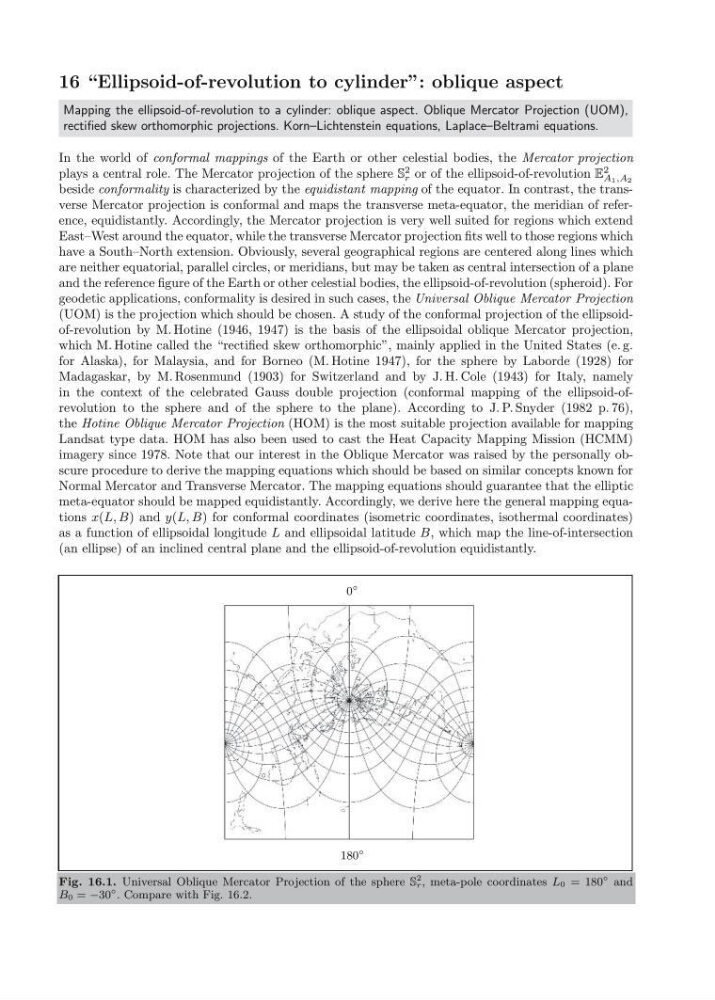
Fig. 16.1. Universal Oblique Mercator Projection of the sphere S
2
r , meta-pole coordinates L 0 = 180
◦ and
B 0 = −30
◦ . Compare with Fig. 16.2.
Mapping the ellipsoid-of-revolution to a cylinder: oblique aspect. Oblique Mercator Projection (UOM),
rectified skew orthomorphic projections. Korn–Lichtenstein equations, Laplace–Beltrami equations.
In the world of conformal mappings of the Earth or other celestial bodies, the Mercator projection
plays a central role. The Mercator projection of the sphere S
2
r or of the ellipsoid-of-revolution E
2
A 1 ,A 2
beside conformality is characterized by the equidistant mapping of the equator. In contrast, the transverse Mercator projection is conformal and maps the transverse meta-equator, the meridian of reference, equidistantly. Accordingly, the Mercator projection is very well suited for regions which extend
East–West around the equator, while the transverse Mercator projection fits well to those regions which
have a South–North extension. Obviously, several geographical regions are centered along lines which
are neither equatorial, parallel circles, or meridians, but may be taken as central intersection of a plane
and the reference figure of the Earth or other celestial bodies, the ellipsoid-of-revolution (spheroid). For
geodetic applications, conformality is desired in such cases, the Universal Oblique Mercator Projection
(UOM) is the projection which should be chosen. A study of the conformal projection of the ellipsoidof-revolution by M. Hotine (1946, 1947) is the basis of the ellipsoidal oblique Mercator projection,
which M. Hotine called the “rectified skew orthomorphic”, mainly applied in the United States (e. g.
for Alaska), for Malaysia, and for Borneo (M. Hotine 1947), for the sphere by Laborde (1928) for
Madagaskar, by M. Rosenmund (1903) for Switzerland and by J. H. Cole (1943) for Italy, namely
in the context of the celebrated Gauss double projection (conformal mapping of the ellipsoid-ofrevolution to the sphere and of the sphere to the plane). According to J. P. Snyder (1982 p. 76),
the Hotine Oblique Mercator Projection (HOM) is the most suitable projection available for mapping
Landsat type data. HOM has also been used to cast the Heat Capacity Mapping Mission (HCMM)
imagery since 1978. Note that our interest in the Oblique Mercator was raised by the personally obscure procedure to derive the mapping equations which should be based on similar concepts known for
Normal Mercator and Transverse Mercator. The mapping equations should guarantee that the elliptic
meta-equator should be mapped equidistantly. Accordingly, we derive here the general mapping equations x(L, B) and y(L, B) for conformal coordinates (isometric coordinates, isothermal coordinates)
as a function of ellipsoidal longitude L and ellipsoidal latitude B, which map the line-of-intersection
(an ellipse) of an inclined central plane and the ellipsoid-of-revolution equidistantly.
0
◦
180
◦
Fig. 16.1. Universal Oblique Mercator Projection of the sphere S
2
r , meta-pole coordinates L 0 = 180
◦ and
B 0 = −30
◦ . Compare with Fig. 16.2.