

346 15 “Ellipsoid-of-revolution to cylinder”: transverse aspect
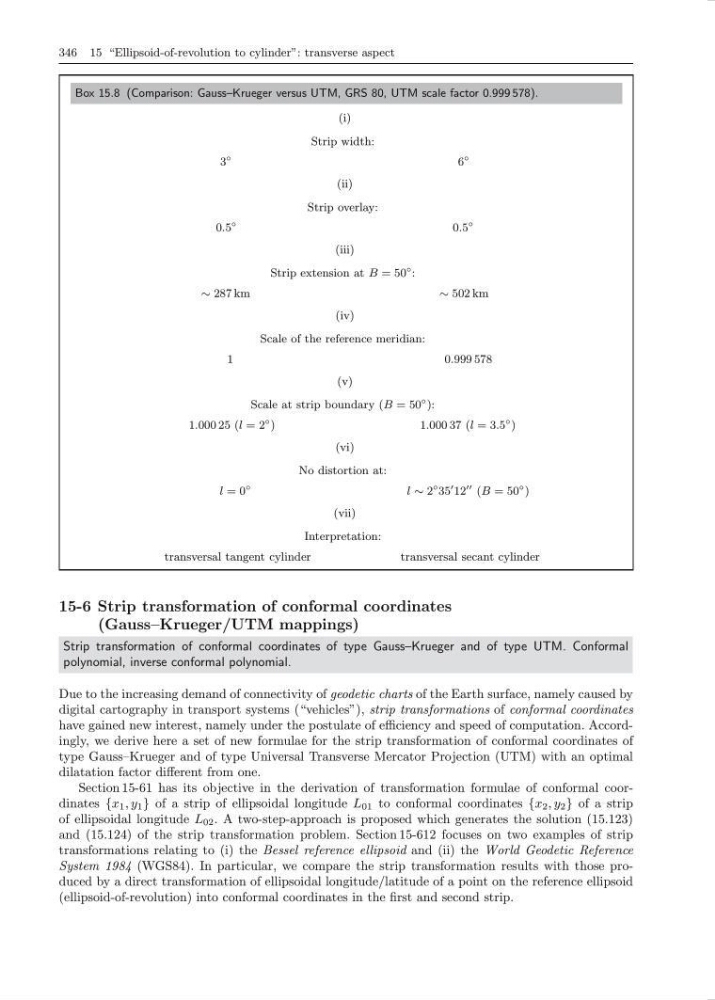
Box 15.8 (Comparison: Gauss–Krueger versus UTM, GRS 80, UTM scale factor 0.999 578).
(i)
Strip width:
3
◦
6
◦
(ii)
Strip overlay:
0.5
◦
0.5
◦
(iii)
Strip extension at B = 50
◦ :
∼ 287 km
∼ 502 km
(iv)
Scale of the reference meridian:
1
0 .999 578
(v)
Scale at strip boundary (B = 50
◦ ):
1.000 25 (l = 2
◦ )
1 .000 37 (l = 3.5
◦ )
(vi)
No distortion at:
l = 0
◦
l ∼ 2
◦ 35
12
(B = 50
◦ )
(vii)
Interpretation:
transversal tangent cylinder
transversal secant cylinder
15-6 Strip transformation of conformal coordinates
(Gauss–Krueger/UTM mappings)
Strip transformation of conformal coordinates of type Gauss–Krueger and of type UTM. Conformal
polynomial, inverse conformal polynomial.
Due to the increasing demand of connectivity of geodetic charts of the Earth surface, namely caused by
digital cartography in transport systems (“vehicles”), strip transformations of conformal coordinates
have gained new interest, namely under the postulate of efficiency and speed of computation. Accordingly, we derive here a set of new formulae for the strip transformation of conformal coordinates of
type Gauss–Krueger and of type Universal Transverse Mercator Projection (UTM) with an optimal
dilatation factor different from one.
Section 15-61 has its objective in the derivation of transformation formulae of conformal coordinates {x 1 , y 1 } of a strip of ellipsoidal longitude L 01 to conformal coordinates {x 2 , y 2 } of a strip
of ellipsoidal longitude L 02 . A two-step-approach is proposed which generates the solution (15.123)
and (15.124) of the strip transformation problem. Section 15-612 focuses on two examples of strip
transformations relating to (i) the Bessel reference ellipsoid and (ii) the World Geodetic Reference
System 1984 (WGS84). In particular, we compare the strip transformation results with those produced by a direct transformation of ellipsoidal longitude/latitude of a point on the reference ellipsoid
(ellipsoid-of-revolution) into conformal coordinates in the first and second strip.
Box 15.8 (Comparison: Gauss–Krueger versus UTM, GRS 80, UTM scale factor 0.999 578).
(i)
Strip width:
3
◦
6
◦
(ii)
Strip overlay:
0.5
◦
0.5
◦
(iii)
Strip extension at B = 50
◦ :
∼ 287 km
∼ 502 km
(iv)
Scale of the reference meridian:
1
0 .999 578
(v)
Scale at strip boundary (B = 50
◦ ):
1.000 25 (l = 2
◦ )
1 .000 37 (l = 3.5
◦ )
(vi)
No distortion at:
l = 0
◦
l ∼ 2
◦ 35
12
(B = 50
◦ )
(vii)
Interpretation:
transversal tangent cylinder
transversal secant cylinder
15-6 Strip transformation of conformal coordinates
(Gauss–Krueger/UTM mappings)
Strip transformation of conformal coordinates of type Gauss–Krueger and of type UTM. Conformal
polynomial, inverse conformal polynomial.
Due to the increasing demand of connectivity of geodetic charts of the Earth surface, namely caused by
digital cartography in transport systems (“vehicles”), strip transformations of conformal coordinates
have gained new interest, namely under the postulate of efficiency and speed of computation. Accordingly, we derive here a set of new formulae for the strip transformation of conformal coordinates of
type Gauss–Krueger and of type Universal Transverse Mercator Projection (UTM) with an optimal
dilatation factor different from one.
Section 15-61 has its objective in the derivation of transformation formulae of conformal coordinates {x 1 , y 1 } of a strip of ellipsoidal longitude L 01 to conformal coordinates {x 2 , y 2 } of a strip
of ellipsoidal longitude L 02 . A two-step-approach is proposed which generates the solution (15.123)
and (15.124) of the strip transformation problem. Section 15-612 focuses on two examples of strip
transformations relating to (i) the Bessel reference ellipsoid and (ii) the World Geodetic Reference
System 1984 (WGS84). In particular, we compare the strip transformation results with those produced by a direct transformation of ellipsoidal longitude/latitude of a point on the reference ellipsoid
(ellipsoid-of-revolution) into conformal coordinates in the first and second strip.