

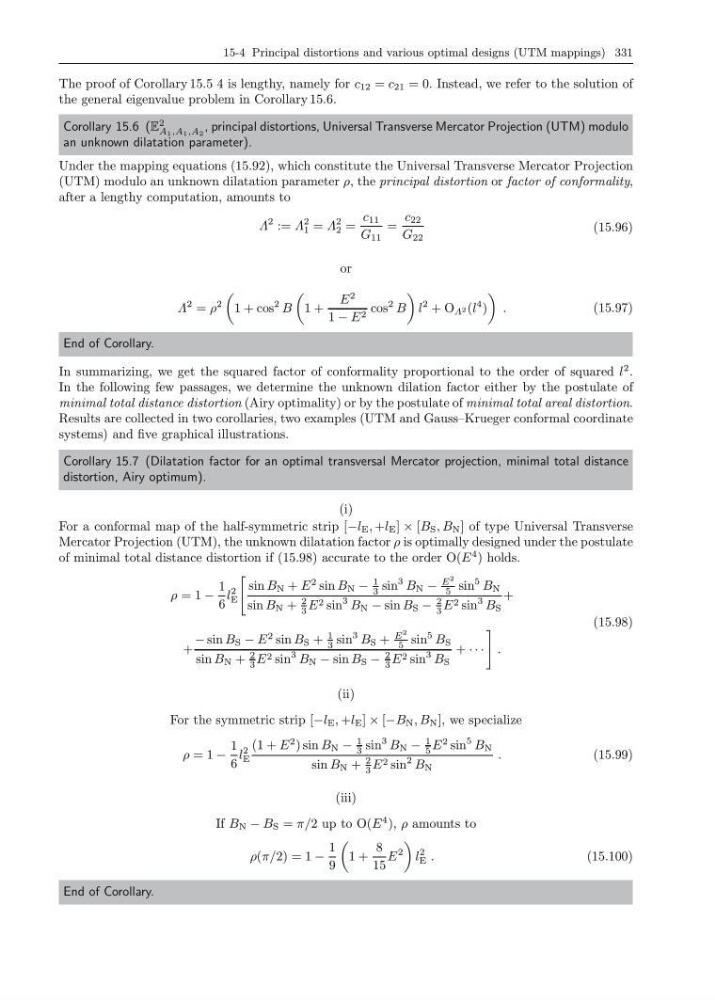
15-4 Principal distortions and various optimal designs (UTM mappings) 331
The proof of Corollary 15.5 4 is lengthy, namely for c 12 = c 21 = 0. Instead, we refer to the solution of
the general eigenvalue problem in Corollary 15.6.
Corollary 15.6 (E
2
A 1 ,A 1 ,A 2
, principal distortions, Universal Transverse Mercator Projection (UTM) modulo
an unknown dilatation parameter).
Under the mapping equations (15.92), which constitute the Universal Transverse Mercator Projection
(UTM) modulo an unknown dilatation parameter ρ, the principal distortion or factor of conformality,
after a lengthy computation, amounts to
Λ
2 := Λ
2
1 = Λ
2
2 =
c 11
G 11
=
c 22
G 22
(15.96)
or
Λ
2 = ρ
2
1 + cos
2 B
1 +
E
2
1 − E 2 cos
2 B
l
2 + O Λ 2 (l
4 )
.
(15.97)
End of Corollary.
In summarizing, we get the squared factor of conformality proportional to the order of squared l
2 .
In the following few passages, we determine the unknown dilation factor either by the postulate of
minimal total distance distortion (Airy optimality) or by the postulate of minimal total areal distortion.
Results are collected in two corollaries, two examples (UTM and Gauss–Krueger conformal coordinate
systems) and five graphical illustrations.
Corollary 15.7 (Dilatation factor for an optimal transversal Mercator projection, minimal total distance
distortion, Airy optimum).
(i)
For a conformal map of the half-symmetric strip [−l E , +l E ] × [B S , B N ] of type Universal Transverse
Mercator Projection (UTM), the unknown dilatation factor ρ is optimally designed under the postulate
of minimal total distance distortion if (15.98) accurate to the order O(E
4 ) holds.
ρ = 1 −
1
6
l
2
E
sin B N + E
2 sin B N −
1
3 sin
3 B N −
E
2
5 sin
5 B N
sin B N +
2
3 E 2 sin
3 B N − sin B S −
2
3 E 2 sin
3 B S
+
+
− sin B S − E
2 sin B S +
1
3 sin
3 B S +
E
2
5 sin
5 B S
sin B N +
2
3 E 2 sin
3 B N − sin B S −
2
3 E 2 sin
3 B S
+ · · ·
.
(15.98)
(ii)
For the symmetric strip [−l E , +l E ] × [−B N , B N ], we specialize
ρ = 1 −
1
6
l
2
E
(1 + E
2 ) sin B N −
1
3 sin
3 B N −
1
5 E
2 sin
5 B N
sin B N +
2
3 E 2 sin
2 B N
.
(15.99)
(iii)
If B N − B S = π/2 up to O(E
4 ), ρ amounts to
ρ(π/2) = 1 −
1
9
1 +
8
15
E
2
l
2
E .
(15.100)
End of Corollary.
The proof of Corollary 15.5 4 is lengthy, namely for c 12 = c 21 = 0. Instead, we refer to the solution of
the general eigenvalue problem in Corollary 15.6.
Corollary 15.6 (E
2
A 1 ,A 1 ,A 2
, principal distortions, Universal Transverse Mercator Projection (UTM) modulo
an unknown dilatation parameter).
Under the mapping equations (15.92), which constitute the Universal Transverse Mercator Projection
(UTM) modulo an unknown dilatation parameter ρ, the principal distortion or factor of conformality,
after a lengthy computation, amounts to
Λ
2 := Λ
2
1 = Λ
2
2 =
c 11
G 11
=
c 22
G 22
(15.96)
or
Λ
2 = ρ
2
1 + cos
2 B
1 +
E
2
1 − E 2 cos
2 B
l
2 + O Λ 2 (l
4 )
.
(15.97)
End of Corollary.
In summarizing, we get the squared factor of conformality proportional to the order of squared l
2 .
In the following few passages, we determine the unknown dilation factor either by the postulate of
minimal total distance distortion (Airy optimality) or by the postulate of minimal total areal distortion.
Results are collected in two corollaries, two examples (UTM and Gauss–Krueger conformal coordinate
systems) and five graphical illustrations.
Corollary 15.7 (Dilatation factor for an optimal transversal Mercator projection, minimal total distance
distortion, Airy optimum).
(i)
For a conformal map of the half-symmetric strip [−l E , +l E ] × [B S , B N ] of type Universal Transverse
Mercator Projection (UTM), the unknown dilatation factor ρ is optimally designed under the postulate
of minimal total distance distortion if (15.98) accurate to the order O(E
4 ) holds.
ρ = 1 −
1
6
l
2
E
sin B N + E
2 sin B N −
1
3 sin
3 B N −
E
2
5 sin
5 B N
sin B N +
2
3 E 2 sin
3 B N − sin B S −
2
3 E 2 sin
3 B S
+
+
− sin B S − E
2 sin B S +
1
3 sin
3 B S +
E
2
5 sin
5 B S
sin B N +
2
3 E 2 sin
3 B N − sin B S −
2
3 E 2 sin
3 B S
+ · · ·
.
(15.98)
(ii)
For the symmetric strip [−l E , +l E ] × [−B N , B N ], we specialize
ρ = 1 −
1
6
l
2
E
(1 + E
2 ) sin B N −
1
3 sin
3 B N −
1
5 E
2 sin
5 B N
sin B N +
2
3 E 2 sin
2 B N
.
(15.99)
(iii)
If B N − B S = π/2 up to O(E
4 ), ρ amounts to
ρ(π/2) = 1 −
1
9
1 +
8
15
E
2
l
2
E .
(15.100)
End of Corollary.