

14-2 Special mapping equations 303
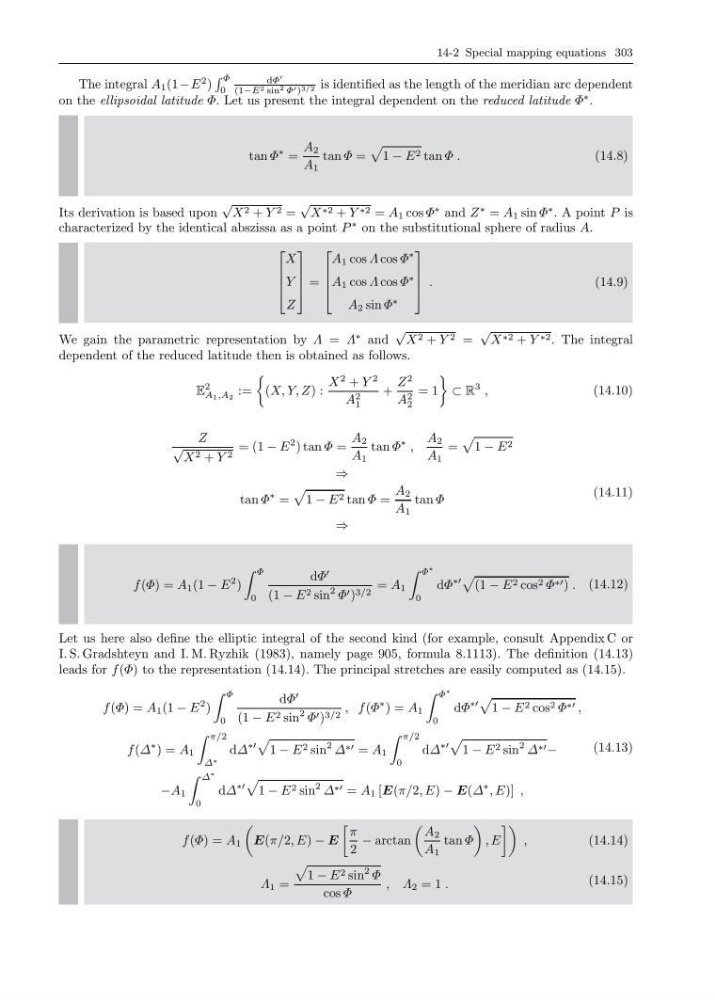
The integral A 1 (1−E
2 )
Φ
0
dΦ
(1−E 2 sin 2 Φ ) 3/2 is identified as the length of the meridian arc dependent
on the ellipsoidal latitude Φ. Let us present the integral dependent on the reduced latitude Φ
∗ .
tan Φ
∗ =
A 2
A 1
tan Φ =
1 − E 2 tan Φ .
(14.8)
Its derivation is based upon
√
X 2 + Y 2 =
√
X ∗2 + Y ∗2 = A 1 cos Φ
∗ and Z
∗ = A 1 sin Φ
∗ . A point P is
characterized by the identical abszissa as a point P
∗ on the substitutional sphere of radius A.
⎡
⎢
⎢
⎣
X
Y
Z
⎤
⎥
⎥
⎦ =
⎡
⎢
⎢
⎣
A 1 cos Λ cos Φ
∗
A 1 cos Λ cos Φ
∗
A 2 sin Φ
∗
⎤
⎥
⎥
⎦ .
(14.9)
We gain the parametric representation by Λ = Λ
∗ and
√
X 2 + Y 2 =
√
X ∗2 + Y ∗2 . The integral
dependent of the reduced latitude then is obtained as follows.
E
2
A 1 ,A 2
:=
(X, Y, Z) :
X
2 + Y
2
A 2
1
+
Z
2
A 2
2
= 1
⊂ R
3 ,
(14.10)
Z
√
X 2 + Y 2
= (1 − E
2 ) tan Φ =
A 2
A 1
tan Φ
∗ ,
A 2
A 1
=
1 − E 2
⇒
tan Φ
∗ =
1 − E 2 tan Φ =
A 2
A 1
tan Φ
⇒
(14.11)
f (Φ) = A 1 (1 − E
2 )
Φ
0
dΦ
(1 − E 2 sin
2 Φ ) 3/2 = A 1
Φ
∗
0
dΦ
∗∗
(1 − E 2 cos 2 Φ ∗∗ ) . (14.12)
Let us here also define the elliptic integral of the second kind (for example, consult Appendix C or
I. S. Gradshteyn and I. M. Ryzhik (1983), namely page 905, formula 8.1113). The definition (14.13)
leads for f (Φ) to the representation (14.14). The principal stretches are easily computed as (14.15).
f (Φ) = A 1 (1 − E
2 )
Φ
0
dΦ
(1 − E 2 sin
2 Φ ) 3/2 , f(Φ
∗ ) = A 1
Φ
∗
0
dΦ
∗∗
1 − E 2 cos 2 Φ ∗∗ ,
f (∆
∗ ) = A 1
π/2
∆ ∗
d∆
∗∗
1 − E 2 sin
2 ∆ ∗∗ = A 1
π/2
0
d∆
∗∗
1 − E 2 sin
2 ∆ ∗∗ −
−A 1
∆
∗
0
d∆
∗∗
1 − E 2 sin
2 ∆ ∗∗ = A 1 [E(π/2, E) − E(∆
∗ , E)] ,
(14.13)
f (Φ) = A 1
E(π/2, E) − E
π
2
− arctan
A 2
A 1
tan Φ
, E
,
(14.14)
Λ 1 =
1 − E 2 sin
2 Φ
cos Φ
, Λ 2 = 1 .
(14.15)
The integral A 1 (1−E
2 )
Φ
0
dΦ
(1−E 2 sin 2 Φ ) 3/2 is identified as the length of the meridian arc dependent
on the ellipsoidal latitude Φ. Let us present the integral dependent on the reduced latitude Φ
∗ .
tan Φ
∗ =
A 2
A 1
tan Φ =
1 − E 2 tan Φ .
(14.8)
Its derivation is based upon
√
X 2 + Y 2 =
√
X ∗2 + Y ∗2 = A 1 cos Φ
∗ and Z
∗ = A 1 sin Φ
∗ . A point P is
characterized by the identical abszissa as a point P
∗ on the substitutional sphere of radius A.
⎡
⎢
⎢
⎣
X
Y
Z
⎤
⎥
⎥
⎦ =
⎡
⎢
⎢
⎣
A 1 cos Λ cos Φ
∗
A 1 cos Λ cos Φ
∗
A 2 sin Φ
∗
⎤
⎥
⎥
⎦ .
(14.9)
We gain the parametric representation by Λ = Λ
∗ and
√
X 2 + Y 2 =
√
X ∗2 + Y ∗2 . The integral
dependent of the reduced latitude then is obtained as follows.
E
2
A 1 ,A 2
:=
(X, Y, Z) :
X
2 + Y
2
A 2
1
+
Z
2
A 2
2
= 1
⊂ R
3 ,
(14.10)
Z
√
X 2 + Y 2
= (1 − E
2 ) tan Φ =
A 2
A 1
tan Φ
∗ ,
A 2
A 1
=
1 − E 2
⇒
tan Φ
∗ =
1 − E 2 tan Φ =
A 2
A 1
tan Φ
⇒
(14.11)
f (Φ) = A 1 (1 − E
2 )
Φ
0
dΦ
(1 − E 2 sin
2 Φ ) 3/2 = A 1
Φ
∗
0
dΦ
∗∗
(1 − E 2 cos 2 Φ ∗∗ ) . (14.12)
Let us here also define the elliptic integral of the second kind (for example, consult Appendix C or
I. S. Gradshteyn and I. M. Ryzhik (1983), namely page 905, formula 8.1113). The definition (14.13)
leads for f (Φ) to the representation (14.14). The principal stretches are easily computed as (14.15).
f (Φ) = A 1 (1 − E
2 )
Φ
0
dΦ
(1 − E 2 sin
2 Φ ) 3/2 , f(Φ
∗ ) = A 1
Φ
∗
0
dΦ
∗∗
1 − E 2 cos 2 Φ ∗∗ ,
f (∆
∗ ) = A 1
π/2
∆ ∗
d∆
∗∗
1 − E 2 sin
2 ∆ ∗∗ = A 1
π/2
0
d∆
∗∗
1 − E 2 sin
2 ∆ ∗∗ −
−A 1
∆
∗
0
d∆
∗∗
1 − E 2 sin
2 ∆ ∗∗ = A 1 [E(π/2, E) − E(∆
∗ , E)] ,
(14.13)
f (Φ) = A 1
E(π/2, E) − E
π
2
− arctan
A 2
A 1
tan Φ
, E
,
(14.14)
Λ 1 =
1 − E 2 sin
2 Φ
cos Φ
, Λ 2 = 1 .
(14.15)