

282 10 “Sphere to cylinder”: polar aspect
Proof (equiareal cylindrical mapping).
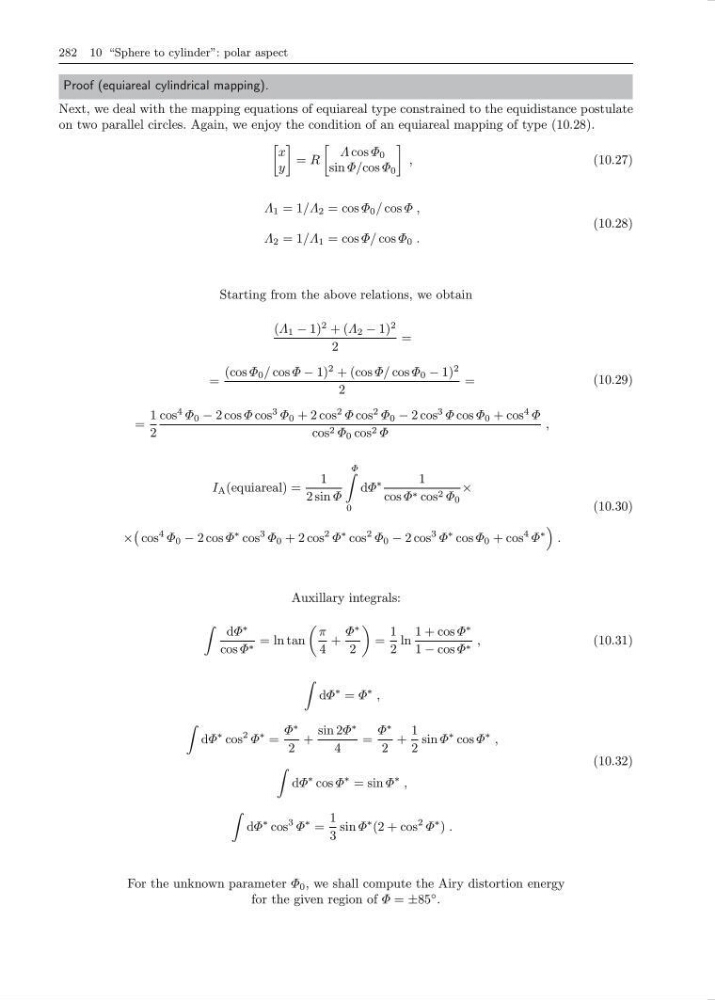
Next, we deal with the mapping equations of equiareal type constrained to the equidistance postulate
on two parallel circles. Again, we enjoy the condition of an equiareal mapping of type (10.28).
x
y
= R
Λ cos Φ 0
sin Φ/cos Φ 0
,
(10.27)
Λ 1 = 1/Λ 2 = cos Φ 0 / cos Φ ,
Λ 2 = 1/Λ 1 = cos Φ/ cos Φ 0 .
(10.28)
Starting from the above relations, we obtain
(Λ 1 − 1)
2 + (Λ 2 − 1)
2
2
=
=
(cos Φ 0 / cos Φ − 1)
2 + (cos Φ/ cos Φ 0 − 1)
2
2
=
=
1
2
cos
4 Φ 0 − 2 cos Φ cos
3 Φ 0 + 2 cos
2 Φ cos
2 Φ 0 − 2 cos
3 Φ cos Φ 0 + cos
4 Φ
cos 2 Φ 0 cos 2 Φ
,
(10.29)
I A (equiareal) =
1
2 sin Φ
Φ
0
dΦ
∗
1
cos Φ ∗ cos 2 Φ 0
×
×
cos
4 Φ 0 − 2 cos Φ
∗ cos
3 Φ 0 + 2 cos
2 Φ
∗ cos
2 Φ 0 − 2 cos
3 Φ
∗ cos Φ 0 + cos
4 Φ
∗
.
(10.30)
Auxillary integrals:
dΦ
∗
cos Φ ∗ = ln tan
π
4
+
Φ
∗
2
=
1
2
ln
1 + cos Φ
∗
1 − cos Φ ∗ ,
(10.31)
dΦ
∗ = Φ
∗ ,
dΦ
∗ cos
2 Φ
∗ =
Φ
∗
2
+
sin 2Φ
∗
4
=
Φ
∗
2
+
1
2
sin Φ
∗ cos Φ
∗ ,
dΦ
∗ cos Φ
∗ = sin Φ
∗ ,
dΦ
∗ cos
3 Φ
∗ =
1
3
sin Φ
∗ (2 + cos
2 Φ
∗ ) .
(10.32)
For the unknown parameter Φ 0 , we shall compute the Airy distortion energy
for the given region of Φ = ±85
◦ .
Proof (equiareal cylindrical mapping).
Next, we deal with the mapping equations of equiareal type constrained to the equidistance postulate
on two parallel circles. Again, we enjoy the condition of an equiareal mapping of type (10.28).
x
y
= R
Λ cos Φ 0
sin Φ/cos Φ 0
,
(10.27)
Λ 1 = 1/Λ 2 = cos Φ 0 / cos Φ ,
Λ 2 = 1/Λ 1 = cos Φ/ cos Φ 0 .
(10.28)
Starting from the above relations, we obtain
(Λ 1 − 1)
2 + (Λ 2 − 1)
2
2
=
=
(cos Φ 0 / cos Φ − 1)
2 + (cos Φ/ cos Φ 0 − 1)
2
2
=
=
1
2
cos
4 Φ 0 − 2 cos Φ cos
3 Φ 0 + 2 cos
2 Φ cos
2 Φ 0 − 2 cos
3 Φ cos Φ 0 + cos
4 Φ
cos 2 Φ 0 cos 2 Φ
,
(10.29)
I A (equiareal) =
1
2 sin Φ
Φ
0
dΦ
∗
1
cos Φ ∗ cos 2 Φ 0
×
×
cos
4 Φ 0 − 2 cos Φ
∗ cos
3 Φ 0 + 2 cos
2 Φ
∗ cos
2 Φ 0 − 2 cos
3 Φ
∗ cos Φ 0 + cos
4 Φ
∗
.
(10.30)
Auxillary integrals:
dΦ
∗
cos Φ ∗ = ln tan
π
4
+
Φ
∗
2
=
1
2
ln
1 + cos Φ
∗
1 − cos Φ ∗ ,
(10.31)
dΦ
∗ = Φ
∗ ,
dΦ
∗ cos
2 Φ
∗ =
Φ
∗
2
+
sin 2Φ
∗
4
=
Φ
∗
2
+
1
2
sin Φ
∗ cos Φ
∗ ,
dΦ
∗ cos Φ
∗ = sin Φ
∗ ,
dΦ
∗ cos
3 Φ
∗ =
1
3
sin Φ
∗ (2 + cos
2 Φ
∗ ) .
(10.32)
For the unknown parameter Φ 0 , we shall compute the Airy distortion energy
for the given region of Φ = ±85
◦ .