

274 10 “Sphere to cylinder”: polar aspect
10-1 General mapping equations
Setting up general equations of the mapping “sphere to cylinder”: projections in the polar aspect. Principle
for constructing a cylindrical map projection.
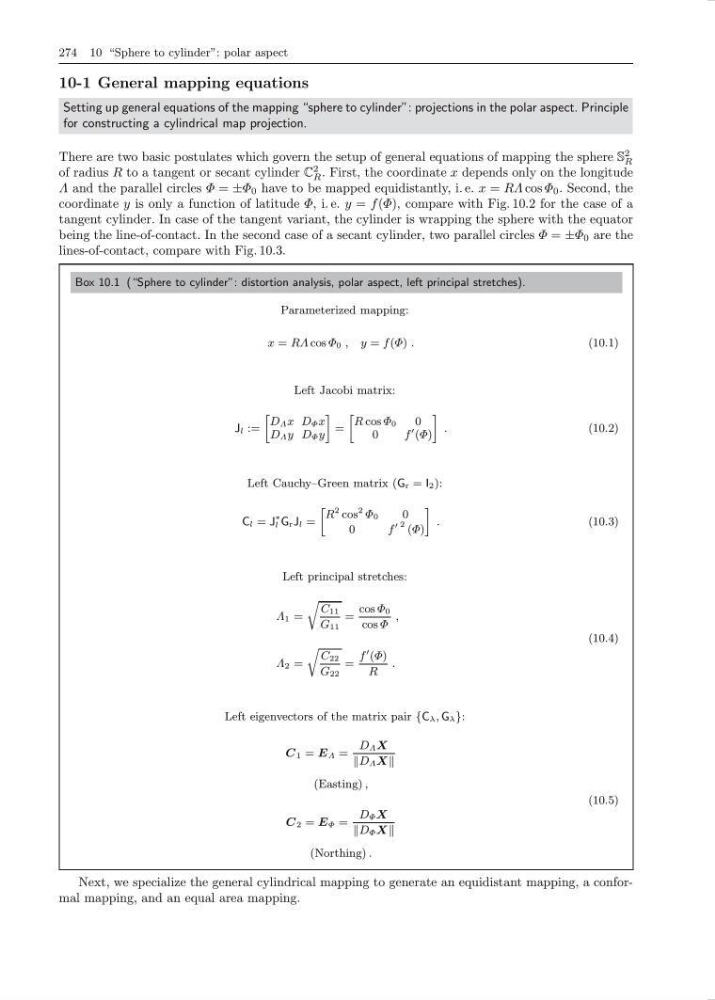
There are two basic postulates which govern the setup of general equations of mapping the sphere S
2
R
of radius R to a tangent or secant cylinder C
2
R . First, the coordinate x depends only on the longitude
Λ and the parallel circles Φ = ±Φ 0 have to be mapped equidistantly, i. e. x = RΛ cos Φ 0 . Second, the
coordinate y is only a function of latitude Φ, i. e. y = f (Φ), compare with Fig. 10.2 for the case of a
tangent cylinder. In case of the tangent variant, the cylinder is wrapping the sphere with the equator
being the line-of-contact. In the second case of a secant cylinder, two parallel circles Φ = ±Φ 0 are the
lines-of-contact, compare with Fig. 10.3.
Box 10.1 (“Sphere to cylinder”: distortion analysis, polar aspect, left principal stretches).
Parameterized mapping:
x = RΛ cos Φ 0 , y = f (Φ) .
(10.1)
Left Jacobi matrix:
J l :=
»
D Λ x D Φ x
D Λ y D Φ y
–
=
»
R cos Φ 0
0
0
f
(Φ)
–
.
(10.2)
Left Cauchy–Green matrix (G r = I 2 ):
C l = J
∗
l G r J l =
»
R
2 cos
2 Φ 0
0
0
f
2 (Φ)
–
.
(10.3)
Left principal stretches:
Λ 1 =
r
C 11
G 11
=
cos Φ 0
cos Φ
,
Λ 2 =
r
C 22
G 22
=
f
(Φ)
R
.
(10.4)
Left eigenvectors of the matrix pair {C λ , G λ }:
C 1 = E Λ =
D Λ X
D Λ X
(Easting) ,
C 2 = E Φ =
D Φ X
D Φ X
(Northing) .
(10.5)
Next, we specialize the general cylindrical mapping to generate an equidistant mapping, a conformal mapping, and an equal area mapping.
10-1 General mapping equations
Setting up general equations of the mapping “sphere to cylinder”: projections in the polar aspect. Principle
for constructing a cylindrical map projection.
There are two basic postulates which govern the setup of general equations of mapping the sphere S
2
R
of radius R to a tangent or secant cylinder C
2
R . First, the coordinate x depends only on the longitude
Λ and the parallel circles Φ = ±Φ 0 have to be mapped equidistantly, i. e. x = RΛ cos Φ 0 . Second, the
coordinate y is only a function of latitude Φ, i. e. y = f (Φ), compare with Fig. 10.2 for the case of a
tangent cylinder. In case of the tangent variant, the cylinder is wrapping the sphere with the equator
being the line-of-contact. In the second case of a secant cylinder, two parallel circles Φ = ±Φ 0 are the
lines-of-contact, compare with Fig. 10.3.
Box 10.1 (“Sphere to cylinder”: distortion analysis, polar aspect, left principal stretches).
Parameterized mapping:
x = RΛ cos Φ 0 , y = f (Φ) .
(10.1)
Left Jacobi matrix:
J l :=
»
D Λ x D Φ x
D Λ y D Φ y
–
=
»
R cos Φ 0
0
0
f
(Φ)
–
.
(10.2)
Left Cauchy–Green matrix (G r = I 2 ):
C l = J
∗
l G r J l =
»
R
2 cos
2 Φ 0
0
0
f
2 (Φ)
–
.
(10.3)
Left principal stretches:
Λ 1 =
r
C 11
G 11
=
cos Φ 0
cos Φ
,
Λ 2 =
r
C 22
G 22
=
f
(Φ)
R
.
(10.4)
Left eigenvectors of the matrix pair {C λ , G λ }:
C 1 = E Λ =
D Λ X
D Λ X
(Easting) ,
C 2 = E Φ =
D Φ X
D Φ X
(Northing) .
(10.5)
Next, we specialize the general cylindrical mapping to generate an equidistant mapping, a conformal mapping, and an equal area mapping.