

10 “Sphere to cylinder”: polar aspect
Mapping the sphere to a cylinder: polar aspect. Equidistant, conformal, and equal area mappings. Principle
for constructing a cylindrical map projection. Optimal cylinder projections of the sphere, equidistant on
two parallels.
In this chapter, we present a collection of most widely used map projections in the polar aspect in
which meridians are shown as a set of equidistant parallel straight lines and parallel circles (parallels)
by a system of parallel straight lines orthogonally crossing the images of the meridians. As a specialty,
the poles are not displayed as points but straight lines as long as the equator. First, we derive the
general mapping equations for both cases of (i) a tangent cylinder and (ii) a secant cylinder and
describe the construction principle. The mapping equations and the equations for the left principal
stretches involve a general latitude dependent function f , which is determined in a following section
through the postulate of (i) an equidistant, (ii) a conformal, or (iii) an equal area mapping. The
resulting map projection are the most simple Plate Carr´ ee projection (“quadratische Plattkarte”), the
famous conformal Mercator projection (presented by Gerardus Mercator (Latinized name of Gerhard
Kremer, 1512–1594) of Flanders in 1569) and the equal area Lambert projection (presented by Johann
Heinrich Lambert (1728–1777) of Alsace in 1772). While the Plate Carr´ ee projection was mainly used
for the representation of equatorial regions, the Mercator projection has found widespread use in
(aero-)nautics and maps for displaying air and ocean currents. A special feature of this projection
is that the loxodrome (rhumb line, line of constant azimuth) is displayed as a straight line crossing
all meridians with a constant angle. The cylindrical Lambert projection, in contrast, has found only
minimal usage, which is mainly due to the fact that the images of parallels lie very dense in medium
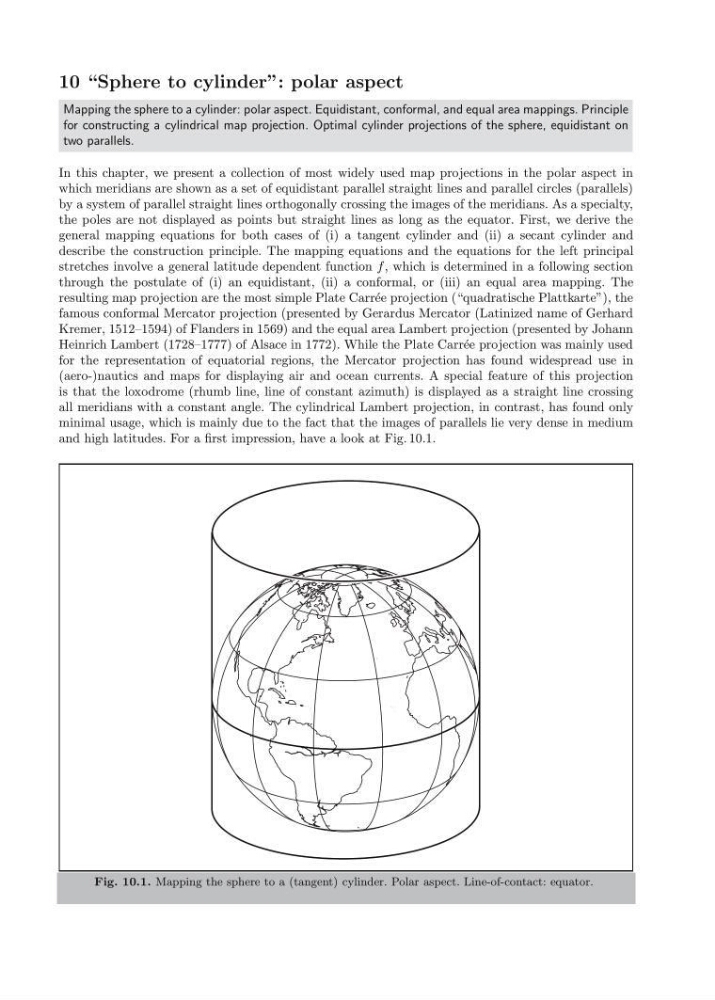
and high latitudes. For a first impression, have a look at Fig. 10.1.
Fig. 10.1. Mapping the sphere to a (tangent) cylinder. Polar aspect. Line-of-contact: equator.
Mapping the sphere to a cylinder: polar aspect. Equidistant, conformal, and equal area mappings. Principle
for constructing a cylindrical map projection. Optimal cylinder projections of the sphere, equidistant on
two parallels.
In this chapter, we present a collection of most widely used map projections in the polar aspect in
which meridians are shown as a set of equidistant parallel straight lines and parallel circles (parallels)
by a system of parallel straight lines orthogonally crossing the images of the meridians. As a specialty,
the poles are not displayed as points but straight lines as long as the equator. First, we derive the
general mapping equations for both cases of (i) a tangent cylinder and (ii) a secant cylinder and
describe the construction principle. The mapping equations and the equations for the left principal
stretches involve a general latitude dependent function f , which is determined in a following section
through the postulate of (i) an equidistant, (ii) a conformal, or (iii) an equal area mapping. The
resulting map projection are the most simple Plate Carr´ ee projection (“quadratische Plattkarte”), the
famous conformal Mercator projection (presented by Gerardus Mercator (Latinized name of Gerhard
Kremer, 1512–1594) of Flanders in 1569) and the equal area Lambert projection (presented by Johann
Heinrich Lambert (1728–1777) of Alsace in 1772). While the Plate Carr´ ee projection was mainly used
for the representation of equatorial regions, the Mercator projection has found widespread use in
(aero-)nautics and maps for displaying air and ocean currents. A special feature of this projection
is that the loxodrome (rhumb line, line of constant azimuth) is displayed as a straight line crossing
all meridians with a constant angle. The cylindrical Lambert projection, in contrast, has found only
minimal usage, which is mainly due to the fact that the images of parallels lie very dense in medium
and high latitudes. For a first impression, have a look at Fig. 10.1.
Fig. 10.1. Mapping the sphere to a (tangent) cylinder. Polar aspect. Line-of-contact: equator.