

260 9 “Ellipsoid-of-revolution to sphere and from sphere to plane”
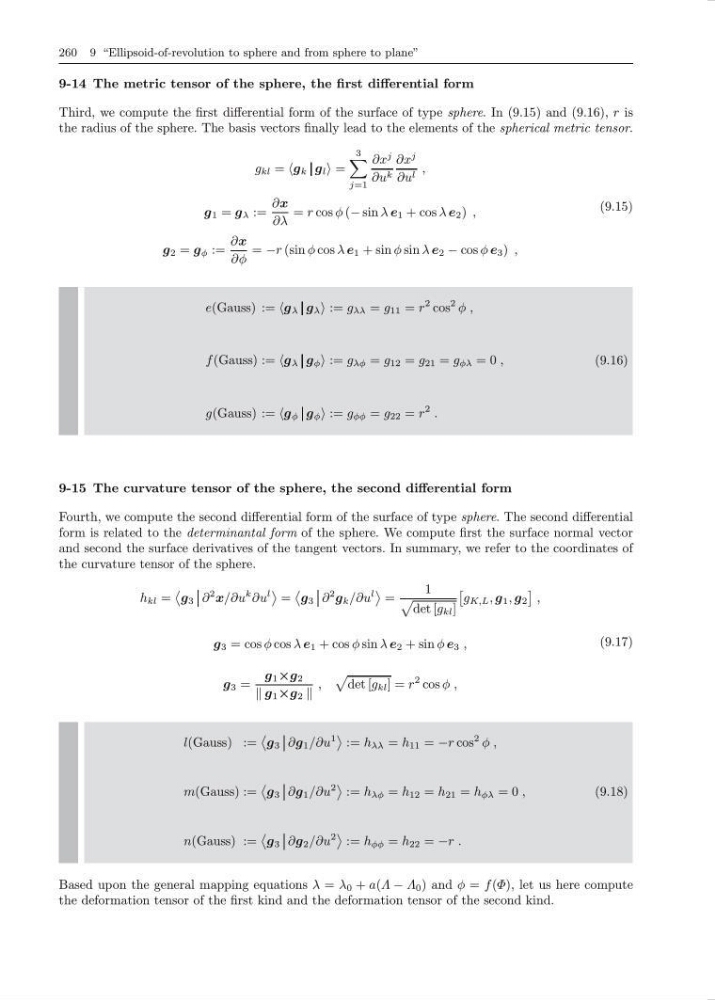
9-14 The metric tensor of the sphere, the first differential form
Third, we compute the first differential form of the surface of type sphere. In (9.15) and (9.16), r is
the radius of the sphere. The basis vectors finally lead to the elements of the spherical metric tensor.
g kl = g k g l =
3
j=1
∂x
j
∂u k
∂x
j
∂u l ,
g 1 = g λ :=
∂x
∂λ
= r cos φ (− sin λ e 1 + cos λ e 2 ) ,
g 2 = g φ :=
∂x
∂φ
= −r (sin φ cos λ e 1 + sin φ sin λ e 2 − cos φ e 3 ) ,
(9.15)
e(Gauss) := g λ g λ := g λλ = g 11 = r
2 cos
2 φ ,
f (Gauss) := g λ g φ := g λφ = g 12 = g 21 = g φλ = 0 ,
g(Gauss) := g φ g φ := g φφ = g 22 = r
2 .
(9.16)
9-15 The curvature tensor of the sphere, the second differential form
Fourth, we compute the second differential form of the surface of type sphere. The second differential
form is related to the determinantal form of the sphere. We compute first the surface normal vector
and second the surface derivatives of the tangent vectors. In summary, we refer to the coordinates of
the curvature tensor of the sphere.
h kl =
g 3 ∂
2 x/∂u
k ∂u
l
=
g 3 ∂
2 g k /∂u
l
=
1
det [g kl ]
g K,L , g 1 , g 2
,
g 3 = cos φ cos λ e 1 + cos φ sin λ e 2 + sin φ e 3 ,
g 3 =
g 1 ×g 2
g 1 ×g 2
,
det [g kl ] = r
2 cos φ ,
(9.17)
l(Gauss) :=
g 3 ∂g 1 /∂u
1
:= h λλ = h 11 = −r cos
2 φ ,
m(Gauss) :=
g 3 ∂g 1 /∂u
2
:= h λφ = h 12 = h 21 = h φλ = 0 ,
n(Gauss) :=
g 3 ∂g 2 /∂u
2
:= h φφ = h 22 = −r .
(9.18)
Based upon the general mapping equations λ = λ 0 + a(Λ − Λ 0 ) and φ = f (Φ), let us here compute
the deformation tensor of the first kind and the deformation tensor of the second kind.
9-14 The metric tensor of the sphere, the first differential form
Third, we compute the first differential form of the surface of type sphere. In (9.15) and (9.16), r is
the radius of the sphere. The basis vectors finally lead to the elements of the spherical metric tensor.
g kl = g k g l =
3
j=1
∂x
j
∂u k
∂x
j
∂u l ,
g 1 = g λ :=
∂x
∂λ
= r cos φ (− sin λ e 1 + cos λ e 2 ) ,
g 2 = g φ :=
∂x
∂φ
= −r (sin φ cos λ e 1 + sin φ sin λ e 2 − cos φ e 3 ) ,
(9.15)
e(Gauss) := g λ g λ := g λλ = g 11 = r
2 cos
2 φ ,
f (Gauss) := g λ g φ := g λφ = g 12 = g 21 = g φλ = 0 ,
g(Gauss) := g φ g φ := g φφ = g 22 = r
2 .
(9.16)
9-15 The curvature tensor of the sphere, the second differential form
Fourth, we compute the second differential form of the surface of type sphere. The second differential
form is related to the determinantal form of the sphere. We compute first the surface normal vector
and second the surface derivatives of the tangent vectors. In summary, we refer to the coordinates of
the curvature tensor of the sphere.
h kl =
g 3 ∂
2 x/∂u
k ∂u
l
=
g 3 ∂
2 g k /∂u
l
=
1
det [g kl ]
g K,L , g 1 , g 2
,
g 3 = cos φ cos λ e 1 + cos φ sin λ e 2 + sin φ e 3 ,
g 3 =
g 1 ×g 2
g 1 ×g 2
,
det [g kl ] = r
2 cos φ ,
(9.17)
l(Gauss) :=
g 3 ∂g 1 /∂u
1
:= h λλ = h 11 = −r cos
2 φ ,
m(Gauss) :=
g 3 ∂g 1 /∂u
2
:= h λφ = h 12 = h 21 = h φλ = 0 ,
n(Gauss) :=
g 3 ∂g 2 /∂u
2
:= h φφ = h 22 = −r .
(9.18)
Based upon the general mapping equations λ = λ 0 + a(Λ − Λ 0 ) and φ = f (Φ), let us here compute
the deformation tensor of the first kind and the deformation tensor of the second kind.