

8-3 Perspective mapping equations 251
8-33 An alternative approach for a topographic point
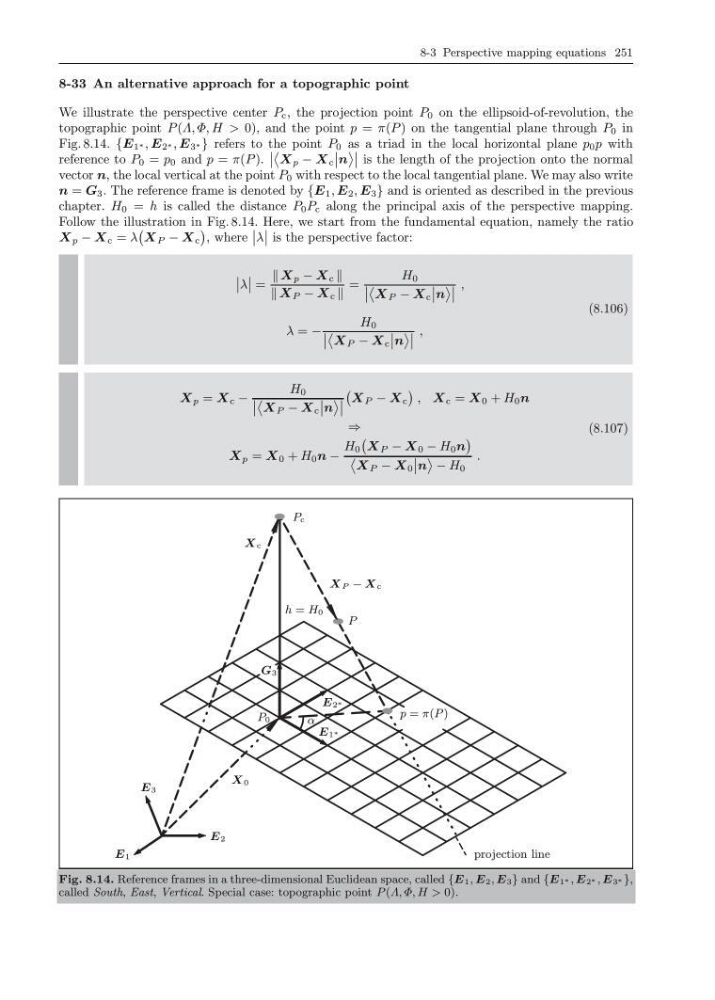
We illustrate the perspective center P c , the projection point P 0 on the ellipsoid-of-revolution, the
topographic point P (Λ, Φ, H > 0), and the point p = π(P ) on the tangential plane through P 0 in
Fig. 8.14. {E 1 ∗ , E 2 ∗ , E 3 ∗ } refers to the point P 0 as a triad in the local horizontal plane p 0 p with
reference to P 0 = p 0 and p = π(P ).
X p − X c
n
is the length of the projection onto the normal
vector n, the local vertical at the point P 0 with respect to the local tangential plane. We may also write
n = G 3 . The reference frame is denoted by {E 1 , E 2 , E 3 } and is oriented as described in the previous
chapter. H 0 = h is called the distance P 0 P c along the principal axis of the perspective mapping.
Follow the illustration in Fig. 8.14. Here, we start from the fundamental equation, namely the ratio
X p − X c = λ
X P − X c
, where
λ
is the perspective factor:
λ
=
X p − X c
X P − X c
=
H 0
X P − X c
n
,
λ = −
H 0
X P − X c
n
,
(8.106)
X p = X c −
H 0
X P − X c
n
X P − X c
, X c = X 0 + H 0 n
⇒
X p = X 0 + H 0 n −
H 0
X P − X 0 − H 0 n
X P − X 0
n
− H 0
.
(8.107)
X c
P c
E 3
E 2
E 1
P 0
P
X P − X c
X 0
p = π(P )
E 1 ∗
G 3
E 2 ∗
h = H 0
α
projection line
Fig. 8.14. Reference frames in a three-dimensional Euclidean space, called {E 1 , E 2 , E 3 } and {E 1 ∗ , E 2 ∗ , E 3 ∗ },
called South, East, Vertical. Special case: topographic point P (Λ, Φ, H > 0).
8-33 An alternative approach for a topographic point
We illustrate the perspective center P c , the projection point P 0 on the ellipsoid-of-revolution, the
topographic point P (Λ, Φ, H > 0), and the point p = π(P ) on the tangential plane through P 0 in
Fig. 8.14. {E 1 ∗ , E 2 ∗ , E 3 ∗ } refers to the point P 0 as a triad in the local horizontal plane p 0 p with
reference to P 0 = p 0 and p = π(P ).
X p − X c
n
is the length of the projection onto the normal
vector n, the local vertical at the point P 0 with respect to the local tangential plane. We may also write
n = G 3 . The reference frame is denoted by {E 1 , E 2 , E 3 } and is oriented as described in the previous
chapter. H 0 = h is called the distance P 0 P c along the principal axis of the perspective mapping.
Follow the illustration in Fig. 8.14. Here, we start from the fundamental equation, namely the ratio
X p − X c = λ
X P − X c
, where
λ
is the perspective factor:
λ
=
X p − X c
X P − X c
=
H 0
X P − X c
n
,
λ = −
H 0
X P − X c
n
,
(8.106)
X p = X c −
H 0
X P − X c
n
X P − X c
, X c = X 0 + H 0 n
⇒
X p = X 0 + H 0 n −
H 0
X P − X 0 − H 0 n
X P − X 0
n
− H 0
.
(8.107)
X c
P c
E 3
E 2
E 1
P 0
P
X P − X c
X 0
p = π(P )
E 1 ∗
G 3
E 2 ∗
h = H 0
α
projection line
Fig. 8.14. Reference frames in a three-dimensional Euclidean space, called {E 1 , E 2 , E 3 } and {E 1 ∗ , E 2 ∗ , E 3 ∗ },
called South, East, Vertical. Special case: topographic point P (Λ, Φ, H > 0).