

8-2 Special mapping equations 237
Question.
Question: “Is the conformal mapping of the ellipsoid-of-revolution to a tangential plane at
the North Pole UPS?” Answer: “Let us work out this subject in the following passage in
more detail.”
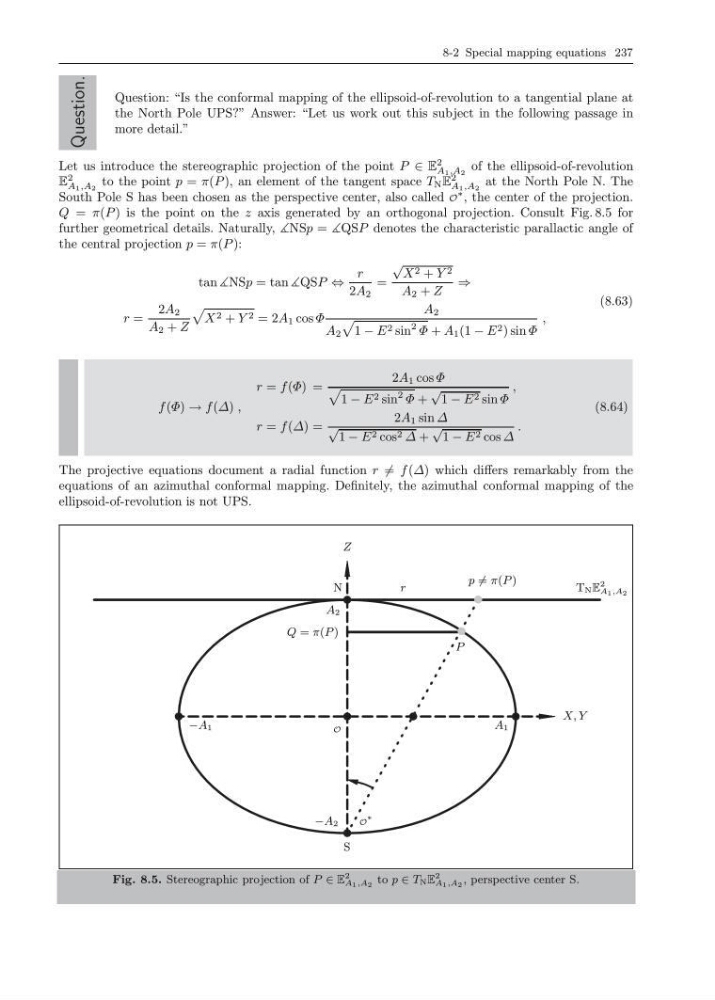
Let us introduce the stereographic projection of the point P ∈ E
2
A 1 ,A 2
of the ellipsoid-of-revolution
E
2
A 1 ,A 2
to the point p = π(P ), an element of the tangent space T N E
2
A 1 ,A 2
at the North Pole N. The
South Pole S has been chosen as the perspective center, also called O
∗ , the center of the projection.
Q = π(P ) is the point on the z axis generated by an orthogonal projection. Consult Fig. 8.5 for
further geometrical details. Naturally, NSp = QSP denotes the characteristic parallactic angle of
the central projection p = π(P ):
tan NSp = tan QSP ⇔
r
2A 2
=
√
X 2 + Y 2
A 2 + Z
⇒
r =
2A 2
A 2 + Z
X 2 + Y 2 = 2A 1 cos Φ
A 2
A 2
1 − E 2 sin
2 Φ + A 1 (1 − E 2 ) sin Φ
,
(8.63)
f (Φ) → f (∆) ,
r = f (Φ) =
2A 1 cos Φ
1 − E 2 sin
2 Φ +
√
1 − E 2 sin Φ
,
r = f (∆) =
2A 1 sin ∆
√
1 − E 2 cos 2 ∆ +
√
1 − E 2 cos ∆
.
(8.64)
The projective equations document a radial function r = f (∆) which differs remarkably from the
equations of an azimuthal conformal mapping. Definitely, the azimuthal conformal mapping of the
ellipsoid-of-revolution is not UPS.
N
Z
T N E
2
A 1 ,A 2
r
A 2
Q = π(P )
−A 2
A 1
X, Y
−A 1
p = π(P )
P
O
S
O
∗
Fig. 8.5. Stereographic projection of P ∈ E
2
A 1 ,A 2 to p ∈ T N E
2
A 1 ,A 2 , perspective center S.
Question.
Question: “Is the conformal mapping of the ellipsoid-of-revolution to a tangential plane at
the North Pole UPS?” Answer: “Let us work out this subject in the following passage in
more detail.”
Let us introduce the stereographic projection of the point P ∈ E
2
A 1 ,A 2
of the ellipsoid-of-revolution
E
2
A 1 ,A 2
to the point p = π(P ), an element of the tangent space T N E
2
A 1 ,A 2
at the North Pole N. The
South Pole S has been chosen as the perspective center, also called O
∗ , the center of the projection.
Q = π(P ) is the point on the z axis generated by an orthogonal projection. Consult Fig. 8.5 for
further geometrical details. Naturally, NSp = QSP denotes the characteristic parallactic angle of
the central projection p = π(P ):
tan NSp = tan QSP ⇔
r
2A 2
=
√
X 2 + Y 2
A 2 + Z
⇒
r =
2A 2
A 2 + Z
X 2 + Y 2 = 2A 1 cos Φ
A 2
A 2
1 − E 2 sin
2 Φ + A 1 (1 − E 2 ) sin Φ
,
(8.63)
f (Φ) → f (∆) ,
r = f (Φ) =
2A 1 cos Φ
1 − E 2 sin
2 Φ +
√
1 − E 2 sin Φ
,
r = f (∆) =
2A 1 sin ∆
√
1 − E 2 cos 2 ∆ +
√
1 − E 2 cos ∆
.
(8.64)
The projective equations document a radial function r = f (∆) which differs remarkably from the
equations of an azimuthal conformal mapping. Definitely, the azimuthal conformal mapping of the
ellipsoid-of-revolution is not UPS.
N
Z
T N E
2
A 1 ,A 2
r
A 2
Q = π(P )
−A 2
A 1
X, Y
−A 1
p = π(P )
P
O
S
O
∗
Fig. 8.5. Stereographic projection of P ∈ E
2
A 1 ,A 2 to p ∈ T N E
2
A 1 ,A 2 , perspective center S.