

210 6 “Sphere to tangential plane”: transverse aspect
These equations result from (3.51) and (3.53) by setting the position of the meta-North Pole to Φ 0 = 0
◦ .
As a matter of course, the polar coordinate α, usually called azimuth, is not anymore identical to the
spherical longitude Λ. The images of (conventional) meridians and (conventional) parallels lose their
typical behavior of being radial straight lines and equicentric circles. Since r equals f (B), parallel
circles Φ = constant are mapped as a function of longitude Λ and longitude Λ 0 of the meta-North
Pole. Likewise, the image of a meridian Λ = constant becomes a complicated curve satisfying the
equation y = − sin(Λ − Λ 0 )/ tan Φ x, i. e. y is a linear function of x but with a longitude and latitude
dependent slope.
6-2 Special mapping equations
Setting up special equations of the mapping “sphere to plane”: the meta-azimuthal projections in the
transverse aspect. Equidistant mapping (transverse Postel projection), conformal mapping (transverse
stereographic projection), equal area mapping (transverse Lambert projection).
6-21 Equidistant mapping (transverse Postel projection)
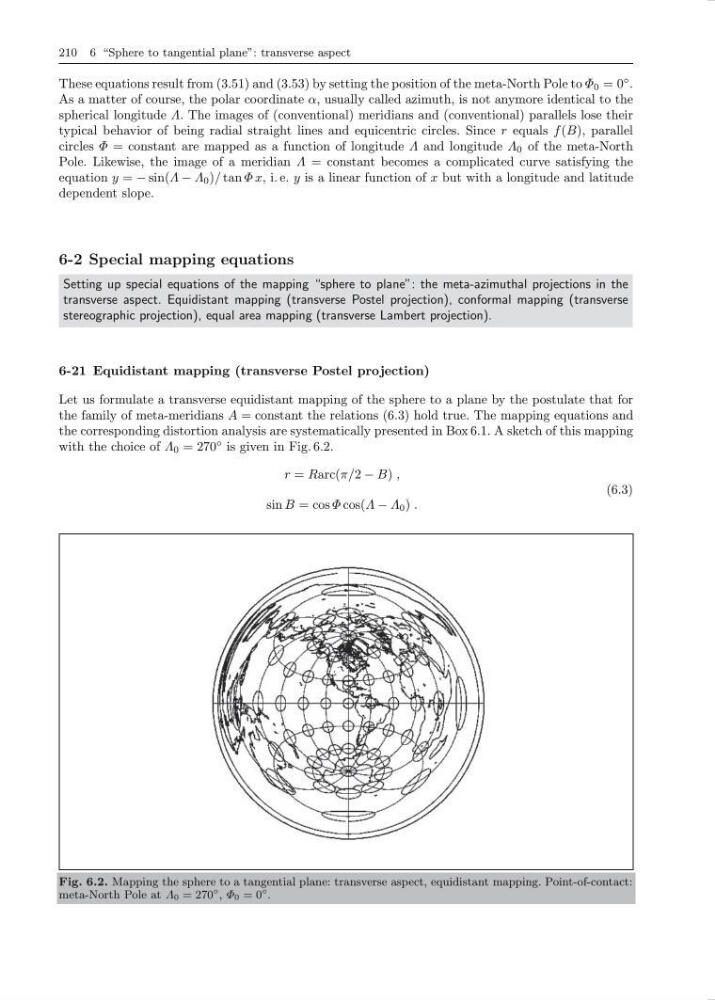
Let us formulate a transverse equidistant mapping of the sphere to a plane by the postulate that for
the family of meta-meridians A = constant the relations (6.3) hold true. The mapping equations and
the corresponding distortion analysis are systematically presented in Box 6.1. A sketch of this mapping
with the choice of Λ 0 = 270
◦ is given in Fig. 6.2.
r = Rarc(π/2 − B) ,
sin B = cos Φ cos(Λ − Λ 0 ) .
(6.3)
Fig. 6.2. Mapping the sphere to a tangential plane: transverse aspect, equidistant mapping. Point-of-contact:
meta-North Pole at Λ 0 = 270
◦ , Φ 0 = 0
◦ .
These equations result from (3.51) and (3.53) by setting the position of the meta-North Pole to Φ 0 = 0
◦ .
As a matter of course, the polar coordinate α, usually called azimuth, is not anymore identical to the
spherical longitude Λ. The images of (conventional) meridians and (conventional) parallels lose their
typical behavior of being radial straight lines and equicentric circles. Since r equals f (B), parallel
circles Φ = constant are mapped as a function of longitude Λ and longitude Λ 0 of the meta-North
Pole. Likewise, the image of a meridian Λ = constant becomes a complicated curve satisfying the
equation y = − sin(Λ − Λ 0 )/ tan Φ x, i. e. y is a linear function of x but with a longitude and latitude
dependent slope.
6-2 Special mapping equations
Setting up special equations of the mapping “sphere to plane”: the meta-azimuthal projections in the
transverse aspect. Equidistant mapping (transverse Postel projection), conformal mapping (transverse
stereographic projection), equal area mapping (transverse Lambert projection).
6-21 Equidistant mapping (transverse Postel projection)
Let us formulate a transverse equidistant mapping of the sphere to a plane by the postulate that for
the family of meta-meridians A = constant the relations (6.3) hold true. The mapping equations and
the corresponding distortion analysis are systematically presented in Box 6.1. A sketch of this mapping
with the choice of Λ 0 = 270
◦ is given in Fig. 6.2.
r = Rarc(π/2 − B) ,
sin B = cos Φ cos(Λ − Λ 0 ) .
(6.3)
Fig. 6.2. Mapping the sphere to a tangential plane: transverse aspect, equidistant mapping. Point-of-contact:
meta-North Pole at Λ 0 = 270
◦ , Φ 0 = 0
◦ .