

204 5 “Sphere to tangential plane”: polar (normal) aspect
Continuation of Box.
G l =
"
R
2 sin
2 ∆ 0
0
R
2
#
, G
−1
l
=
2
6
4
1
R 2 sin
2 ∆
0
0
1
R 2
3
7
5 ,
C l G
−1
l
=
"
c 11 G
−1
11 c 12 G
−1
22
c 12 G
−1
11 c 22 G
−1
22
#
=
2
6
6
4
f
2 g
2
Λ
R 2 sin
2 ∆
f
2 g Λ g ∆
R 2
f
2 g Λ g ∆
R 2 sin
2 ∆
f
2 + f
2 g
2
∆
R 2
3
7
7
5 ,
(5.142)
tr
ˆ
C l G
−1
l
˜
=
1
R 2 sin
2 ∆
h
f
2 g
2
Λ +
“
f
2 + f
2 g
2
∆
”
sin
2 ∆
i
,
det
ˆ
C l G
−1
l
˜
=
1
R 4 sin
2 ∆
h
f
2 g
2
Λ
“
f
2 + f
2 g
2
∆
”
− f
4 g
2
Λ g
2
∆
i
,
tr
ˆ
C l G
−1
l
˜
=
1
R 2 sin
2 ∆
h
f
2 `
g
2
Λ + g
2
∆ sin
2 ∆
´
+ f
2 sin
2 ∆
i
,
det
ˆ
C l G
−1
l
˜
=
1
R 4 sin
2 ∆
f
2 f
2 g
2
Λ .
(5.143)
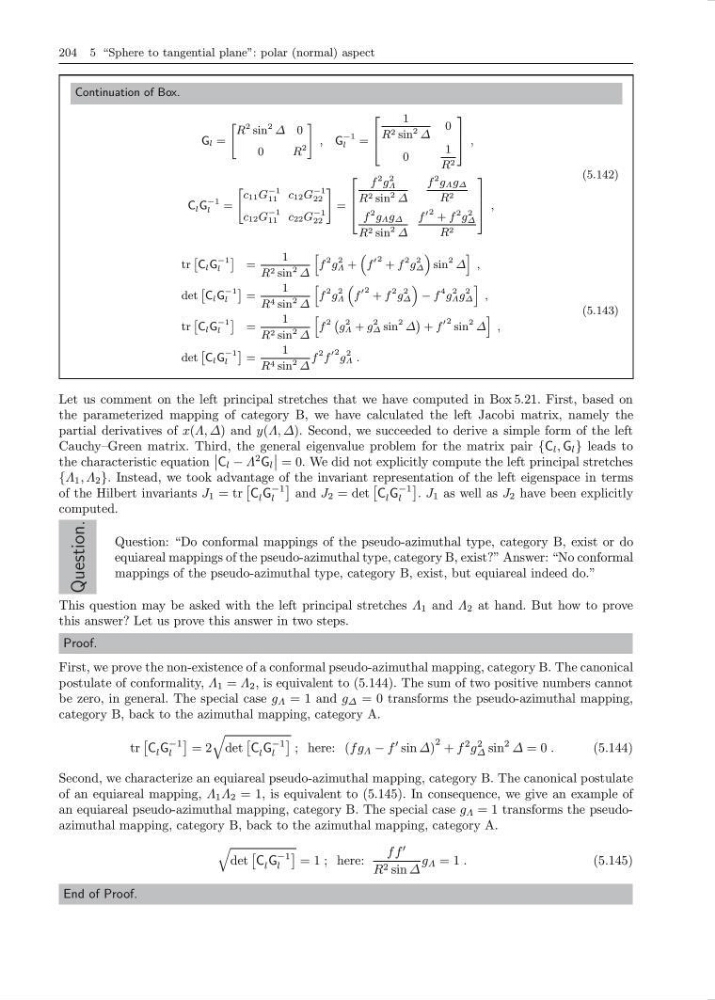
Let us comment on the left principal stretches that we have computed in Box 5.21. First, based on
the parameterized mapping of category B, we have calculated the left Jacobi matrix, namely the
partial derivatives of x(Λ, ∆) and y(Λ, ∆). Second, we succeeded to derive a simple form of the left
Cauchy–Green matrix. Third, the general eigenvalue problem for the matrix pair {C l , G l } leads to
the characteristic equation
C l − Λ
2 G l
= 0. We did not explicitly compute the left principal stretches
{Λ 1 , Λ 2 }. Instead, we took advantage of the invariant representation of the left eigenspace in terms
of the Hilbert invariants J 1 = tr
C l G
−1
l
and J 2 = det
C l G
−1
l
. J 1 as well as J 2 have been explicitly
computed.
Question.
Question: “Do conformal mappings of the pseudo-azimuthal type, category B, exist or do
equiareal mappings of the pseudo-azimuthal type, category B, exist?” Answer: “No conformal
mappings of the pseudo-azimuthal type, category B, exist, but equiareal indeed do.”
This question may be asked with the left principal stretches Λ 1 and Λ 2 at hand. But how to prove
this answer? Let us prove this answer in two steps.
Proof.
First, we prove the non-existence of a conformal pseudo-azimuthal mapping, category B. The canonical
postulate of conformality, Λ 1 = Λ 2 , is equivalent to (5.144). The sum of two positive numbers cannot
be zero, in general. The special case g Λ = 1 and g ∆ = 0 transforms the pseudo-azimuthal mapping,
category B, back to the azimuthal mapping, category A.
tr
C l G
−1
l
= 2
det
C l G
−1
l
; here: (fg Λ − f
sin ∆)
2 + f
2 g
2
∆ sin
2 ∆ = 0 .
(5.144)
Second, we characterize an equiareal pseudo-azimuthal mapping, category B. The canonical postulate
of an equiareal mapping, Λ 1 Λ 2 = 1, is equivalent to (5.145). In consequence, we give an example of
an equiareal pseudo-azimuthal mapping, category B. The special case g Λ = 1 transforms the pseudoazimuthal mapping, category B, back to the azimuthal mapping, category A.
det
C l G
−1
l
= 1 ; here:
ff
R 2 sin ∆
g Λ = 1 .
(5.145)
End of Proof.
Continuation of Box.
G l =
"
R
2 sin
2 ∆ 0
0
R
2
#
, G
−1
l
=
2
6
4
1
R 2 sin
2 ∆
0
0
1
R 2
3
7
5 ,
C l G
−1
l
=
"
c 11 G
−1
11 c 12 G
−1
22
c 12 G
−1
11 c 22 G
−1
22
#
=
2
6
6
4
f
2 g
2
Λ
R 2 sin
2 ∆
f
2 g Λ g ∆
R 2
f
2 g Λ g ∆
R 2 sin
2 ∆
f
2 + f
2 g
2
∆
R 2
3
7
7
5 ,
(5.142)
tr
ˆ
C l G
−1
l
˜
=
1
R 2 sin
2 ∆
h
f
2 g
2
Λ +
“
f
2 + f
2 g
2
∆
”
sin
2 ∆
i
,
det
ˆ
C l G
−1
l
˜
=
1
R 4 sin
2 ∆
h
f
2 g
2
Λ
“
f
2 + f
2 g
2
∆
”
− f
4 g
2
Λ g
2
∆
i
,
tr
ˆ
C l G
−1
l
˜
=
1
R 2 sin
2 ∆
h
f
2 `
g
2
Λ + g
2
∆ sin
2 ∆
´
+ f
2 sin
2 ∆
i
,
det
ˆ
C l G
−1
l
˜
=
1
R 4 sin
2 ∆
f
2 f
2 g
2
Λ .
(5.143)
Let us comment on the left principal stretches that we have computed in Box 5.21. First, based on
the parameterized mapping of category B, we have calculated the left Jacobi matrix, namely the
partial derivatives of x(Λ, ∆) and y(Λ, ∆). Second, we succeeded to derive a simple form of the left
Cauchy–Green matrix. Third, the general eigenvalue problem for the matrix pair {C l , G l } leads to
the characteristic equation
C l − Λ
2 G l
= 0. We did not explicitly compute the left principal stretches
{Λ 1 , Λ 2 }. Instead, we took advantage of the invariant representation of the left eigenspace in terms
of the Hilbert invariants J 1 = tr
C l G
−1
l
and J 2 = det
C l G
−1
l
. J 1 as well as J 2 have been explicitly
computed.
Question.
Question: “Do conformal mappings of the pseudo-azimuthal type, category B, exist or do
equiareal mappings of the pseudo-azimuthal type, category B, exist?” Answer: “No conformal
mappings of the pseudo-azimuthal type, category B, exist, but equiareal indeed do.”
This question may be asked with the left principal stretches Λ 1 and Λ 2 at hand. But how to prove
this answer? Let us prove this answer in two steps.
Proof.
First, we prove the non-existence of a conformal pseudo-azimuthal mapping, category B. The canonical
postulate of conformality, Λ 1 = Λ 2 , is equivalent to (5.144). The sum of two positive numbers cannot
be zero, in general. The special case g Λ = 1 and g ∆ = 0 transforms the pseudo-azimuthal mapping,
category B, back to the azimuthal mapping, category A.
tr
C l G
−1
l
= 2
det
C l G
−1
l
; here: (fg Λ − f
sin ∆)
2 + f
2 g
2
∆ sin
2 ∆ = 0 .
(5.144)
Second, we characterize an equiareal pseudo-azimuthal mapping, category B. The canonical postulate
of an equiareal mapping, Λ 1 Λ 2 = 1, is equivalent to (5.145). In consequence, we give an example of
an equiareal pseudo-azimuthal mapping, category B. The special case g Λ = 1 transforms the pseudoazimuthal mapping, category B, back to the azimuthal mapping, category A.
det
C l G
−1
l
= 1 ; here:
ff
R 2 sin ∆
g Λ = 1 .
(5.145)
End of Proof.