

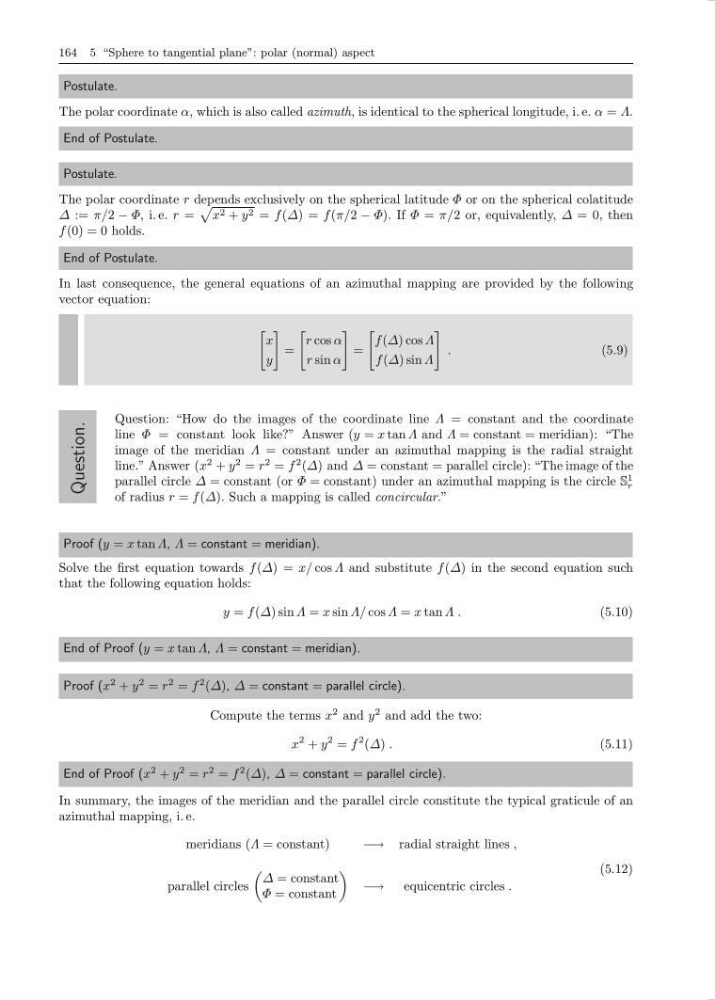
164 5 “Sphere to tangential plane”: polar (normal) aspect
Postulate.
The polar coordinate α, which is also called azimuth, is identical to the spherical longitude, i. e. α = Λ.
End of Postulate.
Postulate.
The polar coordinate r depends exclusively on the spherical latitude Φ or on the spherical colatitude
∆ := π/2 − Φ, i. e. r =
x 2 + y 2 = f (∆) = f (π/2 − Φ). If Φ = π/2 or, equivalently, ∆ = 0, then
f (0) = 0 holds.
End of Postulate.
In last consequence, the general equations of an azimuthal mapping are provided by the following
vector equation:
x
y
=
r cos α
r sin α
=
f (∆) cos Λ
f (∆) sin Λ
.
(5.9)
Question.
Question: “How do the images of the coordinate line Λ = constant and the coordinate
line Φ = constant look like?” Answer (y = x tan Λ and Λ = constant = meridian): “The
image of the meridian Λ = constant under an azimuthal mapping is the radial straight
line.” Answer (x
2 + y
2 = r
2 = f
2 (∆) and ∆ = constant = parallel circle): “The image of the
parallel circle ∆ = constant (or Φ = constant) under an azimuthal mapping is the circle S
1
r
of radius r = f (∆). Such a mapping is called concircular.”
Proof (y = x tan Λ, Λ = constant = meridian).
Solve the first equation towards f (∆) = x/ cos Λ and substitute f (∆) in the second equation such
that the following equation holds:
y = f (∆) sin Λ = x sin Λ/ cos Λ = x tan Λ .
(5.10)
End of Proof (y = x tan Λ, Λ = constant = meridian).
Proof (x
2 + y
2 = r
2 = f
2 (∆), ∆ = constant = parallel circle).
Compute the terms x
2 and y
2 and add the two:
x
2 + y
2 = f
2 (∆) .
(5.11)
End of Proof (x
2 + y
2 = r
2 = f
2 (∆), ∆ = constant = parallel circle).
In summary, the images of the meridian and the parallel circle constitute the typical graticule of an
azimuthal mapping, i. e.
meridians (Λ = constant)
−→ radial straight lines ,
parallel circles
∆ = constant
Φ = constant
−→
equicentric circles .
(5.12)
Postulate.
The polar coordinate α, which is also called azimuth, is identical to the spherical longitude, i. e. α = Λ.
End of Postulate.
Postulate.
The polar coordinate r depends exclusively on the spherical latitude Φ or on the spherical colatitude
∆ := π/2 − Φ, i. e. r =
x 2 + y 2 = f (∆) = f (π/2 − Φ). If Φ = π/2 or, equivalently, ∆ = 0, then
f (0) = 0 holds.
End of Postulate.
In last consequence, the general equations of an azimuthal mapping are provided by the following
vector equation:
x
y
=
r cos α
r sin α
=
f (∆) cos Λ
f (∆) sin Λ
.
(5.9)
Question.
Question: “How do the images of the coordinate line Λ = constant and the coordinate
line Φ = constant look like?” Answer (y = x tan Λ and Λ = constant = meridian): “The
image of the meridian Λ = constant under an azimuthal mapping is the radial straight
line.” Answer (x
2 + y
2 = r
2 = f
2 (∆) and ∆ = constant = parallel circle): “The image of the
parallel circle ∆ = constant (or Φ = constant) under an azimuthal mapping is the circle S
1
r
of radius r = f (∆). Such a mapping is called concircular.”
Proof (y = x tan Λ, Λ = constant = meridian).
Solve the first equation towards f (∆) = x/ cos Λ and substitute f (∆) in the second equation such
that the following equation holds:
y = f (∆) sin Λ = x sin Λ/ cos Λ = x tan Λ .
(5.10)
End of Proof (y = x tan Λ, Λ = constant = meridian).
Proof (x
2 + y
2 = r
2 = f
2 (∆), ∆ = constant = parallel circle).
Compute the terms x
2 and y
2 and add the two:
x
2 + y
2 = f
2 (∆) .
(5.11)
End of Proof (x
2 + y
2 = r
2 = f
2 (∆), ∆ = constant = parallel circle).
In summary, the images of the meridian and the parallel circle constitute the typical graticule of an
azimuthal mapping, i. e.
meridians (Λ = constant)
−→ radial straight lines ,
parallel circles
∆ = constant
Φ = constant
−→
equicentric circles .
(5.12)