

148 3 Coordinates
Next, we have to work out how the oblique quasi-spherical longitude/latitude are related to the
standard surface normal ellipsoidal longitude/latitude. This finally concludes the introduction of the
oblique coordinate system of the ellipsoid-of-revolution. At first, we here aim at a transformation of
oblique quasi-spherical longitude/latitude into surface normal ellipsoidal longitude/latitude to which
we refer as direct transformation. Additionally, we here aim at a transformation of surface normal
ellipsoidal longitude/latitude into oblique quasi-spherical longitude/latitude to which we refer as
inverse transformation.
3-45 Direct transformation of oblique quasi-spherical longitude/latitude
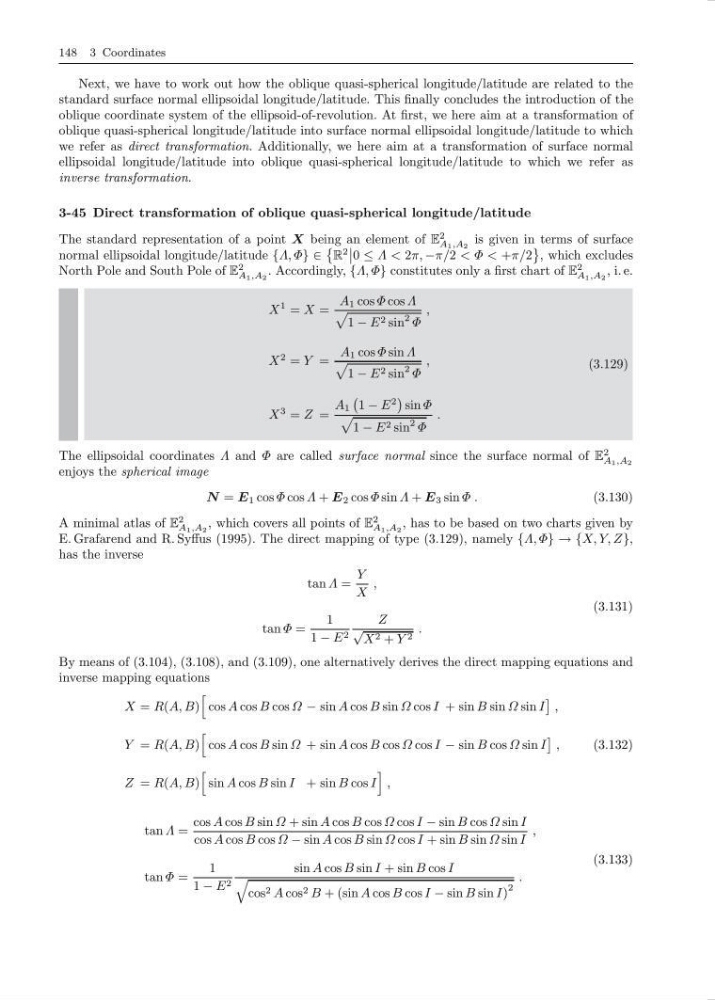
The standard representation of a point X being an element of E
2
A 1 ,A 2
is given in terms of surface
normal ellipsoidal longitude/latitude {Λ, Φ} ∈
R
2
0 ≤ Λ < 2π, −π/2 < Φ < +π/2
, which excludes
North Pole and South Pole of E
2
A 1 ,A 2
. Accordingly, {Λ, Φ} constitutes only a first chart of E
2
A 1 ,A 2
, i. e.
X
1 = X =
A 1 cos Φ cos Λ
1 − E 2 sin
2 Φ
,
X
2 = Y =
A 1 cos Φ sin Λ
1 − E 2 sin
2 Φ
,
X
3 = Z =
A 1
1 − E
2
sin Φ
1 − E 2 sin
2 Φ
.
(3.129)
The ellipsoidal coordinates Λ and Φ are called surface normal since the surface normal of E
2
A 1 ,A 2
enjoys the spherical image
N = E 1 cos Φ cos Λ + E 2 cos Φ sin Λ + E 3 sin Φ .
(3.130)
A minimal atlas of E
2
A 1 ,A 2
, which covers all points of E
2
A 1 ,A 2
, has to be based on two charts given by
E. Grafarend and R. Syffus (1995). The direct mapping of type (3.129), namely {Λ, Φ} → {X, Y, Z},
has the inverse
tan Λ =
Y
X
,
tan Φ =
1
1 − E 2
Z
√
X 2 + Y 2
.
(3.131)
By means of (3.104), (3.108), and (3.109), one alternatively derives the direct mapping equations and
inverse mapping equations
X = R(A, B)
cos A cos B cos Ω − sin A cos B sin Ω cos I + sin B sin Ω sin I
,
Y = R(A, B)
cos A cos B sin Ω + sin A cos B cos Ω cos I − sin B cos Ω sin I
,
Z = R(A, B)
sin A cos B sin I + sin B cos I
,
(3.132)
tan Λ =
cos A cos B sin Ω + sin A cos B cos Ω cos I − sin B cos Ω sin I
cos A cos B cos Ω − sin A cos B sin Ω cos I + sin B sin Ω sin I
,
tan Φ =
1
1 − E 2
sin A cos B sin I + sin B cos I
cos 2 A cos 2 B + (sin A cos B cos I − sin B sin I)
2
.
(3.133)
Next, we have to work out how the oblique quasi-spherical longitude/latitude are related to the
standard surface normal ellipsoidal longitude/latitude. This finally concludes the introduction of the
oblique coordinate system of the ellipsoid-of-revolution. At first, we here aim at a transformation of
oblique quasi-spherical longitude/latitude into surface normal ellipsoidal longitude/latitude to which
we refer as direct transformation. Additionally, we here aim at a transformation of surface normal
ellipsoidal longitude/latitude into oblique quasi-spherical longitude/latitude to which we refer as
inverse transformation.
3-45 Direct transformation of oblique quasi-spherical longitude/latitude
The standard representation of a point X being an element of E
2
A 1 ,A 2
is given in terms of surface
normal ellipsoidal longitude/latitude {Λ, Φ} ∈
R
2
0 ≤ Λ < 2π, −π/2 < Φ < +π/2
, which excludes
North Pole and South Pole of E
2
A 1 ,A 2
. Accordingly, {Λ, Φ} constitutes only a first chart of E
2
A 1 ,A 2
, i. e.
X
1 = X =
A 1 cos Φ cos Λ
1 − E 2 sin
2 Φ
,
X
2 = Y =
A 1 cos Φ sin Λ
1 − E 2 sin
2 Φ
,
X
3 = Z =
A 1
1 − E
2
sin Φ
1 − E 2 sin
2 Φ
.
(3.129)
The ellipsoidal coordinates Λ and Φ are called surface normal since the surface normal of E
2
A 1 ,A 2
enjoys the spherical image
N = E 1 cos Φ cos Λ + E 2 cos Φ sin Λ + E 3 sin Φ .
(3.130)
A minimal atlas of E
2
A 1 ,A 2
, which covers all points of E
2
A 1 ,A 2
, has to be based on two charts given by
E. Grafarend and R. Syffus (1995). The direct mapping of type (3.129), namely {Λ, Φ} → {X, Y, Z},
has the inverse
tan Λ =
Y
X
,
tan Φ =
1
1 − E 2
Z
√
X 2 + Y 2
.
(3.131)
By means of (3.104), (3.108), and (3.109), one alternatively derives the direct mapping equations and
inverse mapping equations
X = R(A, B)
cos A cos B cos Ω − sin A cos B sin Ω cos I + sin B sin Ω sin I
,
Y = R(A, B)
cos A cos B sin Ω + sin A cos B cos Ω cos I − sin B cos Ω sin I
,
Z = R(A, B)
sin A cos B sin I + sin B cos I
,
(3.132)
tan Λ =
cos A cos B sin Ω + sin A cos B cos Ω cos I − sin B cos Ω sin I
cos A cos B cos Ω − sin A cos B sin Ω cos I + sin B sin Ω sin I
,
tan Φ =
1
1 − E 2
sin A cos B sin I + sin B cos I
cos 2 A cos 2 B + (sin A cos B cos I − sin B sin I)
2
.
(3.133)