

118 3 Coordinates
x
y
[x, y]
t 3
φ 3
t 3
U 3
x
y
[x, y]
t 4
φ 4
t 4
U 4
x
y
[x, y]
t 1
φ 1
t 1
U 1
x
y
[x, y]
t 2
φ 2
t 2
U 2
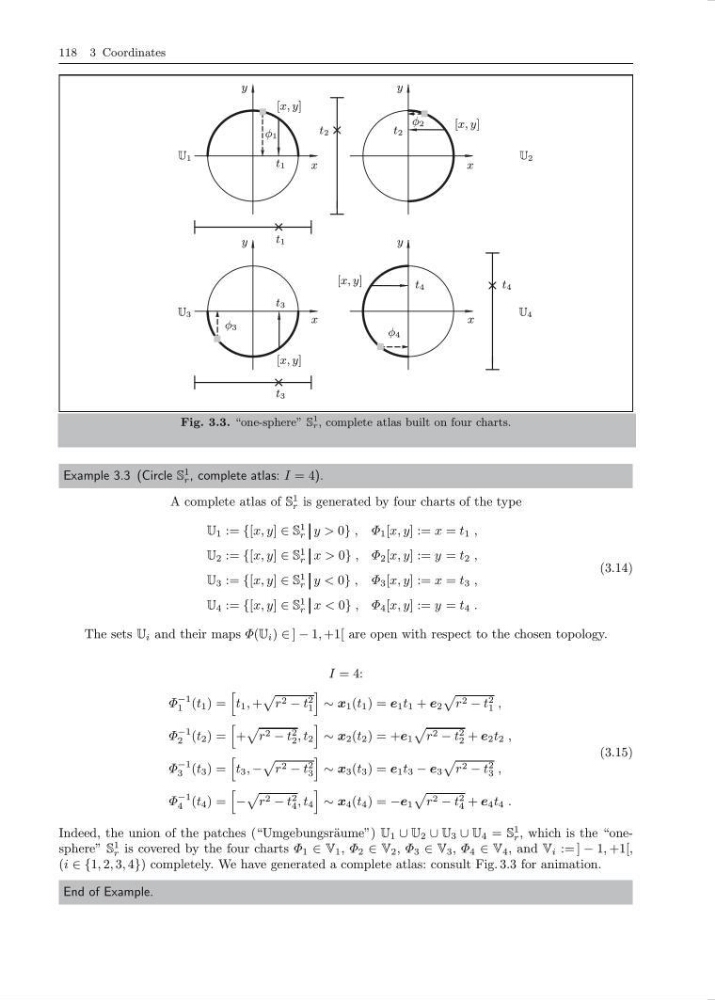
Fig. 3.3. “one-sphere” S
1
r , complete atlas built on four charts.
Example 3.3 (Circle S
1
r , complete atlas: I = 4).
A complete atlas of S
1
r is generated by four charts of the type
U 1 := {[x, y] ∈ S
1
r y > 0} , Φ 1 [x, y] := x = t 1 ,
U 2 := {[x, y] ∈ S
1
r x > 0} , Φ 2 [x, y] := y = t 2 ,
U 3 := {[x, y] ∈ S
1
r y < 0} , Φ 3 [x, y] := x = t 3 ,
U 4 := {[x, y] ∈ S
1
r x < 0} , Φ 4 [x, y] := y = t 4 .
(3.14)
The sets U i and their maps Φ(U i ) ∈ ] − 1, +1[ are open with respect to the chosen topology.
I = 4:
Φ
−1
1 (t 1 ) =
t 1 , +
r 2 − t 2
1
∼ x 1 (t 1 ) = e 1 t 1 + e 2
r 2 − t 2
1 ,
Φ
−1
2 (t 2 ) =
+
r 2 − t 2
2 , t 2
∼ x 2 (t 2 ) = +e 1
r 2 − t 2
2 + e 2 t 2 ,
Φ
−1
3 (t 3 ) =
t 3 , −
r 2 − t 2
3
∼ x 3 (t 3 ) = e 1 t 3 − e 3
r 2 − t 2
3 ,
Φ
−1
4 (t 4 ) =
−
r 2 − t 2
4 , t 4
∼ x 4 (t 4 ) = −e 1
r 2 − t 2
4 + e 4 t 4 .
(3.15)
Indeed, the union of the patches (“Umgebungsr¨ aume”) U 1 ∪ U 2 ∪ U 3 ∪ U 4 = S
1
r , which is the “onesphere” S
1
r is covered by the four charts Φ 1 ∈ V 1 , Φ 2 ∈ V 2 , Φ 3 ∈ V 3 , Φ 4 ∈ V 4 , and V i := ] − 1, +1[,
(i ∈ {1, 2, 3, 4}) completely. We have generated a complete atlas: consult Fig. 3.3 for animation.
End of Example.
x
y
[x, y]
t 3
φ 3
t 3
U 3
x
y
[x, y]
t 4
φ 4
t 4
U 4
x
y
[x, y]
t 1
φ 1
t 1
U 1
x
y
[x, y]
t 2
φ 2
t 2
U 2
Fig. 3.3. “one-sphere” S
1
r , complete atlas built on four charts.
Example 3.3 (Circle S
1
r , complete atlas: I = 4).
A complete atlas of S
1
r is generated by four charts of the type
U 1 := {[x, y] ∈ S
1
r y > 0} , Φ 1 [x, y] := x = t 1 ,
U 2 := {[x, y] ∈ S
1
r x > 0} , Φ 2 [x, y] := y = t 2 ,
U 3 := {[x, y] ∈ S
1
r y < 0} , Φ 3 [x, y] := x = t 3 ,
U 4 := {[x, y] ∈ S
1
r x < 0} , Φ 4 [x, y] := y = t 4 .
(3.14)
The sets U i and their maps Φ(U i ) ∈ ] − 1, +1[ are open with respect to the chosen topology.
I = 4:
Φ
−1
1 (t 1 ) =
t 1 , +
r 2 − t 2
1
∼ x 1 (t 1 ) = e 1 t 1 + e 2
r 2 − t 2
1 ,
Φ
−1
2 (t 2 ) =
+
r 2 − t 2
2 , t 2
∼ x 2 (t 2 ) = +e 1
r 2 − t 2
2 + e 2 t 2 ,
Φ
−1
3 (t 3 ) =
t 3 , −
r 2 − t 2
3
∼ x 3 (t 3 ) = e 1 t 3 − e 3
r 2 − t 2
3 ,
Φ
−1
4 (t 4 ) =
−
r 2 − t 2
4 , t 4
∼ x 4 (t 4 ) = −e 1
r 2 − t 2
4 + e 4 t 4 .
(3.15)
Indeed, the union of the patches (“Umgebungsr¨ aume”) U 1 ∪ U 2 ∪ U 3 ∪ U 4 = S
1
r , which is the “onesphere” S
1
r is covered by the four charts Φ 1 ∈ V 1 , Φ 2 ∈ V 2 , Φ 3 ∈ V 3 , Φ 4 ∈ V 4 , and V i := ] − 1, +1[,
(i ∈ {1, 2, 3, 4}) completely. We have generated a complete atlas: consult Fig. 3.3 for animation.
End of Example.