

1-14 Review: the canonical criteria 87
Ψ l
π
2
− Ψ l
C2
D1
C1
V = constant
U = constant
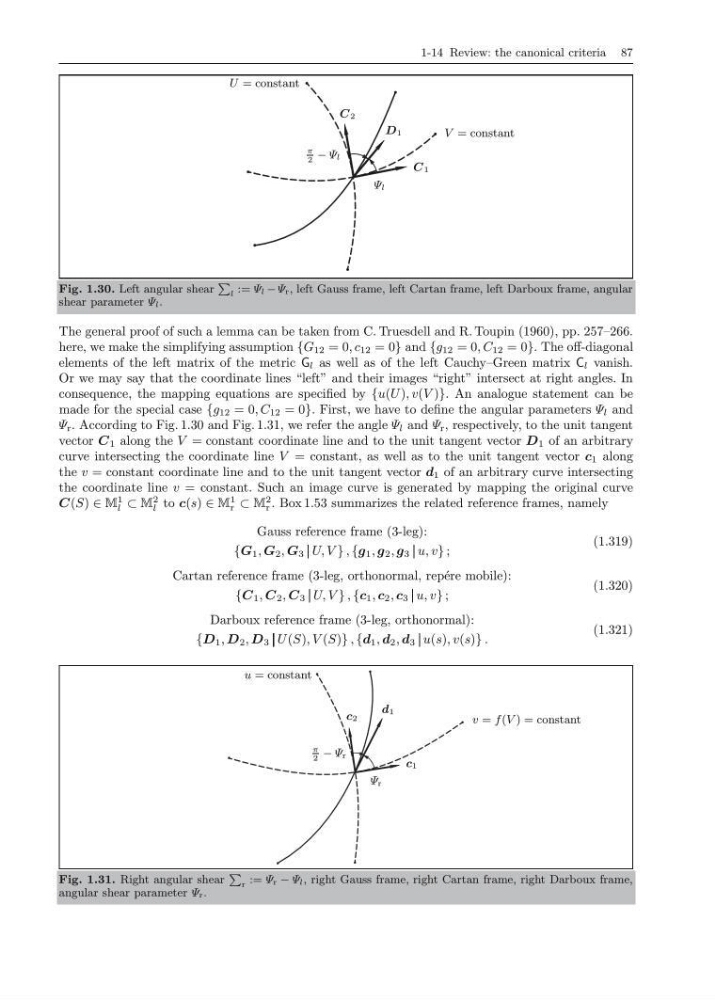
Fig. 1.30. Left angular shear
P
l := Ψ l − Ψ r , left Gauss frame, left Cartan frame, left Darboux frame, angular
shear parameter Ψ l .
The general proof of such a lemma can be taken from C. Truesdell and R. Toupin (1960), pp. 257–266.
here, we make the simplifying assumption {G 12 = 0, c 12 = 0} and {g 12 = 0, C 12 = 0}. The off-diagonal
elements of the left matrix of the metric G l as well as of the left Cauchy–Green matrix C l vanish.
Or we may say that the coordinate lines “left” and their images “right” intersect at right angles. In
consequence, the mapping equations are specified by {u(U ), v(V )}. An analogue statement can be
made for the special case {g 12 = 0, C 12 = 0}. First, we have to define the angular parameters Ψ l and
Ψ r . According to Fig. 1.30 and Fig. 1.31, we refer the angle Ψ l and Ψ r , respectively, to the unit tangent
vector C 1 along the V = constant coordinate line and to the unit tangent vector D 1 of an arbitrary
curve intersecting the coordinate line V = constant, as well as to the unit tangent vector c 1 along
the v = constant coordinate line and to the unit tangent vector d 1 of an arbitrary curve intersecting
the coordinate line v = constant. Such an image curve is generated by mapping the original curve
C(S) ∈ M
1
l ⊂ M
2
l to c(s) ∈ M
1
r ⊂ M
2
r . Box 1.53 summarizes the related reference frames, namely
Gauss reference frame (3-leg):
{G 1 , G 2 , G 3 U, V } , {g 1 , g 2 , g 3 u, v} ;
(1.319)
Cartan reference frame (3-leg, orthonormal, rep´ ere mobile):
{C 1 , C 2 , C 3 U, V } , {c 1 , c 2 , c 3 u, v} ;
(1.320)
Darboux reference frame (3-leg, orthonormal):
{D 1 , D 2 , D 3 U (S), V (S)} , {d 1 , d 2 , d 3 u(s), v(s)} .
(1.321)
Ψ r
π
2
− Ψ r
c2
d1
c1
v = f (V ) = constant
u = constant
Fig. 1.31. Right angular shear
P
r := Ψ r − Ψ l , right Gauss frame, right Cartan frame, right Darboux frame,
angular shear parameter Ψ r .
Ψ l
π
2
− Ψ l
C2
D1
C1
V = constant
U = constant
Fig. 1.30. Left angular shear
P
l := Ψ l − Ψ r , left Gauss frame, left Cartan frame, left Darboux frame, angular
shear parameter Ψ l .
The general proof of such a lemma can be taken from C. Truesdell and R. Toupin (1960), pp. 257–266.
here, we make the simplifying assumption {G 12 = 0, c 12 = 0} and {g 12 = 0, C 12 = 0}. The off-diagonal
elements of the left matrix of the metric G l as well as of the left Cauchy–Green matrix C l vanish.
Or we may say that the coordinate lines “left” and their images “right” intersect at right angles. In
consequence, the mapping equations are specified by {u(U ), v(V )}. An analogue statement can be
made for the special case {g 12 = 0, C 12 = 0}. First, we have to define the angular parameters Ψ l and
Ψ r . According to Fig. 1.30 and Fig. 1.31, we refer the angle Ψ l and Ψ r , respectively, to the unit tangent
vector C 1 along the V = constant coordinate line and to the unit tangent vector D 1 of an arbitrary
curve intersecting the coordinate line V = constant, as well as to the unit tangent vector c 1 along
the v = constant coordinate line and to the unit tangent vector d 1 of an arbitrary curve intersecting
the coordinate line v = constant. Such an image curve is generated by mapping the original curve
C(S) ∈ M
1
l ⊂ M
2
l to c(s) ∈ M
1
r ⊂ M
2
r . Box 1.53 summarizes the related reference frames, namely
Gauss reference frame (3-leg):
{G 1 , G 2 , G 3 U, V } , {g 1 , g 2 , g 3 u, v} ;
(1.319)
Cartan reference frame (3-leg, orthonormal, rep´ ere mobile):
{C 1 , C 2 , C 3 U, V } , {c 1 , c 2 , c 3 u, v} ;
(1.320)
Darboux reference frame (3-leg, orthonormal):
{D 1 , D 2 , D 3 U (S), V (S)} , {d 1 , d 2 , d 3 u(s), v(s)} .
(1.321)
Ψ r
π
2
− Ψ r
c2
d1
c1
v = f (V ) = constant
u = constant
Fig. 1.31. Right angular shear
P
r := Ψ r − Ψ l , right Gauss frame, right Cartan frame, right Darboux frame,
angular shear parameter Ψ r .