

4.1. Finite Difference Methods
77
are
2D
L\x
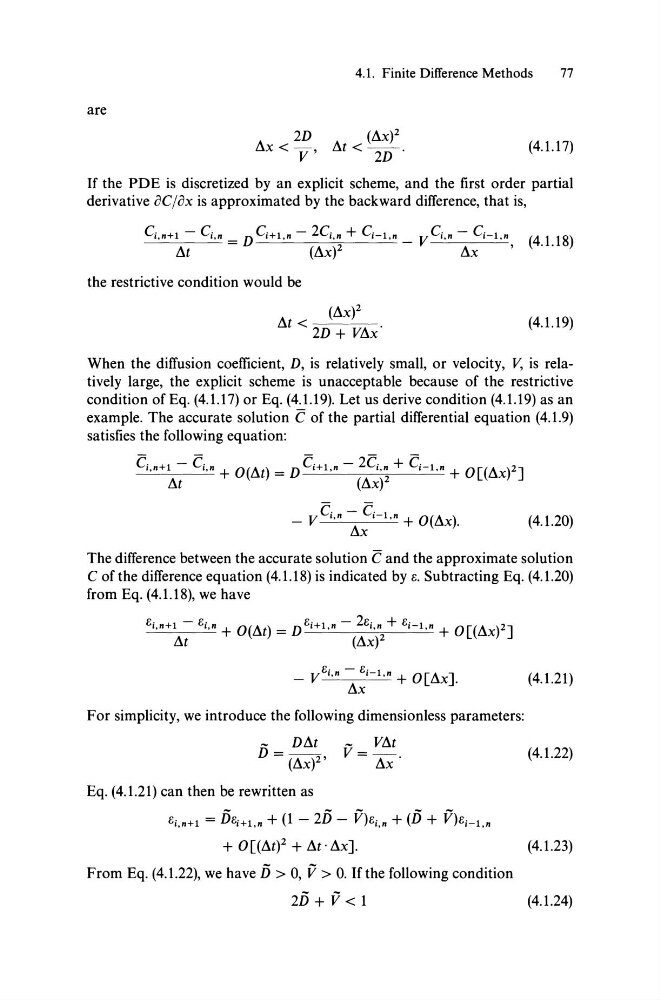
If the PDE is discretized by an explicit scheme, and the first order partial
derivative aC/ax is approximated by the backward difference, that is,
Ci,1I+1 - Ci,lI = Ci+1,11 - 2Ci,II + Ci- 1,1I _ V Ci,1I - Ci- 1,1I (4 118)
L\t
D
(L\X)2
L\x
'
..
the restrictive condition would be
A
(L\X)2
/..},t<---2D + VL\x
(4.1.19)
When the diffusion coefficient, D, is relatively small, or velocity, V, is relatively large, the explicit scheme is unacceptable because of the restrictive
condition of Eq. (4.1.17) or Eq. (4.1.19). Let us derive condition (4.1.19) as an
example. The accurate solution C of the partial differential equation (4.1.9)
satisfies the following equation:
C. +1 - C.
C'+l - 2C· + C. 1
',li
',li + O(L\t) = D ',n
',li
,- ,n + O[(L\X)2]
L\t
(L\X)2
_ vCi,n ~;i-1'" + O(L\x).
(4.1.20)
The difference between the accurate solution C and the approximate solution
C ofthe difference equation (4.1.18) is indicated by 8. Subtracting Eq. (4.1.20)
from Eq. (4.1.18), we have
8· +1 - 8·
8'+1 - 28· + 8· 1
',li
',li + O(L\t) = D"II
',li
,- ,11 + O[(L\X)2]
L\t
(L\X)2
_ V 8i ,II ~;i-l,n + O[L\x].
For simplicity, we introduce the following dimensionless parameters:
-
DL\t
-
VL\t
D = (L\X)2' V = L\x'
Eq. (4.1.21) can then be rewritten as
8i,n+1 = 158;+l,n + (1 - 215 - V)8i,n + (15 + V)8 i - 1 ,1I
+ O[(L\t)2 + L\t· L\x].
From Eq. (4.1.22), we have 15 > 0, V> O. If the following condition
215+v<1
(4.1.21)
(4.1.22)
(4.1.23)
(4.1.24)
77
are
2D
L\x
If the PDE is discretized by an explicit scheme, and the first order partial
derivative aC/ax is approximated by the backward difference, that is,
Ci,1I+1 - Ci,lI = Ci+1,11 - 2Ci,II + Ci- 1,1I _ V Ci,1I - Ci- 1,1I (4 118)
L\t
D
(L\X)2
L\x
'
..
the restrictive condition would be
A
(L\X)2
/..},t<---2D + VL\x
(4.1.19)
When the diffusion coefficient, D, is relatively small, or velocity, V, is relatively large, the explicit scheme is unacceptable because of the restrictive
condition of Eq. (4.1.17) or Eq. (4.1.19). Let us derive condition (4.1.19) as an
example. The accurate solution C of the partial differential equation (4.1.9)
satisfies the following equation:
C. +1 - C.
C'+l - 2C· + C. 1
',li
',li + O(L\t) = D ',n
',li
,- ,n + O[(L\X)2]
L\t
(L\X)2
_ vCi,n ~;i-1'" + O(L\x).
(4.1.20)
The difference between the accurate solution C and the approximate solution
C ofthe difference equation (4.1.18) is indicated by 8. Subtracting Eq. (4.1.20)
from Eq. (4.1.18), we have
8· +1 - 8·
8'+1 - 28· + 8· 1
',li
',li + O(L\t) = D"II
',li
,- ,11 + O[(L\X)2]
L\t
(L\X)2
_ V 8i ,II ~;i-l,n + O[L\x].
For simplicity, we introduce the following dimensionless parameters:
-
DL\t
-
VL\t
D = (L\X)2' V = L\x'
Eq. (4.1.21) can then be rewritten as
8i,n+1 = 158;+l,n + (1 - 215 - V)8i,n + (15 + V)8 i - 1 ,1I
+ O[(L\t)2 + L\t· L\x].
From Eq. (4.1.22), we have 15 > 0, V> O. If the following condition
215+v<1
(4.1.21)
(4.1.22)
(4.1.23)
(4.1.24)