

3.2. Some Canonical Problems Having Analytic Solutions
61
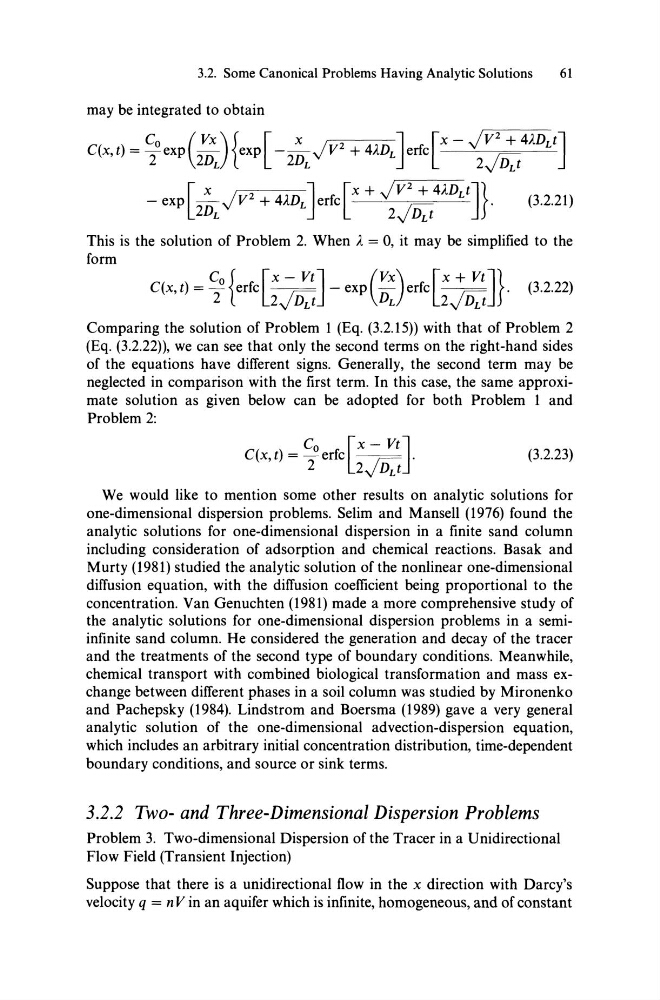
may be integrated to obtain
- exp [2~L JV 2 + 4,WL J erfc [x + ~~ 4).D L t J}. (3.2.21)
This is the solution of Problem 2. When ). = 0, it may be simplified to the
form
C(x, t) = ~o {erfc [;~J -exp (~:) erfc [;~J}. (3.2.22)
Comparing the solution of Problem 1 (Eq. (3.2.15)) with that of Problem 2
(Eq. (3.2.22)), we can see that only the second terms on the right-hand sides
of the equations have different signs. Generally, the second term may be
neglected in comparison with the first term. In this case, the same approximate solution as given below can be adopted for both Problem 1 and
Problem 2:
C(x, t) = ~o erfc [x ~J.
2y DL t
(3.2.23)
We would like to mention some other results on analytic solutions for
one-dimensional dispersion problems. Selim and ManseIl (1976) found the
analytic solutions for one-dimensional dispersion in a finite sand column
including consideration of adsorption and chemical reactions. Basak and
Murty (1981) studied the analytic solution of the nonlinear one-dimensional
diffusion equation, with the diffusion coefficient being proportional to the
concentration. Van Genuchten (1981) made a more comprehensive study of
the analytic solutions for one-dimensional dispersion problems in a semiinfinite sand column. He considered the generation and decay of the tracer
and the treatments of the second type of boundary conditions. Meanwhile,
chemical transport with combined biological transformation and mass exchange between different phases in a soil column was studied by Mironenko
and Pachepsky (1984). Lindstrom and Boersma (1989) gave a very general
analytic solution of the one-dimensional advection-dispersion equation,
which includes an arbitrary initial concentration distribution, time-dependent
boundary conditions, and source or sink terms.
3.2.2 Two- and Three-Dimensional Dispersion Problems
Problem 3. Two-dimensional Dispersion of the Tracer in a Unidirectional
Flow Field (Transient Injection)
Suppose that there is a unidirectional flow in the x direction with Darcy's
velocity q = n V in an aquifer which is infinite, homogeneous, and of constant
61
may be integrated to obtain
- exp [2~L JV 2 + 4,WL J erfc [x + ~~ 4).D L t J}. (3.2.21)
This is the solution of Problem 2. When ). = 0, it may be simplified to the
form
C(x, t) = ~o {erfc [;~J -exp (~:) erfc [;~J}. (3.2.22)
Comparing the solution of Problem 1 (Eq. (3.2.15)) with that of Problem 2
(Eq. (3.2.22)), we can see that only the second terms on the right-hand sides
of the equations have different signs. Generally, the second term may be
neglected in comparison with the first term. In this case, the same approximate solution as given below can be adopted for both Problem 1 and
Problem 2:
C(x, t) = ~o erfc [x ~J.
2y DL t
(3.2.23)
We would like to mention some other results on analytic solutions for
one-dimensional dispersion problems. Selim and ManseIl (1976) found the
analytic solutions for one-dimensional dispersion in a finite sand column
including consideration of adsorption and chemical reactions. Basak and
Murty (1981) studied the analytic solution of the nonlinear one-dimensional
diffusion equation, with the diffusion coefficient being proportional to the
concentration. Van Genuchten (1981) made a more comprehensive study of
the analytic solutions for one-dimensional dispersion problems in a semiinfinite sand column. He considered the generation and decay of the tracer
and the treatments of the second type of boundary conditions. Meanwhile,
chemical transport with combined biological transformation and mass exchange between different phases in a soil column was studied by Mironenko
and Pachepsky (1984). Lindstrom and Boersma (1989) gave a very general
analytic solution of the one-dimensional advection-dispersion equation,
which includes an arbitrary initial concentration distribution, time-dependent
boundary conditions, and source or sink terms.
3.2.2 Two- and Three-Dimensional Dispersion Problems
Problem 3. Two-dimensional Dispersion of the Tracer in a Unidirectional
Flow Field (Transient Injection)
Suppose that there is a unidirectional flow in the x direction with Darcy's
velocity q = n V in an aquifer which is infinite, homogeneous, and of constant