

60
3. Analytic Solutions of Hydrodynamic Dispersion Equations
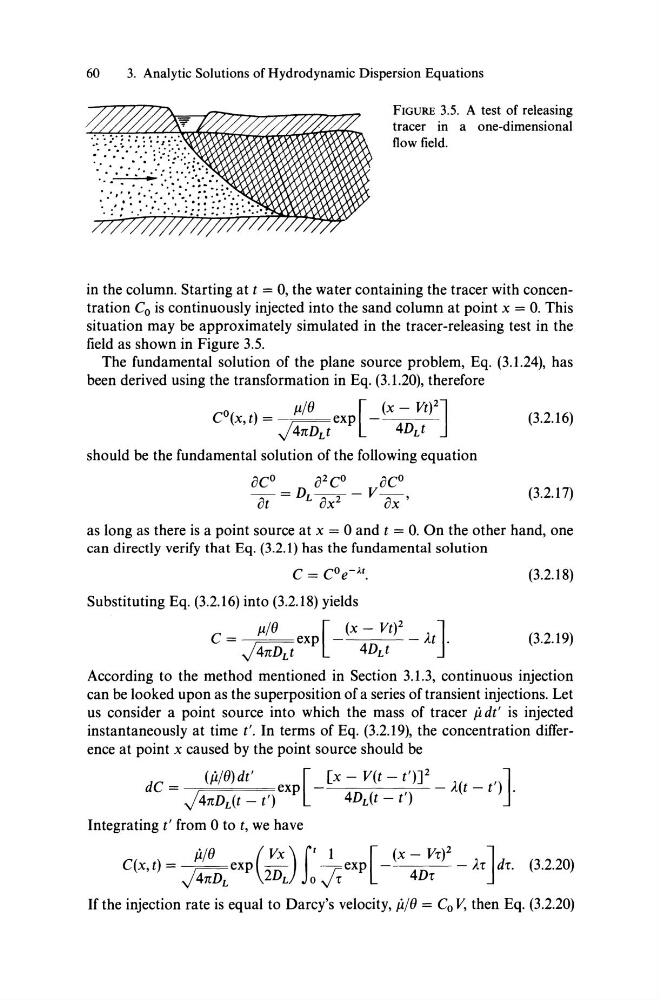
FIGURE 3.5. A test of releasing
tracer in a one-dimensional
flow field.
in the column. Starting at t = 0, the water containing the tracer with concentration Co is continuously injected into the sand column at point x = O. This
situation may be approximately simulated in the tracer-releasing test in the
field as shown in Figure 3.5.
The fundamental solution of the plane source problem, Eq. (3.1.24), has
been derived using the transformation in Eq. (3.1.20), therefore
C o( )
Jl/O
[(X - Vt)2J
x, t =
exp - -'-----::-=-J4nD L t
4DL t
(3.2.16)
should be the fundamental solution of the following equation
oC o
02CO
oCo
Tt = DL ox2 - V ox '
(3.2.17)
as long as there is a point source at x = 0 and t = O. On the other hand, one
can directly verify that Eq. (3.2.1) has the fundamental solution
(3.2.18)
Substituting Eq. (3.2.16) into (3.2.18) yields
C
Jl/O
[(X - Vt)2 1 J
=
exp
- At .
J4nD L t
4DL t
(3.2.19)
According to the method mentioned in Section 3.1.3, continuous injection
can be looked upon as the superposition of aseries of transient injections. Let
us consider a point source into which the mass of tracer fJ. dt' is injected
instantaneously at time t'. In terms of Eq. (3.2.19), the concentration difference at point x caused by the point source should be
d
(fJ.!O) dt'
[[X - V(t - t')]2 1( ' )J
C =
exp -
, - A t - t .
J 4nDdt - t')
4DL (t - t )
Integrating t' from 0 to t, we have
( )
fJ.!O
( vx) (' 1 [(X - Vr)2 _ l .. J d". (3.2.20)
C x,t = J4nD L exp 2D L Jo Jr exp
4Dr
A . .
If the injection rate is equal to Darcy's velocity, fJ.!O = Co V, then Eq. (3.2.20)
3. Analytic Solutions of Hydrodynamic Dispersion Equations
FIGURE 3.5. A test of releasing
tracer in a one-dimensional
flow field.
in the column. Starting at t = 0, the water containing the tracer with concentration Co is continuously injected into the sand column at point x = O. This
situation may be approximately simulated in the tracer-releasing test in the
field as shown in Figure 3.5.
The fundamental solution of the plane source problem, Eq. (3.1.24), has
been derived using the transformation in Eq. (3.1.20), therefore
C o( )
Jl/O
[(X - Vt)2J
x, t =
exp - -'-----::-=-J4nD L t
4DL t
(3.2.16)
should be the fundamental solution of the following equation
oC o
02CO
oCo
Tt = DL ox2 - V ox '
(3.2.17)
as long as there is a point source at x = 0 and t = O. On the other hand, one
can directly verify that Eq. (3.2.1) has the fundamental solution
(3.2.18)
Substituting Eq. (3.2.16) into (3.2.18) yields
C
Jl/O
[(X - Vt)2 1 J
=
exp
- At .
J4nD L t
4DL t
(3.2.19)
According to the method mentioned in Section 3.1.3, continuous injection
can be looked upon as the superposition of aseries of transient injections. Let
us consider a point source into which the mass of tracer fJ. dt' is injected
instantaneously at time t'. In terms of Eq. (3.2.19), the concentration difference at point x caused by the point source should be
d
(fJ.!O) dt'
[[X - V(t - t')]2 1( ' )J
C =
exp -
, - A t - t .
J 4nDdt - t')
4DL (t - t )
Integrating t' from 0 to t, we have
( )
fJ.!O
( vx) (' 1 [(X - Vr)2 _ l .. J d". (3.2.20)
C x,t = J4nD L exp 2D L Jo Jr exp
4Dr
A . .
If the injection rate is equal to Darcy's velocity, fJ.!O = Co V, then Eq. (3.2.20)