

52
3. Analytic Solutions of Hydrodynamic Dispersion Equations
CI (M/fJ)
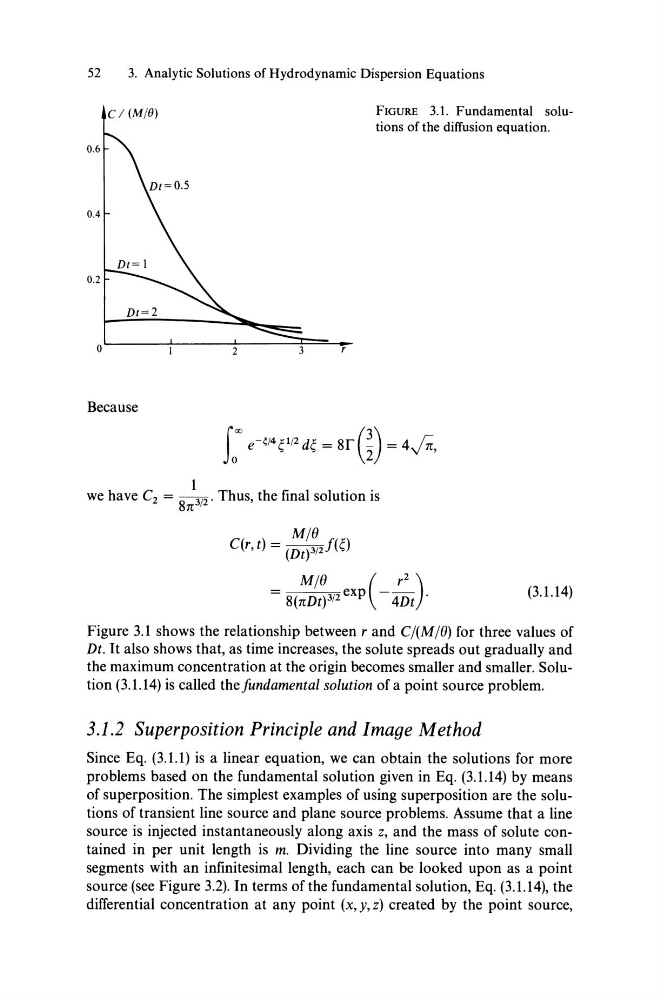
FIGURE 3.1. Fundamental solutions of the diffusion equation.
o
2
Because
we have C 2 = 1 3 / 2 , Thus, the final solution is
8n
M/ß
C(r, t) = (Dt)3/2f(~)
= 8(:r:t~3/2 exp ( - ;;J.
(3.1.14)
Figure 3.1 shows the relationship between rand C!(M/ß) for three values of
Dt. It also shows that, as time increases, the solute spreads out gradually and
the maximum concentration at the origin becomes sm aller and smaller. Solution (3.1.14) is called thefundamental solution of a point source problem.
3.1.2 Superposition Principle and Image M ethod
Since Eq. (3.1.1) is a linear equation, we can obtain the solutions for more
problems based on the fundamental solution given in Eq. (3.1.14) by means
of superposition. The simplest examples of using superposition are the solutions of transient line source and plane source problems. Assume that a li ne
source is injected instantaneously along axis z, and the mass of solute contained in per unit length is m. Dividing the line source into many sm all
segments with an infinitesimal length, each can be looked upon as a point
source (see Figure 3.2). In terms of the fundamental solution, Eq. (3.1.14), the
differential concentration at any point (x, y, z) created by the point source,
3. Analytic Solutions of Hydrodynamic Dispersion Equations
CI (M/fJ)
FIGURE 3.1. Fundamental solutions of the diffusion equation.
o
2
Because
we have C 2 = 1 3 / 2 , Thus, the final solution is
8n
M/ß
C(r, t) = (Dt)3/2f(~)
= 8(:r:t~3/2 exp ( - ;;J.
(3.1.14)
Figure 3.1 shows the relationship between rand C!(M/ß) for three values of
Dt. It also shows that, as time increases, the solute spreads out gradually and
the maximum concentration at the origin becomes sm aller and smaller. Solution (3.1.14) is called thefundamental solution of a point source problem.
3.1.2 Superposition Principle and Image M ethod
Since Eq. (3.1.1) is a linear equation, we can obtain the solutions for more
problems based on the fundamental solution given in Eq. (3.1.14) by means
of superposition. The simplest examples of using superposition are the solutions of transient line source and plane source problems. Assume that a li ne
source is injected instantaneously along axis z, and the mass of solute contained in per unit length is m. Dividing the line source into many sm all
segments with an infinitesimal length, each can be looked upon as a point
source (see Figure 3.2). In terms of the fundamental solution, Eq. (3.1.14), the
differential concentration at any point (x, y, z) created by the point source,