

3.1. Superposition of Fundamental Solutions
51
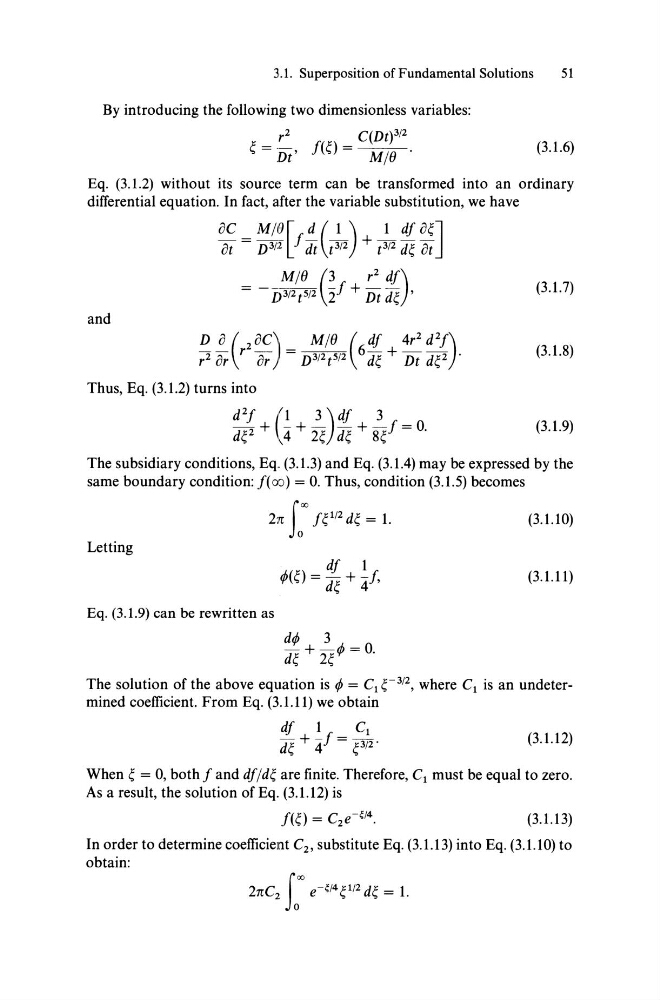
By introducing the following two dimensionless variables:
e = ~ f(e) = C(Dt)3/2.
Dt'
M/9
(3.1.6)
Eq. (3.1.2) without its source term can be transformed into an ordinary
differential equation. In fact, after the variable substitution, we have
OC M/9[ d( 1) 1 dfOe]
at = D 3 / 2 f dt t 3 / 2 + t 3 / 2 de ot
M/9 (3 r
2
df )
= - D3/2t5/2 2,f + Dt de '
(3.1. 7)
and
D 0 ( 20C)
M/9 (d f
4r 2 d 2f )
r 2 0r r Tr = D3/ 2 t5/ 2 6 de + Dt de 2 .
(3.1.8)
Thus, Eq. (3.1.2) turns into
d
2
f (1 3 )df 3
de 2 + 4 + 2e de + 8e f = o.
(3.1.9)
The subsidiary conditions, Eq. (3.1.3) and Eq. (3.1.4) may be expressed by the
same boundary condition: f( (0) = O. Thus, condition (3.1.5) becomes
2n t
oo
R l / 2 de = 1.
(3.1.10)
Letting
Eq. (3.1.9) can be rewritten as
df 1
~(e) = de + 4 f ,
d~
3
de + 2e~ = O.
(3.1.11)
The solution of the above equation is ~ = Cl e- 3 / 2 , where Cl is an undetermined coefficient. From Eq. (3.1.11) we obtain
(3.1.12)
When e = 0, both fand dflde are finite. Therefore, Cl must be equal to zero.
As a result, the solution of Eq. (3.1.12) is
f(e) = C2e-~/4.
(3.1.13)
In order to determine coefficient C 2 , substitute Eq. (3.1.13) into Eq. (3.1.10) to
obtain:
51
By introducing the following two dimensionless variables:
e = ~ f(e) = C(Dt)3/2.
Dt'
M/9
(3.1.6)
Eq. (3.1.2) without its source term can be transformed into an ordinary
differential equation. In fact, after the variable substitution, we have
OC M/9[ d( 1) 1 dfOe]
at = D 3 / 2 f dt t 3 / 2 + t 3 / 2 de ot
M/9 (3 r
2
df )
= - D3/2t5/2 2,f + Dt de '
(3.1. 7)
and
D 0 ( 20C)
M/9 (d f
4r 2 d 2f )
r 2 0r r Tr = D3/ 2 t5/ 2 6 de + Dt de 2 .
(3.1.8)
Thus, Eq. (3.1.2) turns into
d
2
f (1 3 )df 3
de 2 + 4 + 2e de + 8e f = o.
(3.1.9)
The subsidiary conditions, Eq. (3.1.3) and Eq. (3.1.4) may be expressed by the
same boundary condition: f( (0) = O. Thus, condition (3.1.5) becomes
2n t
oo
R l / 2 de = 1.
(3.1.10)
Letting
Eq. (3.1.9) can be rewritten as
df 1
~(e) = de + 4 f ,
d~
3
de + 2e~ = O.
(3.1.11)
The solution of the above equation is ~ = Cl e- 3 / 2 , where Cl is an undetermined coefficient. From Eq. (3.1.11) we obtain
(3.1.12)
When e = 0, both fand dflde are finite. Therefore, Cl must be equal to zero.
As a result, the solution of Eq. (3.1.12) is
f(e) = C2e-~/4.
(3.1.13)
In order to determine coefficient C 2 , substitute Eq. (3.1.13) into Eq. (3.1.10) to
obtain: