

284
8. Applications of Groundwater Quality Models
e3
e4
e29 e S
e7
e6
el
seepage pond
0 0 0 0 0 0
BCDEFGH
H o =87.8m
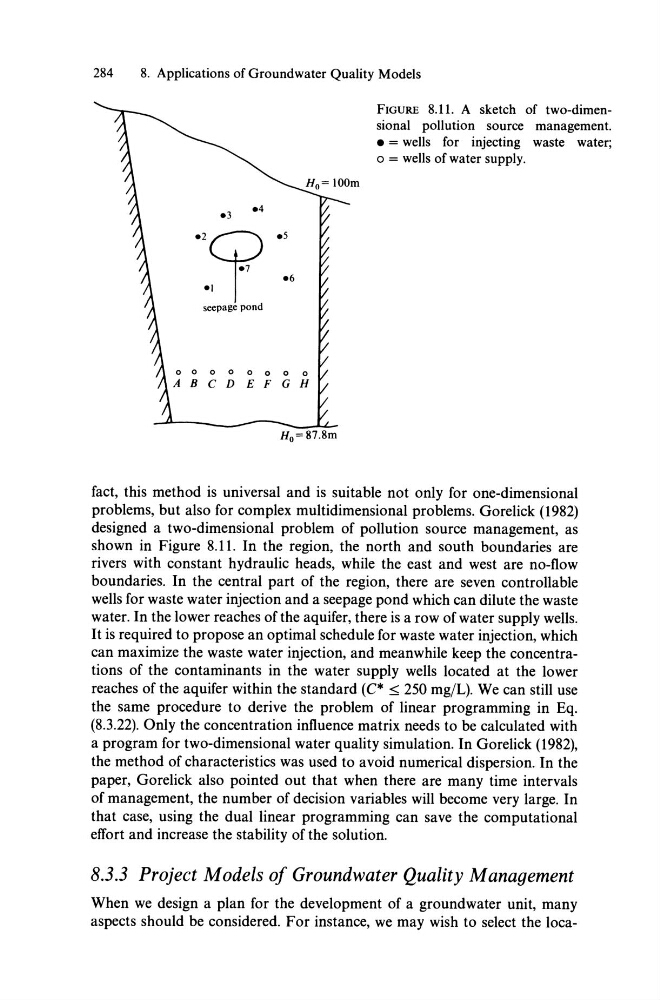
FIGURE 8.11. A sketch of two-dimensional pollution source management.
• = weHs for injecting waste water;
o = weHs of water supply.
fact, this method is universal and is suitable not only for one-dimensional
problems, but also for complex multidimensional problems. Gorelick (1982)
designed a two-dimensional problem of pollution source management, as
shown in Figure 8.11. In the region, the north and south boundaries are
rivers with constant hydraulic heads, while the east and west are no-flow
boundaries. In the central part of the region, there are seven controllable
wells for waste water injection and a see page pond wh ich can dilute the waste
water. In the lower reaches ofthe aquifer, there is a row of water supply wells.
It is required to propose an optimal schedule for waste water injection, which
can maximize the waste water injection, and meanwhile keep the concentrations of the contaminants in the water supply wells located at the lower
reaches of the aquifer within the standard (C* ~ 250 mgjL). We can still use
the same procedure to derive the problem of linear programming in Eq.
(8.3.22). Only the concentration influence matrix needs to be calculated with
a pro gram for two-dimensional water quality simulation. In Gorelick (1982),
the method of characteristics was used to avoid numerical dispersion. In the
paper, Gorelick also pointed out that when there are many time intervals
of management, the number of decision variables will become very large. In
that case, using the dual linear programming can save the computational
effort and increase the stability of the solution.
8.3.3 Project Models of Groundwater Quality Management
When we design a plan for the development of a groundwater unit, many
aspects should be considered. For instance, we may wish to select the loca-
8. Applications of Groundwater Quality Models
e3
e4
e29 e S
e7
e6
el
seepage pond
0 0 0 0 0 0
BCDEFGH
H o =87.8m
FIGURE 8.11. A sketch of two-dimensional pollution source management.
• = weHs for injecting waste water;
o = weHs of water supply.
fact, this method is universal and is suitable not only for one-dimensional
problems, but also for complex multidimensional problems. Gorelick (1982)
designed a two-dimensional problem of pollution source management, as
shown in Figure 8.11. In the region, the north and south boundaries are
rivers with constant hydraulic heads, while the east and west are no-flow
boundaries. In the central part of the region, there are seven controllable
wells for waste water injection and a see page pond wh ich can dilute the waste
water. In the lower reaches ofthe aquifer, there is a row of water supply wells.
It is required to propose an optimal schedule for waste water injection, which
can maximize the waste water injection, and meanwhile keep the concentrations of the contaminants in the water supply wells located at the lower
reaches of the aquifer within the standard (C* ~ 250 mgjL). We can still use
the same procedure to derive the problem of linear programming in Eq.
(8.3.22). Only the concentration influence matrix needs to be calculated with
a pro gram for two-dimensional water quality simulation. In Gorelick (1982),
the method of characteristics was used to avoid numerical dispersion. In the
paper, Gorelick also pointed out that when there are many time intervals
of management, the number of decision variables will become very large. In
that case, using the dual linear programming can save the computational
effort and increase the stability of the solution.
8.3.3 Project Models of Groundwater Quality Management
When we design a plan for the development of a groundwater unit, many
aspects should be considered. For instance, we may wish to select the loca-