

282
8. Applications of Groundwater Quality Models
centrations in the source ditches do not exceed the specified value at any
time. During the simulation, time step ßt = 10 day is taken, so there are
60 time steps in the total management period of 600 days. The concentrations
in the three source ditches at the 60 time steps are numbered as Cl' C 2 , ••• ,
CJ> J = 180, which is equal to the number of the source ditches times the
number of the time steps. These state variables depend on decision variables
ql' q2'· .. ' q/. The constraints stated above can be expressed as
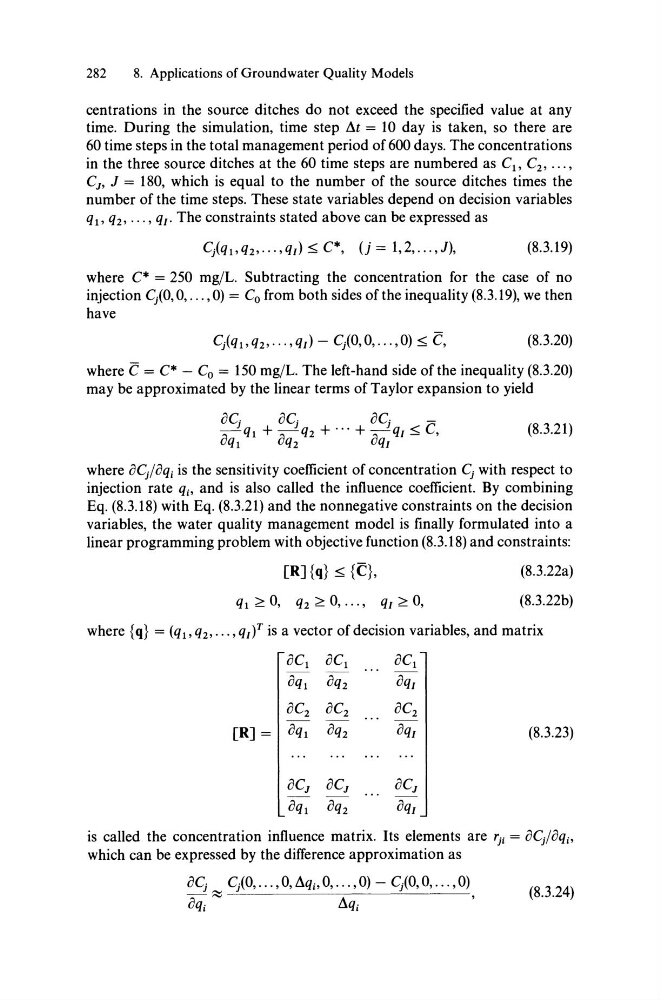
(8.3.19)
where C* = 250 mg/L. Subtracting the concentration for the case of no
injection Cj(O,O, ... , 0) = Co from both sides of the inequality (8.3.19), we then
have
(8.3.20)
where C = C* - Co = 150 mg/L. The left-hand side of the inequality (8.3.20)
may be approximated by the linear terms of Taylor expansion to yield
oe.
oe.
o e . -
-0 J ql + -0 J q2 + ... + -0 J q/:::;; C,
ql
q2
q/
(8.3.21)
where OCj/Oqi is the sensitivity coefficient of concentration Cj with respect to
injection rate qi' and is also called the influence coefficient. By combining
Eq. (8.3.18) with Eq. (8.3.21) and the nonnegative constraints on the decision
variables, the water quality management model is finally formulated into a
linear programming problem with objective function (8.3.18) and constraints:
[R] {q} :::;; {C},
(8.3.22a)
(8.3.22b)
where {q} = (ql,q2, ... ,q/f is a vector ofdecision variables, and matrix
oC l oC l
oC l
Oql Oq2
oq/
oC 2 oC2
oC 2
[R] = Oql Oq2
oq/
(8.3.23)
OC) oC}
oC}
Oql Oq2
oq/
is called the concentration influence matrix. Its elements are rji = OCj/Oqi'
which can be expressed by the difference approximation as
oCj '" Cj(O, ... , 0, ßqi' 0, ... ,0) - Cj(O, 0, ... ,0)
Oqi'"
ßqi
'
(8.3.24)
8. Applications of Groundwater Quality Models
centrations in the source ditches do not exceed the specified value at any
time. During the simulation, time step ßt = 10 day is taken, so there are
60 time steps in the total management period of 600 days. The concentrations
in the three source ditches at the 60 time steps are numbered as Cl' C 2 , ••• ,
CJ> J = 180, which is equal to the number of the source ditches times the
number of the time steps. These state variables depend on decision variables
ql' q2'· .. ' q/. The constraints stated above can be expressed as
(8.3.19)
where C* = 250 mg/L. Subtracting the concentration for the case of no
injection Cj(O,O, ... , 0) = Co from both sides of the inequality (8.3.19), we then
have
(8.3.20)
where C = C* - Co = 150 mg/L. The left-hand side of the inequality (8.3.20)
may be approximated by the linear terms of Taylor expansion to yield
oe.
oe.
o e . -
-0 J ql + -0 J q2 + ... + -0 J q/:::;; C,
ql
q2
q/
(8.3.21)
where OCj/Oqi is the sensitivity coefficient of concentration Cj with respect to
injection rate qi' and is also called the influence coefficient. By combining
Eq. (8.3.18) with Eq. (8.3.21) and the nonnegative constraints on the decision
variables, the water quality management model is finally formulated into a
linear programming problem with objective function (8.3.18) and constraints:
[R] {q} :::;; {C},
(8.3.22a)
(8.3.22b)
where {q} = (ql,q2, ... ,q/f is a vector ofdecision variables, and matrix
oC l oC l
oC l
Oql Oq2
oq/
oC 2 oC2
oC 2
[R] = Oql Oq2
oq/
(8.3.23)
OC) oC}
oC}
Oql Oq2
oq/
is called the concentration influence matrix. Its elements are rji = OCj/Oqi'
which can be expressed by the difference approximation as
oCj '" Cj(O, ... , 0, ßqi' 0, ... ,0) - Cj(O, 0, ... ,0)
Oqi'"
ßqi
'
(8.3.24)