

280
8. Applications of Groundwater Quality Models
and the objective function of Eq. (8.3.1) is then translated into
m
m m
Z = L cuP; + L L ci2aijp;~,
i=l
i=l j=l
(8.3.15)
which is a quadratic function of decision variables (P 1 , P 2 , ••• , Pm). The
management problem, which requires finding the minimum of Eq. (8.3.15)
with constraints Eqs. (8.3.12b) to (8.3. 12d), is a problem of quadratic
programming.
A simple example of hydraulic management can be found in Bear (1979).
Remson and Gorelick (1980) studied the optimal control problem ofhydraulic gradients. Haidari (1982) and Willis (1983) demonstrated some practical
applications ofthe influence matrix method. Willis and Finney (1985) considered the hydraulic management of phreatic aquifers and proposed a quasilinearization solution.
8.3.2 Management of Groundwater Pollution Soure es
The problem of groundwater quality management has been raised in recent
years. For instance, in many cases, aquifers are both the sewage disposal sites
and the water supply sources. How do we determine the time and quantity of
waste water injection to keep the sources up to the water quality criteria?
Also, in order to prevent the pollution of the sources, how do we assign the
water quality of recharged waste water and, at the same time, minimize the
cost of waste water treatment? To solve these problems we should combine
the management model with a prediction model of water quality, and consider them as a problem of mathematical programming.
Gorelick and Remson (1982) extended the influence matrix method to
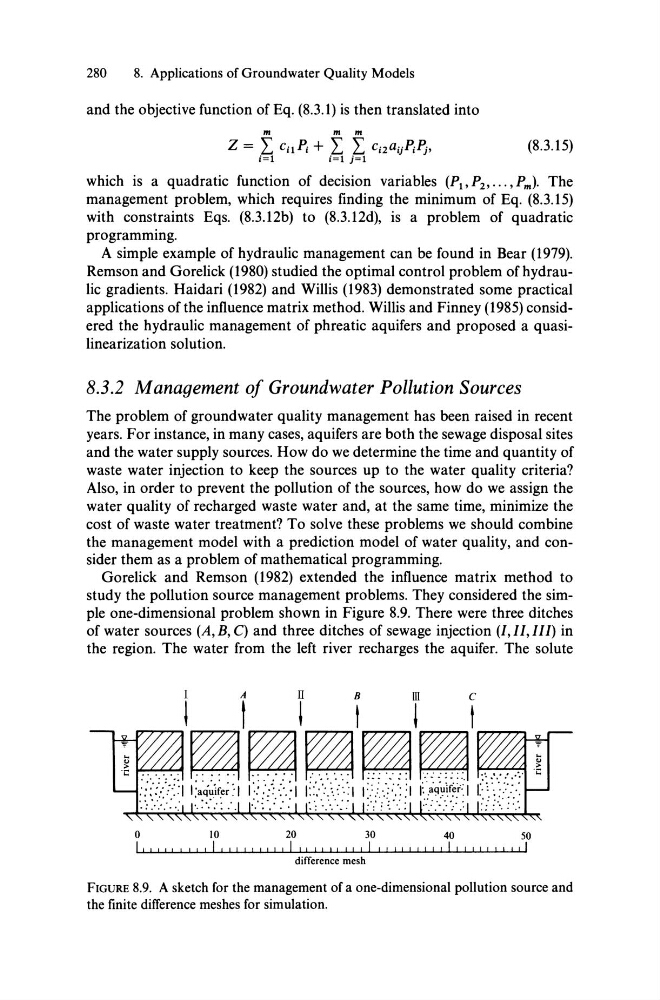
study the pollution source management problems. They considered the simple one-dimensional problem shown in Figure 8.9. There were three ditches
of water sources (A, B, C) and three ditches of sewage injection (1, H, IH) in
the region. The water from the left river recharges the aquifer. The solute
o
10
20
30
40
50
I , ! , " , , , , I , 11 , , ! I ! ! I I I ! I " ! ! , I , , I ! ! ! I ! ! I ! I I I ! ! I I I I
difTerence mesh
FIGURE 8.9. A sketch for the management of a one-dimensional pollution source and
the finite difference meshes for simulation.
8. Applications of Groundwater Quality Models
and the objective function of Eq. (8.3.1) is then translated into
m
m m
Z = L cuP; + L L ci2aijp;~,
i=l
i=l j=l
(8.3.15)
which is a quadratic function of decision variables (P 1 , P 2 , ••• , Pm). The
management problem, which requires finding the minimum of Eq. (8.3.15)
with constraints Eqs. (8.3.12b) to (8.3. 12d), is a problem of quadratic
programming.
A simple example of hydraulic management can be found in Bear (1979).
Remson and Gorelick (1980) studied the optimal control problem ofhydraulic gradients. Haidari (1982) and Willis (1983) demonstrated some practical
applications ofthe influence matrix method. Willis and Finney (1985) considered the hydraulic management of phreatic aquifers and proposed a quasilinearization solution.
8.3.2 Management of Groundwater Pollution Soure es
The problem of groundwater quality management has been raised in recent
years. For instance, in many cases, aquifers are both the sewage disposal sites
and the water supply sources. How do we determine the time and quantity of
waste water injection to keep the sources up to the water quality criteria?
Also, in order to prevent the pollution of the sources, how do we assign the
water quality of recharged waste water and, at the same time, minimize the
cost of waste water treatment? To solve these problems we should combine
the management model with a prediction model of water quality, and consider them as a problem of mathematical programming.
Gorelick and Remson (1982) extended the influence matrix method to
study the pollution source management problems. They considered the simple one-dimensional problem shown in Figure 8.9. There were three ditches
of water sources (A, B, C) and three ditches of sewage injection (1, H, IH) in
the region. The water from the left river recharges the aquifer. The solute
o
10
20
30
40
50
I , ! , " , , , , I , 11 , , ! I ! ! I I I ! I " ! ! , I , , I ! ! ! I ! ! I ! I I I ! ! I I I I
difTerence mesh
FIGURE 8.9. A sketch for the management of a one-dimensional pollution source and
the finite difference meshes for simulation.