

274
8. Applications of Groundwater Quality Models
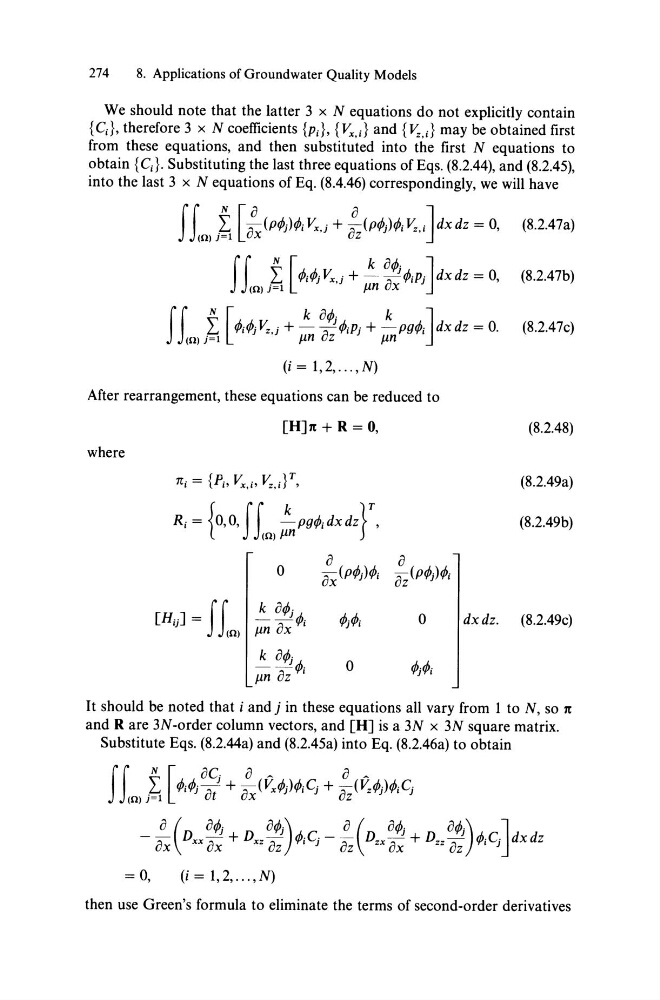
We should note that the latter 3 x N equations do not explicitly contain
{Cd, therefore 3 x N coefficients {pd, {Vx.d and {~.d may be obtained first
from these equations, and then substituted into the first N equations to
obtain {Ci}' Substituting the last three equations of Eqs. (8.2.44), and (8.2.45),
into the last 3 x N equations of Eq. (8.4.46) correspondingly, we will have
(i = 1,2, ... ,N)
After rearrangement, these equations can be reduced to
where
[H]1t + R = 0,
Ri = {o, 0, fi ~ pgf/Ji dx dZ}T,
(r!) Jm
o
° OX (Pf/Jj)f/Ji
[Hij] = f i
~ of/Jjf/J.
f/Jjf/Ji
(0)
Jin OX I
~ of/Jjf/J.
Jin oz I
°
°
f/JA
(8.2.47a)
(8.2.47b)
(8.2.47c)
(8.2.48)
(8.2.49a)
(8.2.49b)
dxdz.
(8.2.49c)
It should be noted that i and j in these equations all vary from 1 to N, so 1t
and Rare 3N -order column vectors, and [H] is a 3N x 3N square matrix.
Substitute Eqs. (8.2.44a) and (8.2.45a) into Eq. (8.2.46a) to obtain
-:x (Dxx ~~ + D xz ~~ )f/Ji Cj - :z (Dzx ~~ + D zz ~~ ) f/JiCj]dxdz
= 0,
(i = 1,2, ... ,N)
then use Green's formula to eliminate the terms of second-order derivatives
8. Applications of Groundwater Quality Models
We should note that the latter 3 x N equations do not explicitly contain
{Cd, therefore 3 x N coefficients {pd, {Vx.d and {~.d may be obtained first
from these equations, and then substituted into the first N equations to
obtain {Ci}' Substituting the last three equations of Eqs. (8.2.44), and (8.2.45),
into the last 3 x N equations of Eq. (8.4.46) correspondingly, we will have
(i = 1,2, ... ,N)
After rearrangement, these equations can be reduced to
where
[H]1t + R = 0,
Ri = {o, 0, fi ~ pgf/Ji dx dZ}T,
(r!) Jm
o
° OX (Pf/Jj)f/Ji
[Hij] = f i
~ of/Jjf/J.
f/Jjf/Ji
(0)
Jin OX I
~ of/Jjf/J.
Jin oz I
°
°
f/JA
(8.2.47a)
(8.2.47b)
(8.2.47c)
(8.2.48)
(8.2.49a)
(8.2.49b)
dxdz.
(8.2.49c)
It should be noted that i and j in these equations all vary from 1 to N, so 1t
and Rare 3N -order column vectors, and [H] is a 3N x 3N square matrix.
Substitute Eqs. (8.2.44a) and (8.2.45a) into Eq. (8.2.46a) to obtain
-:x (Dxx ~~ + D xz ~~ )f/Ji Cj - :z (Dzx ~~ + D zz ~~ ) f/JiCj]dxdz
= 0,
(i = 1,2, ... ,N)
then use Green's formula to eliminate the terms of second-order derivatives