

7.2. Model Calibration and Parameter Estimation
219
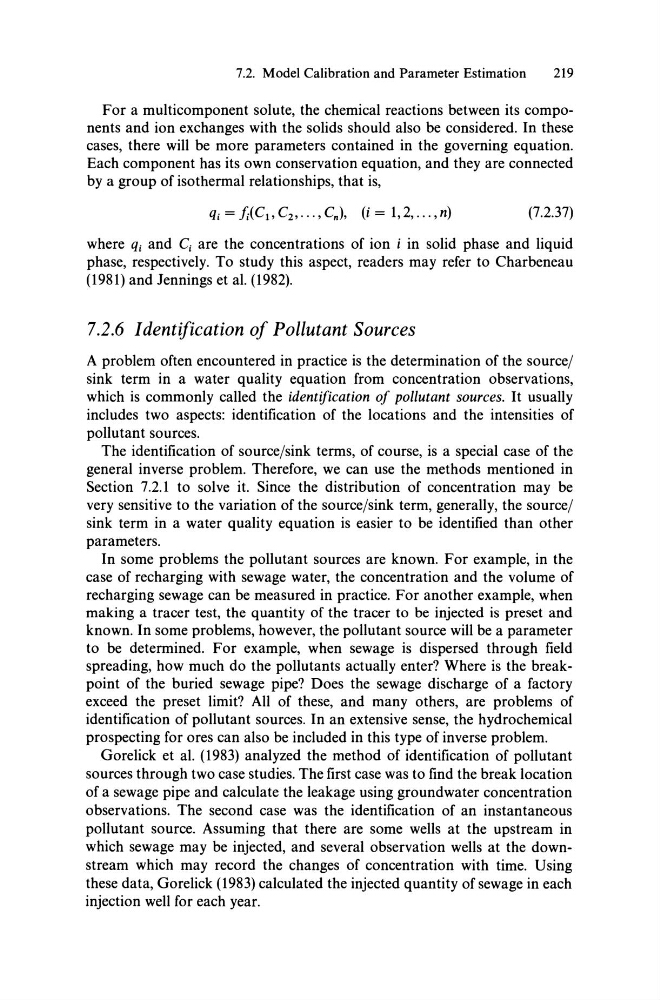
For a multicomponent solute, the chemical reactions between its components and ion exchanges with the solids should also be considered. In these
cases, there will be more parameters contained in the governing equation.
Each component has its own conservation equation, and they are connected
by a group of isotherm al relationships, that is,
(7.2.37)
where qi and Ci are the concentrations of ion i in solid phase and liquid
phase, respectively. To study this aspect, readers may refer to Charbeneau
(1981) and Jennings et al. (1982).
7.2.6 Identification of Pollutant Sources
A problem often encountered in practice is the determination of the sourcej
sink term in a water quality equation from concentration observations,
which is commonly called the identification of pollutant sourees. It usually
includes two aspects: identification of the locations and the intensities of
pollutant sources.
The identification of sourcejsink terms, of course, is a special case of the
general inverse problem. Therefore, we can use the methods mentioned in
Section 7.2.1 to solve it. Since the distribution of concentration may be
very sensitive to the variation of the sourcejsink term, gene rally, the sourcej
sink term in a water quality equation is easier to be identified than other
parameters.
In some problems the pollutant sources are known. For example, in the
case of recharging with sewage water, the concentration and the volume of
recharging sewage can be measured in practice. For another example, when
making a tracer test, the quantity of the tracer to be injected is preset and
known. In some problems, however, the pollutant source will be a parameter
to be determined. For example, when sewage is dispersed through field
spreading, how much do the pollutants actually enter? Where is the breakpoint of the buried sewage pipe? Does the sewage discharge of a factory
exceed the preset limit? All of these, and many others, are problems of
identification of pollutant sources. In an extensive sense, the hydrochemical
prospecting for ores can also be included in this type of inverse problem.
Gorelick et al. (1983) analyzed the method of identification of pollutant
sources through two case studies. The first case was to find the break location
of asewage pipe and calculate the leakage using groundwater concentration
observations. The second case was the identification of an instantaneous
pollutant source. Assuming that there are some wells at the upstream in
which sewage may be injected, and several observation wells at the downstream which may record the changes of concentration with time. Using
these data, Gorelick (1983) calculated the injected quantity of sewage in each
injection weIl for each year.
219
For a multicomponent solute, the chemical reactions between its components and ion exchanges with the solids should also be considered. In these
cases, there will be more parameters contained in the governing equation.
Each component has its own conservation equation, and they are connected
by a group of isotherm al relationships, that is,
(7.2.37)
where qi and Ci are the concentrations of ion i in solid phase and liquid
phase, respectively. To study this aspect, readers may refer to Charbeneau
(1981) and Jennings et al. (1982).
7.2.6 Identification of Pollutant Sources
A problem often encountered in practice is the determination of the sourcej
sink term in a water quality equation from concentration observations,
which is commonly called the identification of pollutant sourees. It usually
includes two aspects: identification of the locations and the intensities of
pollutant sources.
The identification of sourcejsink terms, of course, is a special case of the
general inverse problem. Therefore, we can use the methods mentioned in
Section 7.2.1 to solve it. Since the distribution of concentration may be
very sensitive to the variation of the sourcejsink term, gene rally, the sourcej
sink term in a water quality equation is easier to be identified than other
parameters.
In some problems the pollutant sources are known. For example, in the
case of recharging with sewage water, the concentration and the volume of
recharging sewage can be measured in practice. For another example, when
making a tracer test, the quantity of the tracer to be injected is preset and
known. In some problems, however, the pollutant source will be a parameter
to be determined. For example, when sewage is dispersed through field
spreading, how much do the pollutants actually enter? Where is the breakpoint of the buried sewage pipe? Does the sewage discharge of a factory
exceed the preset limit? All of these, and many others, are problems of
identification of pollutant sources. In an extensive sense, the hydrochemical
prospecting for ores can also be included in this type of inverse problem.
Gorelick et al. (1983) analyzed the method of identification of pollutant
sources through two case studies. The first case was to find the break location
of asewage pipe and calculate the leakage using groundwater concentration
observations. The second case was the identification of an instantaneous
pollutant source. Assuming that there are some wells at the upstream in
which sewage may be injected, and several observation wells at the downstream which may record the changes of concentration with time. Using
these data, Gorelick (1983) calculated the injected quantity of sewage in each
injection weIl for each year.