

218
7. Mathematical Models of Groundwater Quality
and steady values of the flow velocity. The velocity distribution of the wh oie
region can only be obtained through calibration of either a flow model or a
coupled flow and quality model.
7.2.5 Identification of Retardation Factor and Chemical
Reaction Parameters
When the actions of adsorption, ion exchange and chemical reaction are
included into a water quality model, some other undetermined parameters
may appear in the model.
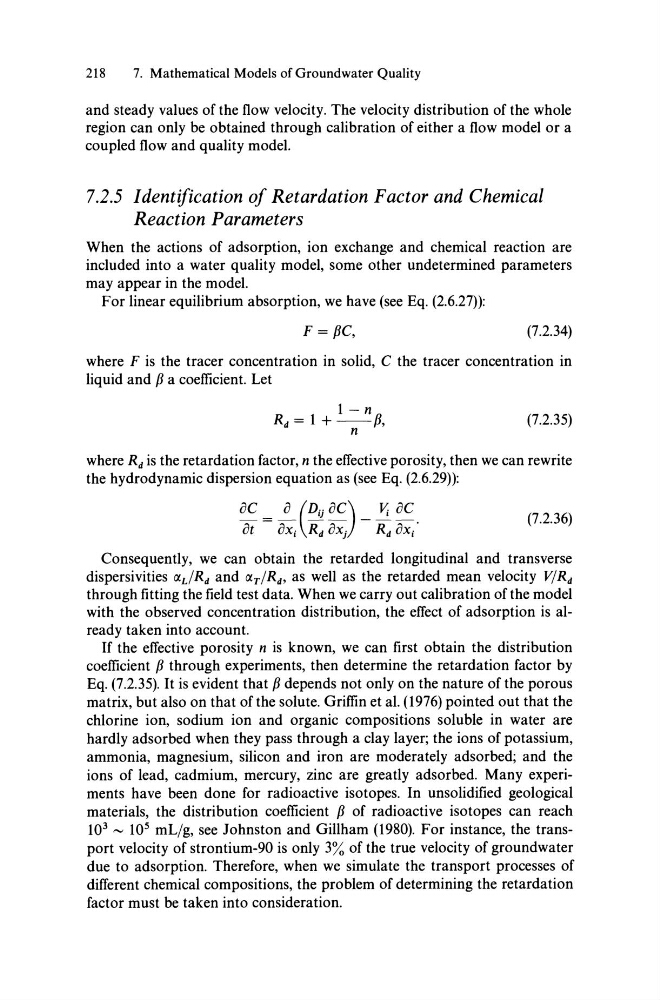
For linear equilibrium absorption, we have (see Eq. (2.6.27)):
F=ßC,
(7.2.34)
where F is the tracer concentration in solid, C the tracer concentration in
liquid and ß a coefficient. Let
1 - n
Rd = 1 +--ß,
n
(7.2.35)
where R d is the retardation factor, n the effective porosity, then we can rewrite
the hydrodynamic dispersion equation as (see Eq. (2.6.29)):
OC
0 (Dij OC)
l'i oC
Tl = oX i R d oX j - R d ox i '
(7.2.36)
Consequently, we can obtain the retarded longitudinal and trans verse
dispersivities adRd and aT/Rd , as weIl as the retarded me an velocity V/Rd
through fitting the field test data. When we carry out calibration of the model
with the observed concentration distribution, the effect of adsorption is already taken into account.
If the effective porosity n is known, we can first obtain the distribution
coefficient ß through experiments, then determine the retardation factor by
Eq. (7.2.35). It is evident that ß depends not only on the nature of the porous
matrix, but also on that ofthe solute. Griffin et al. (1976) pointed out that the
chlorine ion, sodium ion and organic compositions soluble in water are
hardly adsorbed when they pass through a clay layer; the ions of potassium,
ammonia, magnesium, silicon and iron are moderately adsorbed; and the
ions of lead, cadmium, mercury, zinc are greatly adsorbed. Many experiments have been done for radioactive isotopes. In unsolidified geological
materials, the distribution coefficient ß of radioactive isotopes can reach
10 3 '" 10 5 mL/g, see lohnston and Gillham (1980). For instance, the transport velocity of strontium-90 is only 3% of the true velocity of groundwater
due to adsorption. Therefore, when we simulate the transport processes of
different chemical compositions, the problem of determining the retardation
factor must be taken into consideration.
7. Mathematical Models of Groundwater Quality
and steady values of the flow velocity. The velocity distribution of the wh oie
region can only be obtained through calibration of either a flow model or a
coupled flow and quality model.
7.2.5 Identification of Retardation Factor and Chemical
Reaction Parameters
When the actions of adsorption, ion exchange and chemical reaction are
included into a water quality model, some other undetermined parameters
may appear in the model.
For linear equilibrium absorption, we have (see Eq. (2.6.27)):
F=ßC,
(7.2.34)
where F is the tracer concentration in solid, C the tracer concentration in
liquid and ß a coefficient. Let
1 - n
Rd = 1 +--ß,
n
(7.2.35)
where R d is the retardation factor, n the effective porosity, then we can rewrite
the hydrodynamic dispersion equation as (see Eq. (2.6.29)):
OC
0 (Dij OC)
l'i oC
Tl = oX i R d oX j - R d ox i '
(7.2.36)
Consequently, we can obtain the retarded longitudinal and trans verse
dispersivities adRd and aT/Rd , as weIl as the retarded me an velocity V/Rd
through fitting the field test data. When we carry out calibration of the model
with the observed concentration distribution, the effect of adsorption is already taken into account.
If the effective porosity n is known, we can first obtain the distribution
coefficient ß through experiments, then determine the retardation factor by
Eq. (7.2.35). It is evident that ß depends not only on the nature of the porous
matrix, but also on that ofthe solute. Griffin et al. (1976) pointed out that the
chlorine ion, sodium ion and organic compositions soluble in water are
hardly adsorbed when they pass through a clay layer; the ions of potassium,
ammonia, magnesium, silicon and iron are moderately adsorbed; and the
ions of lead, cadmium, mercury, zinc are greatly adsorbed. Many experiments have been done for radioactive isotopes. In unsolidified geological
materials, the distribution coefficient ß of radioactive isotopes can reach
10 3 '" 10 5 mL/g, see lohnston and Gillham (1980). For instance, the transport velocity of strontium-90 is only 3% of the true velocity of groundwater
due to adsorption. Therefore, when we simulate the transport processes of
different chemical compositions, the problem of determining the retardation
factor must be taken into consideration.