

208
7. Mathematical Models of Groundwater Quality
dual-weIl extraction-injection test, two wells are drilled about 10 meters
apart. Water is pumped from one weIl and injected into the other at the
same rate, so as to form a steady flow field. Mter steady state conditions are
achieved, a tracer is added into the injection weIl, either continuously or in a
pulse. If the aquifer is infinite, homogeneous and isotropic, the effect of the
natural flow velocity near the weIl can be neglected, then it is easy to formulate a mathematical model for this system. The velocity distribution is the
superposition of two radial flow velocity fields genera ted by a source and a
sink, respectively.
By sampling from the extraction weIl, we can obtain a curve of the tracer
concentration versus time. Modifying the longitudinal dispersivity, IXL' so
that the model output agrees with the observed curve, we then have the value
of IXL.lfthere are observation wells outside the line between the two weIls, we
can also obtain the transverse dispersivity IXT by fitting the observed concentrations in the observation wells.
Hoopes and Harleman (1967) gave an analytical expression for the tracer
concentration distribution in a dual-weIl test in an integral form, and pointed
out that the dispersion in the extraction weIl mainly shows in the early period
of pumping when the relative concentration is rather low. Grove (1971)
provided a program for calculating the dispersivity based on the interpretation of a dual-weH test. Pickens and Grisak (1981) presented areport of their
dual-weH tests including the testing conditions, types oftracers, facilities used
and the interpretation of their results.
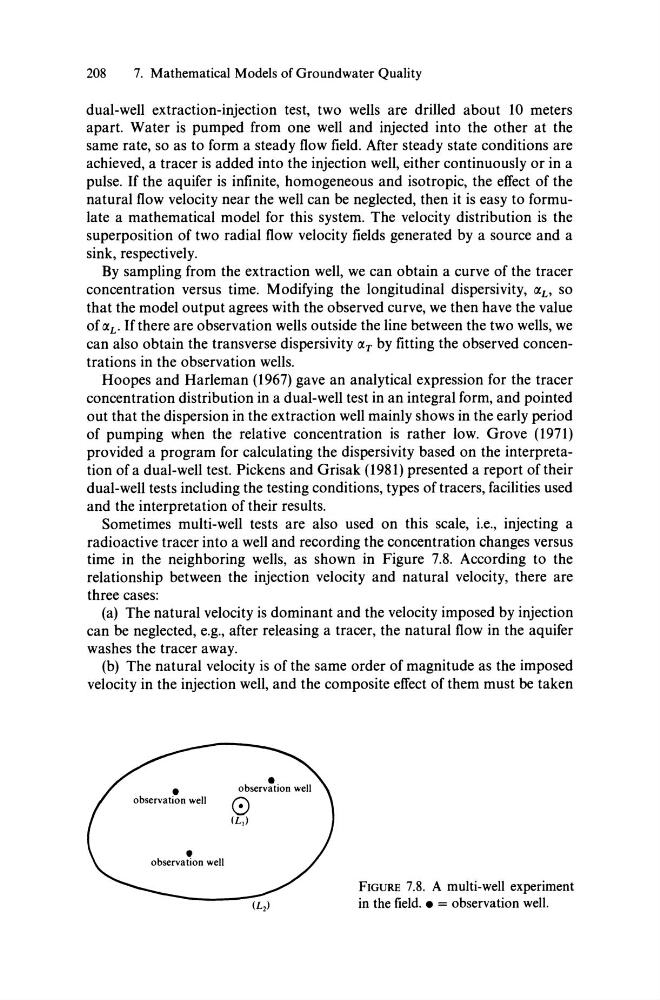
Sometimes multi-weIl tests are also used on this scale, i.e., injecting a
radioactive tracer into a weH and recording the concentration changes versus
time in the neighboring weHs, as shown in Figure 7.8. According to the
relationship between the injection velocity and natural velocity, there are
three ca ses:
(a) The natural velocity is dominant and the velocity imposed by injection
can be neglected, e.g., after releasing a tracer, the natural flow in the aquifer
washes the tracer away.
(b) The natural velocity is of the same order of magnitude as the imposed
velocity in the injection weH, and the composite effect of them must be taken
•
observation weil
•
observation weil
<:)
(L,)
FIGURE 7.8. A multi-weil experiment
in the field .• = observation weil.
7. Mathematical Models of Groundwater Quality
dual-weIl extraction-injection test, two wells are drilled about 10 meters
apart. Water is pumped from one weIl and injected into the other at the
same rate, so as to form a steady flow field. Mter steady state conditions are
achieved, a tracer is added into the injection weIl, either continuously or in a
pulse. If the aquifer is infinite, homogeneous and isotropic, the effect of the
natural flow velocity near the weIl can be neglected, then it is easy to formulate a mathematical model for this system. The velocity distribution is the
superposition of two radial flow velocity fields genera ted by a source and a
sink, respectively.
By sampling from the extraction weIl, we can obtain a curve of the tracer
concentration versus time. Modifying the longitudinal dispersivity, IXL' so
that the model output agrees with the observed curve, we then have the value
of IXL.lfthere are observation wells outside the line between the two weIls, we
can also obtain the transverse dispersivity IXT by fitting the observed concentrations in the observation wells.
Hoopes and Harleman (1967) gave an analytical expression for the tracer
concentration distribution in a dual-weIl test in an integral form, and pointed
out that the dispersion in the extraction weIl mainly shows in the early period
of pumping when the relative concentration is rather low. Grove (1971)
provided a program for calculating the dispersivity based on the interpretation of a dual-weH test. Pickens and Grisak (1981) presented areport of their
dual-weH tests including the testing conditions, types oftracers, facilities used
and the interpretation of their results.
Sometimes multi-weIl tests are also used on this scale, i.e., injecting a
radioactive tracer into a weH and recording the concentration changes versus
time in the neighboring weHs, as shown in Figure 7.8. According to the
relationship between the injection velocity and natural velocity, there are
three ca ses:
(a) The natural velocity is dominant and the velocity imposed by injection
can be neglected, e.g., after releasing a tracer, the natural flow in the aquifer
washes the tracer away.
(b) The natural velocity is of the same order of magnitude as the imposed
velocity in the injection weH, and the composite effect of them must be taken
•
observation weil
•
observation weil
<:)
(L,)
FIGURE 7.8. A multi-weil experiment
in the field .• = observation weil.