

198
7. Mathematical Models of Groundwater Quality
P.C
h.C
and
~ Q.c
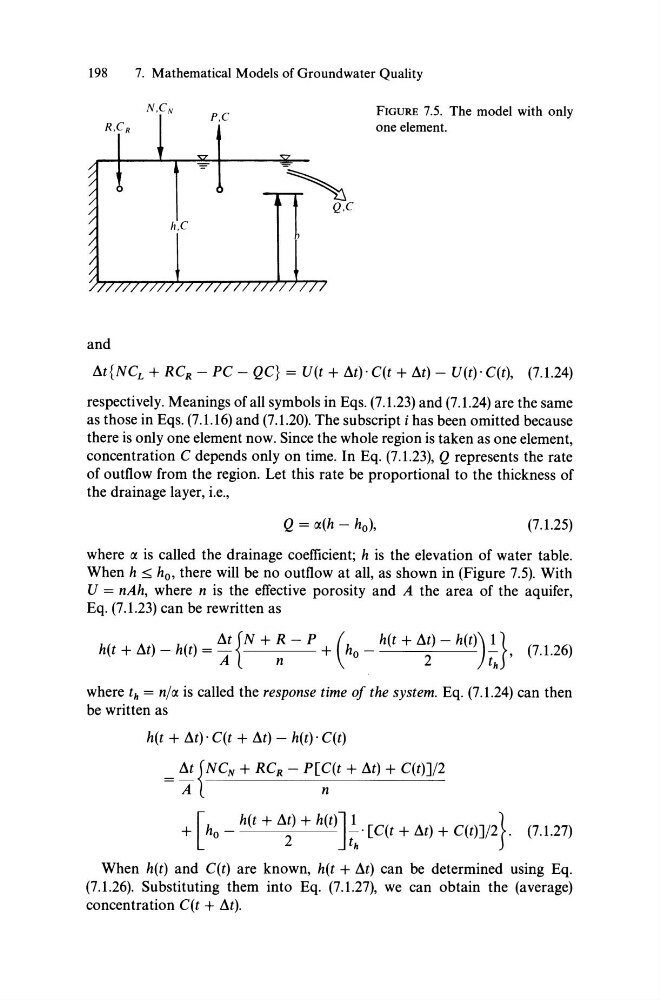
FIGURE 7.5. The model with only
one element.
M{NCL + RCR - PC - Qe} = U(t + M)'C(t + M) - U(t)·C(t), (7.1.24)
respectively. Meanings of all symbols in Eqs. (7.1.23) and (7.1.24) are the same
as those in Eqs. (7.1.16) and (7.1.20). The subscript i has been omitted because
there is only one element now. Since the whole region is taken as one element,
concentration C depends only on time. In Eq. (7.1.23), Q represents the rate
of outflow from the region. Let this rate be proportional to the thickness of
the drainage layer, i.e.,
(7.1.25)
where C( is called the drainage coefficient; h is the elevation of water table.
When h :::::; h o , there will be no outflow at all, as shown in (Figure 7.5) . . With
U = nAh, where n is the effective porosity and A the area of the aquifer,
Eq. (7.1.23) can be rewritten as
h(t + M) _ h(t) = ~ {N + : - P + (ho _ h(t + L1~) - h(t))~}, (7.1.26)
where t h = n/C( is called the response time of the system. Eq. (7.1.24) can then
be written as
h(t + M)' C(t + L1t) - h(t)· C(t)
= M {NCN + RCR - P[C(t + M) + C(t)]/2
A
n
+ [ho - h(t + L1~) + h(t)J~.[C(t + L1t) + C(t)]/2}. (7.1.27)
When h(t) and C(t) are known, h(t + M) can be determined using Eq.
(7.1.26). Substituting them into Eq. (7.1.27), we can obtain the (average)
concentration C(t + M).
7. Mathematical Models of Groundwater Quality
P.C
h.C
and
~ Q.c
FIGURE 7.5. The model with only
one element.
M{NCL + RCR - PC - Qe} = U(t + M)'C(t + M) - U(t)·C(t), (7.1.24)
respectively. Meanings of all symbols in Eqs. (7.1.23) and (7.1.24) are the same
as those in Eqs. (7.1.16) and (7.1.20). The subscript i has been omitted because
there is only one element now. Since the whole region is taken as one element,
concentration C depends only on time. In Eq. (7.1.23), Q represents the rate
of outflow from the region. Let this rate be proportional to the thickness of
the drainage layer, i.e.,
(7.1.25)
where C( is called the drainage coefficient; h is the elevation of water table.
When h :::::; h o , there will be no outflow at all, as shown in (Figure 7.5) . . With
U = nAh, where n is the effective porosity and A the area of the aquifer,
Eq. (7.1.23) can be rewritten as
h(t + M) _ h(t) = ~ {N + : - P + (ho _ h(t + L1~) - h(t))~}, (7.1.26)
where t h = n/C( is called the response time of the system. Eq. (7.1.24) can then
be written as
h(t + M)' C(t + L1t) - h(t)· C(t)
= M {NCN + RCR - P[C(t + M) + C(t)]/2
A
n
+ [ho - h(t + L1~) + h(t)J~.[C(t + L1t) + C(t)]/2}. (7.1.27)
When h(t) and C(t) are known, h(t + M) can be determined using Eq.
(7.1.26). Substituting them into Eq. (7.1.27), we can obtain the (average)
concentration C(t + M).