

192
7. Mathematical Models of Groundwater Quality
Two-Dimensional Dispersion in a Two-Dimensional Horizontal Flow Field
The flow equation:
S oh = ~ (Km Oh) + ~ (Km Oh) + W';
ot OX
OX
oy
oy
(7.1.10)
the dispersion equation:
o(mC)
0 [ (
oC
oC
)]
~ = OX m Dxx OX + Dxy oy - Cv.,
+ :y[ m(Dxy ~~ + Dyy ~~ - cv,)] + 1', (7.1.11)
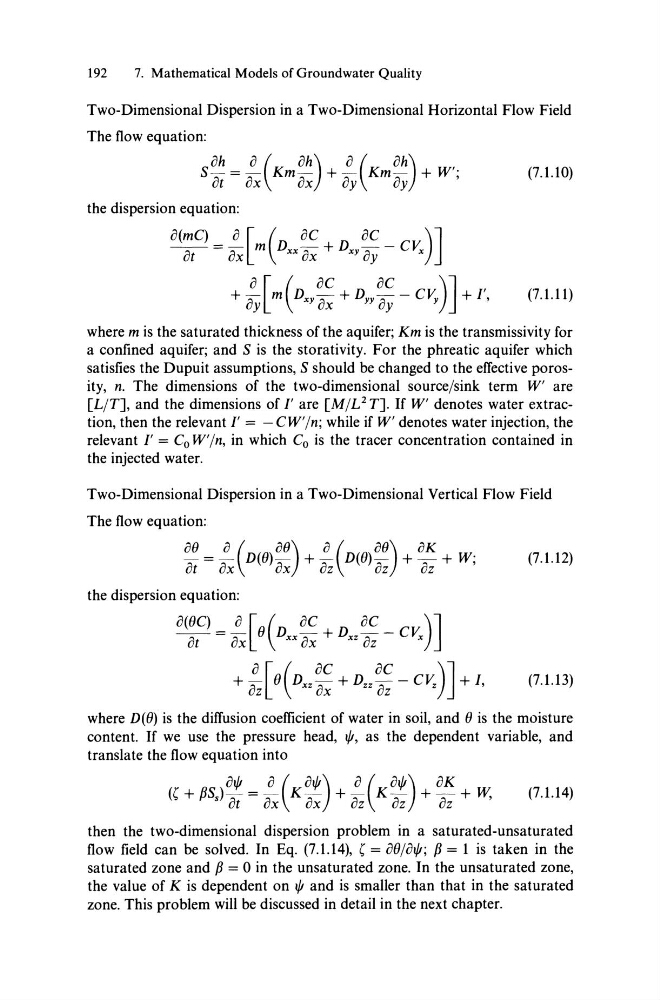
where m is the saturated thickness of the aquifer; Km is the transmissivity for
a confined aquifer; and S is the storativity. For the phreatic aquifer which
satisfies the Dupuit assumptions, S should be changed to the effective porosity, n. The dimensions of the two-dimensional sourcejsink term W' are
[LjT], and the dimensions of l' are [MjL 2 T]. If W' denotes water extraction, then the relevant l' = - CW' jn; while if W' denotes water injection, the
relevant l' = Co W' jn, in wh ich Co is the tracer concentration contained in
the injected water.
Two-Dimensional Dispersion in a Two-Dimensional Vertical Flow Field
The flow equation:
00
0 (
00)
0 (
00) oK
ot = ox D(O) OX + oz D(O) oz + Tz + W;
(7.1.12)
the dispersion equation:
o(OC)
0 [ ( oC
oC
)]
-----at = ox 0 Dxx OX + Dxz oz - CVx
+ :z[O(Dxz ~~ + Dzz ~~ - C~)] + I, (7.1.13)
where D(O) is the diffusion coefficient of water in soil, and 0 is the moisture
content. If we use the pressure head, I/!, as the dependent variable, and
translate the flow equation into
(7.1.14)
then the two-dimensional dispersion problem in a saturated-unsaturated
flow field can be solved. In Eq. (7.1.14), , = oOjol/!; ß = 1 is taken in the
saturated zone and ß = 0 in the unsaturated zone. In the unsaturated zone,
the value of K is dependent on I/! and is smaller than that in the saturated
zone. This problem will be discussed in detail in the next chapter.
7. Mathematical Models of Groundwater Quality
Two-Dimensional Dispersion in a Two-Dimensional Horizontal Flow Field
The flow equation:
S oh = ~ (Km Oh) + ~ (Km Oh) + W';
ot OX
OX
oy
oy
(7.1.10)
the dispersion equation:
o(mC)
0 [ (
oC
oC
)]
~ = OX m Dxx OX + Dxy oy - Cv.,
+ :y[ m(Dxy ~~ + Dyy ~~ - cv,)] + 1', (7.1.11)
where m is the saturated thickness of the aquifer; Km is the transmissivity for
a confined aquifer; and S is the storativity. For the phreatic aquifer which
satisfies the Dupuit assumptions, S should be changed to the effective porosity, n. The dimensions of the two-dimensional sourcejsink term W' are
[LjT], and the dimensions of l' are [MjL 2 T]. If W' denotes water extraction, then the relevant l' = - CW' jn; while if W' denotes water injection, the
relevant l' = Co W' jn, in wh ich Co is the tracer concentration contained in
the injected water.
Two-Dimensional Dispersion in a Two-Dimensional Vertical Flow Field
The flow equation:
00
0 (
00)
0 (
00) oK
ot = ox D(O) OX + oz D(O) oz + Tz + W;
(7.1.12)
the dispersion equation:
o(OC)
0 [ ( oC
oC
)]
-----at = ox 0 Dxx OX + Dxz oz - CVx
+ :z[O(Dxz ~~ + Dzz ~~ - C~)] + I, (7.1.13)
where D(O) is the diffusion coefficient of water in soil, and 0 is the moisture
content. If we use the pressure head, I/!, as the dependent variable, and
translate the flow equation into
(7.1.14)
then the two-dimensional dispersion problem in a saturated-unsaturated
flow field can be solved. In Eq. (7.1.14), , = oOjol/!; ß = 1 is taken in the
saturated zone and ß = 0 in the unsaturated zone. In the unsaturated zone,
the value of K is dependent on I/! and is smaller than that in the saturated
zone. This problem will be discussed in detail in the next chapter.