

7.1. The Classification ofGroundwater Quality Models
191
7.1.2 Coupled Equations of Groundwater Flow and
M ass Transport
In both the tracer and general cases, the advection-dispersion equation is
coupled with the flow equation through the continuity and kinetic equations.
In this section, we will give some specific forms of these equations which are
often encountered in groundwater pollution problems.
When studying the groundwater flow in a saturated zone, we always use
the water head, h = z + p/pg, as adependent variable. For an isotropic
porous medium, the kinetic equation (7.1.3), i.e., Darcy's law, can be expressed as:
K ah
V; = - - - , (i = 1,2,3),
n aXj
(7.1.6)
where K = kpg/Jl. is the hydraulic conductivity of the isotropic porous medium. It depends on the density and viscosity of the fluid, as weIl as, the
permeability, k, of the porous medium. For a homogeneous fluid, the partial
differential equation of groundwater flow can be obtained by combining
Darcy's law and the continuity equation:
ah
S. at = div(K grad h) + W,
(7.1.7)
where S. is the specific storativity, and W is the source/sink term. In this case,
a model may be constructed by coupling the advection-dispersion equation
(7.1.1) with the flow equation (7.1.7) by the aid of Darcy's law, rather than
using the general system of hydrodynamic dispersion Eqs. (7.1.1) to (7.1.4).
Several common combinations are listed below. All equations are written in
scalar forms in the Cartesian coordinates.
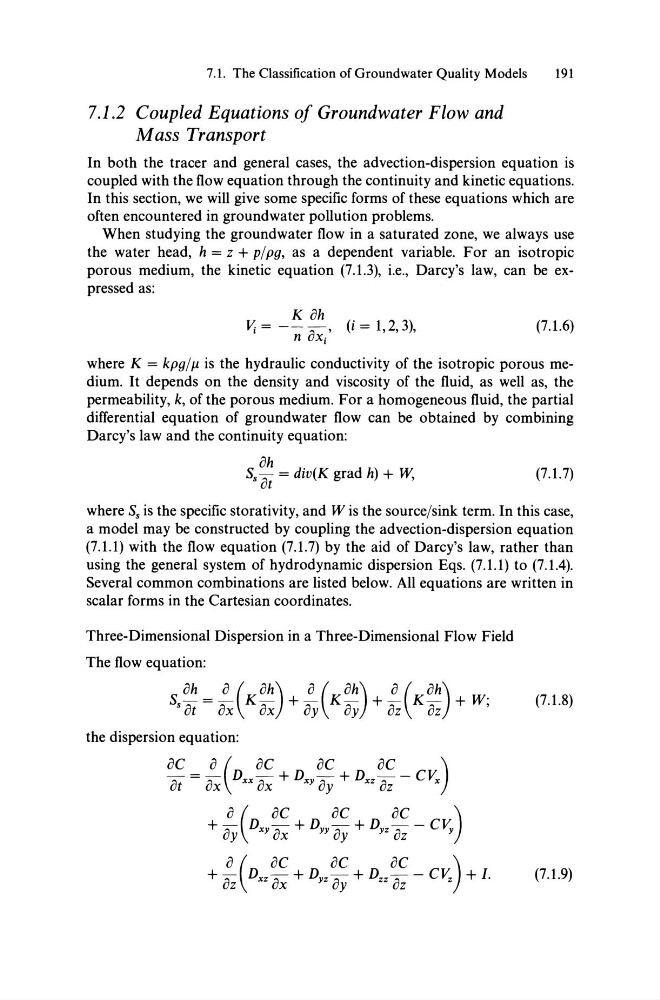
Three-Dimensional Dispersion in a Three-Dimensional Flow Field
The flow equation:
(7.1.8)
(7.1.9)
191
7.1.2 Coupled Equations of Groundwater Flow and
M ass Transport
In both the tracer and general cases, the advection-dispersion equation is
coupled with the flow equation through the continuity and kinetic equations.
In this section, we will give some specific forms of these equations which are
often encountered in groundwater pollution problems.
When studying the groundwater flow in a saturated zone, we always use
the water head, h = z + p/pg, as adependent variable. For an isotropic
porous medium, the kinetic equation (7.1.3), i.e., Darcy's law, can be expressed as:
K ah
V; = - - - , (i = 1,2,3),
n aXj
(7.1.6)
where K = kpg/Jl. is the hydraulic conductivity of the isotropic porous medium. It depends on the density and viscosity of the fluid, as weIl as, the
permeability, k, of the porous medium. For a homogeneous fluid, the partial
differential equation of groundwater flow can be obtained by combining
Darcy's law and the continuity equation:
ah
S. at = div(K grad h) + W,
(7.1.7)
where S. is the specific storativity, and W is the source/sink term. In this case,
a model may be constructed by coupling the advection-dispersion equation
(7.1.1) with the flow equation (7.1.7) by the aid of Darcy's law, rather than
using the general system of hydrodynamic dispersion Eqs. (7.1.1) to (7.1.4).
Several common combinations are listed below. All equations are written in
scalar forms in the Cartesian coordinates.
Three-Dimensional Dispersion in a Three-Dimensional Flow Field
The flow equation:
(7.1.8)
(7.1.9)