

164
6. Numerical Solutions of Advection-Dominated Problems
k
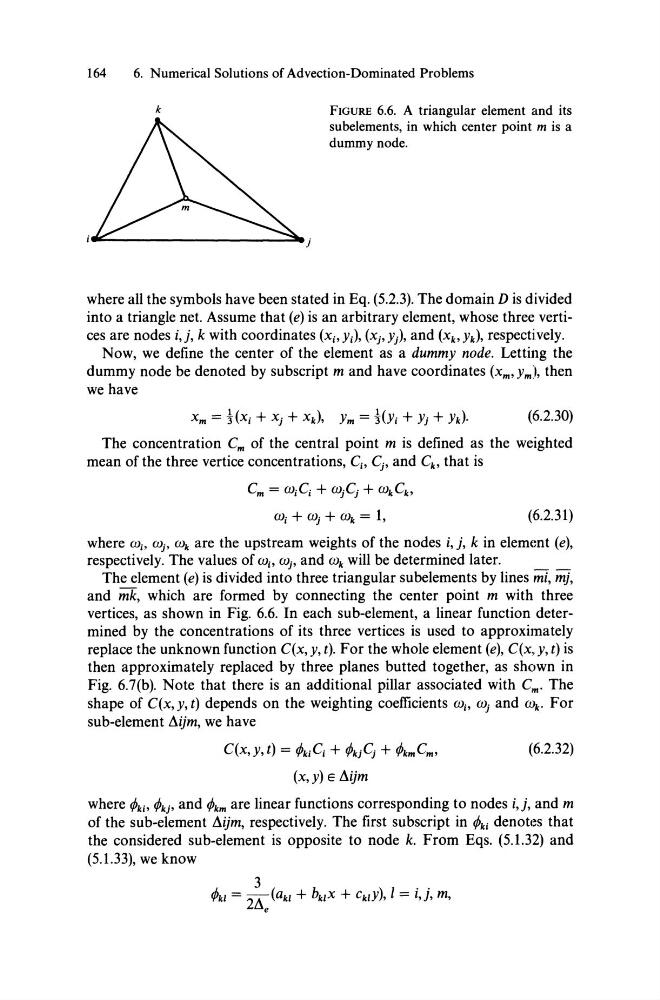
FIGURE 6.6. A triangular element and its
subelements, in which center point m is a
dummy node.
~--------------------~j
where all the symbols have been stated in Eq. (5.2.3). The domain D is divided
into a triangle net. Assume that (e) is an arbitrary element, whose three vertices are nodes i,j, k with coordinates (Xj'Yj), (Xj'Yj)' and (Xk'Yk), respectively.
Now, we define the center of the element as a dummy node. Letting the
dummy node be denoted by subscrlpt m and have coordinates (xm, Ym)' then
we have
Xm = t(Xj + Xj + Xk), Ym = t(Yj + Yj + Yk)'
(6.2.30)
The concentration C m of the central point m is defined as the weighted
mean of the three vertice concentrations, Ci> Cj' and Ck' that is
Cm = WiCi + WjCj + co,.Ck,
(6.2.31)
where W i , w j , w,. are the upstream weights of the nodes i, j, k in element (e),
respectively. The values of Wj, wj , and co,. will be determined later.
The element (e) is divided into three triangular subelements by lines mi, mj,
and mk, which are formed by connecting the center point m with three
vertices, as shown in Fig. 6.6. In each sub-element, a linear function determined by the concentrations of its three vertices is used to approximately
replace the unknown function C(x, y, t). For the whole element (e), C(x" y, t) is
then approximately replaced by three planes butted together, as shown in
Fig. 6.7(b). Note that there is an additional pillar associated with C m • The
shape of C(x, y, t) depends on the weighting coefficients Wj, wj and co,.. For
sub-element ßijm, we have
C(X, y, t) = ~jCj + rPkjCj + rPkm Cm,
(6.2.32)
(x,y) E ßijm
where rPkj, ~j' and ~m are linear functions corresponding to nodes i, j, and m
of the sub-element ßijm, respectively. The first subscript in rPkj denotl~s that
the considered sub-element is opposite to node k. From Eqs. (5.1.32) and
(5.1.33), we know
3
rPkl = 2ß (akl + bklx + Ckly), I = i,j, m,
e
6. Numerical Solutions of Advection-Dominated Problems
k
FIGURE 6.6. A triangular element and its
subelements, in which center point m is a
dummy node.
~--------------------~j
where all the symbols have been stated in Eq. (5.2.3). The domain D is divided
into a triangle net. Assume that (e) is an arbitrary element, whose three vertices are nodes i,j, k with coordinates (Xj'Yj), (Xj'Yj)' and (Xk'Yk), respectively.
Now, we define the center of the element as a dummy node. Letting the
dummy node be denoted by subscrlpt m and have coordinates (xm, Ym)' then
we have
Xm = t(Xj + Xj + Xk), Ym = t(Yj + Yj + Yk)'
(6.2.30)
The concentration C m of the central point m is defined as the weighted
mean of the three vertice concentrations, Ci> Cj' and Ck' that is
Cm = WiCi + WjCj + co,.Ck,
(6.2.31)
where W i , w j , w,. are the upstream weights of the nodes i, j, k in element (e),
respectively. The values of Wj, wj , and co,. will be determined later.
The element (e) is divided into three triangular subelements by lines mi, mj,
and mk, which are formed by connecting the center point m with three
vertices, as shown in Fig. 6.6. In each sub-element, a linear function determined by the concentrations of its three vertices is used to approximately
replace the unknown function C(x, y, t). For the whole element (e), C(x" y, t) is
then approximately replaced by three planes butted together, as shown in
Fig. 6.7(b). Note that there is an additional pillar associated with C m • The
shape of C(x, y, t) depends on the weighting coefficients Wj, wj and co,.. For
sub-element ßijm, we have
C(X, y, t) = ~jCj + rPkjCj + rPkm Cm,
(6.2.32)
(x,y) E ßijm
where rPkj, ~j' and ~m are linear functions corresponding to nodes i, j, and m
of the sub-element ßijm, respectively. The first subscript in rPkj denotl~s that
the considered sub-element is opposite to node k. From Eqs. (5.1.32) and
(5.1.33), we know
3
rPkl = 2ß (akl + bklx + Ckly), I = i,j, m,
e