

6.1. Advection Dominated Problems
we can rewrite Eq. (6.1.8) as
( - V)
-
(- V)
- D + 2 Ci-l,k+l + (1 + 2D)Ci,k+1 - D - 2 Ci+l,k+l = Ci,k'
Assuming that
we then have
Ci,k+l = A~Ci,k = A~Cnexp(ißnt + ÜTnX),
Ci-l,k+l = A~Ci-l,k = A~Cnexp[ißnt + ian(x - L\x)],
Ci+l,k+l = A~Ci+l,k = A~Cn exp[ißnt + ian(x + L\x)].
Substituting these equations into (6.1.9), we obtain:
151
(6.1.9)
( - V)
- (- V)
- D + 2 A~ exp( - ianL\x) + (1 + 2D)A~ - D - 2 A~ exp(ianL\x) = 1.
Hence, the solution for A~ is
A.' = (1 + D - 2D cos anL\x) - iV sin anL\x
n
(1 + 2D - 2D cos a n L\x)2 + V 2 sin 2 anL\x
(6.1.10)
From this equation, it is not difficult to obtain the magnitude IA~I and phase
angle (]~ of the numerical enlargement factor A~.
Since the length of the nth wave is Ln = 2n/an, the number of time steps
needed by the numerical solution to pro pagate the whole wavelength is:
N = Ln =~=!.r:
n
VL\t VL\x V'
where In = Ln/L\x is the ratio between the wavelength and L\x.
For each time step, the ratio between the numerical and the analytic
enlargement factors is A~/ An, and its magnitude can be taken as a measure of
the amplitude error of the numerical solution. After propagating a wh oie
wavelength, the amplitude ratio is
A _ (IA~I)Nn _ (
IA~I
)Nn
n - IAnl - exp( -a;DM)
(
I A~ I
)'n/ V
= exp( -4n 2 D/i;)
.
(6.1.11)
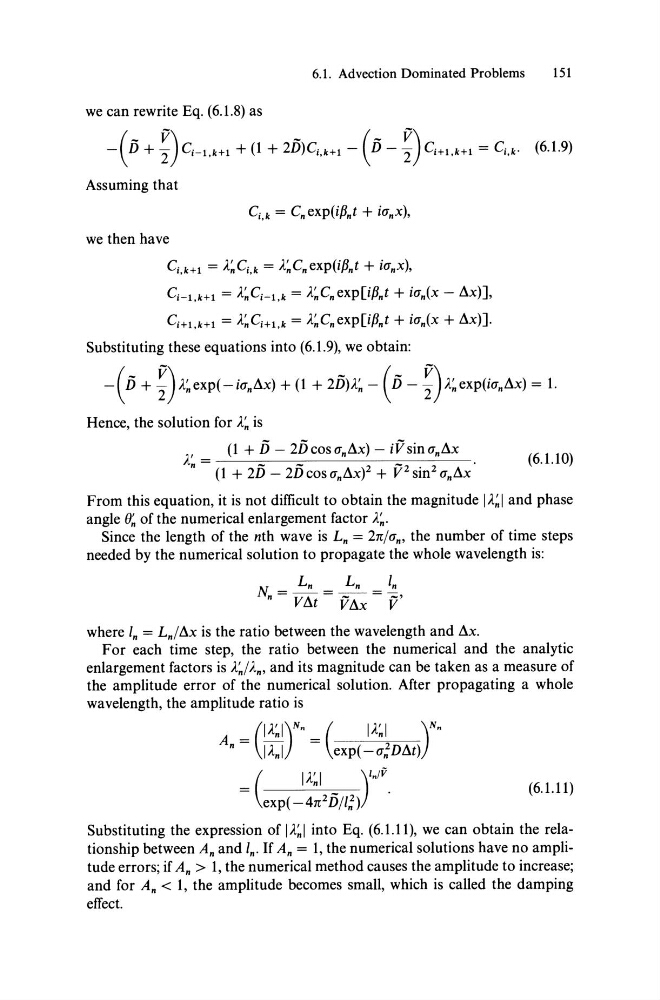
Substituting the expression of IA~I into Eq. (6.1.11), we can obtain the relationship between An and in. If An = 1, the numerical solutions have no amplitude errors; if An > 1, the numerical method causes the amplitude to increase;
and for An < 1, the amplitude becomes small, which is called the damping
efTect.
we can rewrite Eq. (6.1.8) as
( - V)
-
(- V)
- D + 2 Ci-l,k+l + (1 + 2D)Ci,k+1 - D - 2 Ci+l,k+l = Ci,k'
Assuming that
we then have
Ci,k+l = A~Ci,k = A~Cnexp(ißnt + ÜTnX),
Ci-l,k+l = A~Ci-l,k = A~Cnexp[ißnt + ian(x - L\x)],
Ci+l,k+l = A~Ci+l,k = A~Cn exp[ißnt + ian(x + L\x)].
Substituting these equations into (6.1.9), we obtain:
151
(6.1.9)
( - V)
- (- V)
- D + 2 A~ exp( - ianL\x) + (1 + 2D)A~ - D - 2 A~ exp(ianL\x) = 1.
Hence, the solution for A~ is
A.' = (1 + D - 2D cos anL\x) - iV sin anL\x
n
(1 + 2D - 2D cos a n L\x)2 + V 2 sin 2 anL\x
(6.1.10)
From this equation, it is not difficult to obtain the magnitude IA~I and phase
angle (]~ of the numerical enlargement factor A~.
Since the length of the nth wave is Ln = 2n/an, the number of time steps
needed by the numerical solution to pro pagate the whole wavelength is:
N = Ln =~=!.r:
n
VL\t VL\x V'
where In = Ln/L\x is the ratio between the wavelength and L\x.
For each time step, the ratio between the numerical and the analytic
enlargement factors is A~/ An, and its magnitude can be taken as a measure of
the amplitude error of the numerical solution. After propagating a wh oie
wavelength, the amplitude ratio is
A _ (IA~I)Nn _ (
IA~I
)Nn
n - IAnl - exp( -a;DM)
(
I A~ I
)'n/ V
= exp( -4n 2 D/i;)
.
(6.1.11)
Substituting the expression of IA~I into Eq. (6.1.11), we can obtain the relationship between An and in. If An = 1, the numerical solutions have no amplitude errors; if An > 1, the numerical method causes the amplitude to increase;
and for An < 1, the amplitude becomes small, which is called the damping
efTect.