

5.1. Finite Element Methods for Two-Dimensional Problems
111
6
o~------------~_x
x=x(e,,,>
y= y(e,,,>
~
2
3
I
" 5 6
0
,
4
7
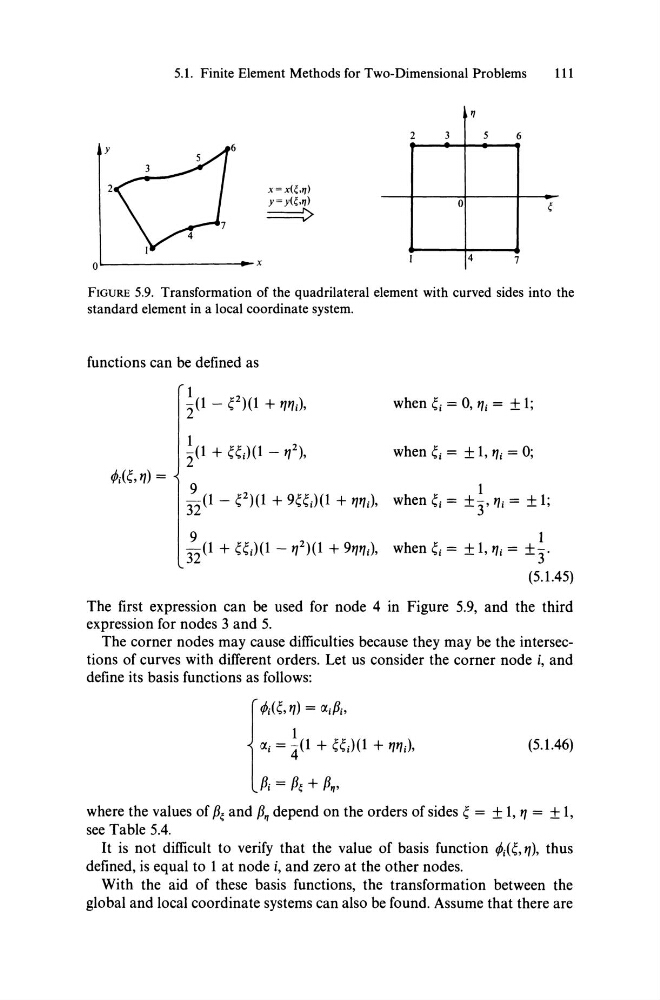
FIGURE 5.9. Transformation of the quadrilateral element with curved sides into the
standard element in a local coordinate system.
functions can be defined as
when ~i = 0, '1i = ± 1;
1
2
2:(1 + ~~i)(1 - '1 ),
when ~i = ± 1, '1i = 0;
9
32(1 - e)(1 + 9~~i)(1 + '1'1i)'
1
when J:. = +- n. = +1'
,:>,
-3' '/I - ,
9
2
1
32(1 + ~~i)(1 - '1 )(1 + 9'1'1i)' when ~i = ± 1, '1i = ±3'
(5.1.45)
The first expression can be used for node 4 in Figure 5.9, and the third
expression for nodes 3 and 5.
The corner nodes may cause difficulties because they may be the intersections of curves with different orders. Let us consider the corner node i, and
define its basis functions as follows:
(M~, '1) = aßi'
1
(Xi = 4(1 + ~~;)(1 + '1'1;),
(5.1.46)
ßi = ß~ + ß",
where the values of ß~ and ß" depend on the orders of sides ~ = ± 1, '1 = ± 1,
see Table 5.4.
It is not difficult to verify that the value of basis function (M~, '1), thus
defined, is equal to 1 at node i, and zero at the other nodes.
With the aid of these basis functions, the transformation between the
global and local coordinate systems can also be found. Assume that there are
111
6
o~------------~_x
x=x(e,,,>
y= y(e,,,>
~
2
3
I
" 5 6
0
,
4
7
FIGURE 5.9. Transformation of the quadrilateral element with curved sides into the
standard element in a local coordinate system.
functions can be defined as
when ~i = 0, '1i = ± 1;
1
2
2:(1 + ~~i)(1 - '1 ),
when ~i = ± 1, '1i = 0;
9
32(1 - e)(1 + 9~~i)(1 + '1'1i)'
1
when J:. = +- n. = +1'
,:>,
-3' '/I - ,
9
2
1
32(1 + ~~i)(1 - '1 )(1 + 9'1'1i)' when ~i = ± 1, '1i = ±3'
(5.1.45)
The first expression can be used for node 4 in Figure 5.9, and the third
expression for nodes 3 and 5.
The corner nodes may cause difficulties because they may be the intersections of curves with different orders. Let us consider the corner node i, and
define its basis functions as follows:
(M~, '1) = aßi'
1
(Xi = 4(1 + ~~;)(1 + '1'1;),
(5.1.46)
ßi = ß~ + ß",
where the values of ß~ and ß" depend on the orders of sides ~ = ± 1, '1 = ± 1,
see Table 5.4.
It is not difficult to verify that the value of basis function (M~, '1), thus
defined, is equal to 1 at node i, and zero at the other nodes.
With the aid of these basis functions, the transformation between the
global and local coordinate systems can also be found. Assume that there are