

5.1. Finite Element Methods for Two-Dimensional Problems
103
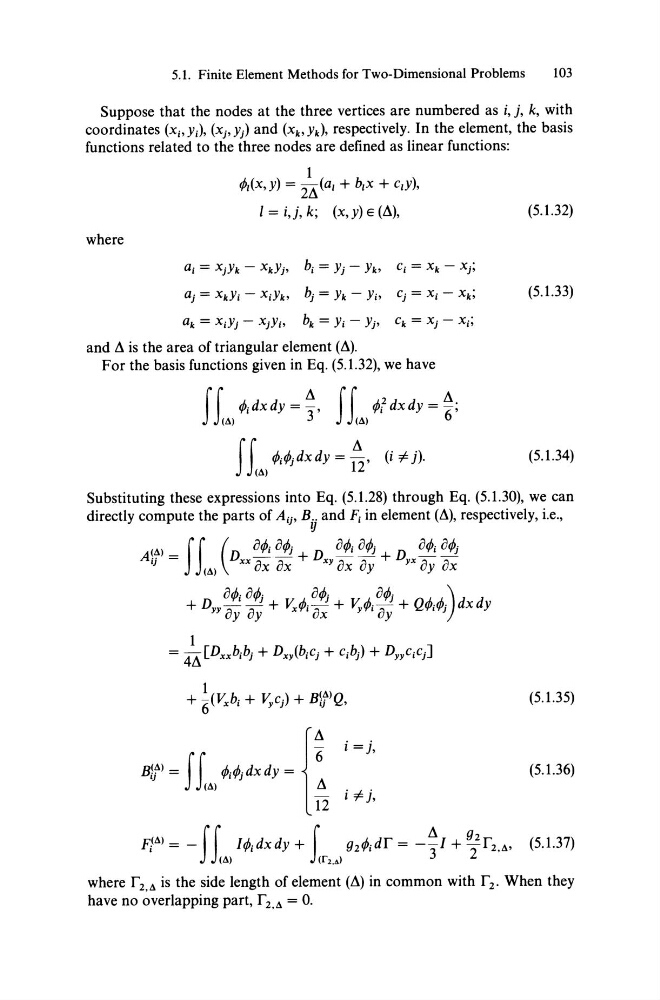
Suppose that the nodes at the three vertices are numbered as i, j, k, with
coordinates (Xi' yJ, (Xj, Y) and (xk, Yk), respectively. In the element, the basis
functions related to the three nodes are defined as linear functions:
where
1
1J,(X, y) = 2~ (a, + b,x + c,y),
1= i,j, k; (x,y) E (~),
ai = xjYk - xkYj, bi = Yj - Yk, Ci = Xk - Xj;
aj = XkYi - XiYk, bj = Yk - Yi' Cj = Xi - Xk;
ak = x,yj - XjYi, bk = Yi - Yj' Ck = Xj - Xi;
and ~ is the area of triangular element (~).
For the basis functions given in Eq. (5.1.32), we have
f l~/idXdY = t, f Id/ldXdY =~;
f r 1Ji1Jj dxdy = ~, (i # j).
Jd)
(5.1.32)
(5.1.33)
(5.1.34)
Substituting these expressions into Eq. (5.1.28) through Eq. (5.1.30), we can
directly compute the parts of Aij' B .. and Fi in element (~), respectively, i.e.,
Ij
A!~) = fr (D 01Ji o1Jj + D 01Ji o1Jj + D 01Ji o1Jj
I)
J(d)
xx OX ox
xy ox oY
yx oY OX
01Ji o1Jj
o1Jj
o1Jj
)
+ D yy oY oY + Vx1Ji ox + Yy1Ji oY + Q1Ji1Jj dx dy
1
= 4~ [Dxxbibj + Dxy(bicj + cibj) + DyycicJ
(5.1.35)
(5.1.36)
F/ d ) = -f r 11Ji dxdy + r g21Jidr = -~I + g2 r2.d, (5.1.37)
J (d)
J (f2 ,A)
3
2
where r 2 • d is the side length of element (~) in common with r 2 • When they
have no overlapping part, r 2 • d = O.
103
Suppose that the nodes at the three vertices are numbered as i, j, k, with
coordinates (Xi' yJ, (Xj, Y) and (xk, Yk), respectively. In the element, the basis
functions related to the three nodes are defined as linear functions:
where
1
1J,(X, y) = 2~ (a, + b,x + c,y),
1= i,j, k; (x,y) E (~),
ai = xjYk - xkYj, bi = Yj - Yk, Ci = Xk - Xj;
aj = XkYi - XiYk, bj = Yk - Yi' Cj = Xi - Xk;
ak = x,yj - XjYi, bk = Yi - Yj' Ck = Xj - Xi;
and ~ is the area of triangular element (~).
For the basis functions given in Eq. (5.1.32), we have
f l~/idXdY = t, f Id/ldXdY =~;
f r 1Ji1Jj dxdy = ~, (i # j).
Jd)
(5.1.32)
(5.1.33)
(5.1.34)
Substituting these expressions into Eq. (5.1.28) through Eq. (5.1.30), we can
directly compute the parts of Aij' B .. and Fi in element (~), respectively, i.e.,
Ij
A!~) = fr (D 01Ji o1Jj + D 01Ji o1Jj + D 01Ji o1Jj
I)
J(d)
xx OX ox
xy ox oY
yx oY OX
01Ji o1Jj
o1Jj
o1Jj
)
+ D yy oY oY + Vx1Ji ox + Yy1Ji oY + Q1Ji1Jj dx dy
1
= 4~ [Dxxbibj + Dxy(bicj + cibj) + DyycicJ
(5.1.35)
(5.1.36)
F/ d ) = -f r 11Ji dxdy + r g21Jidr = -~I + g2 r2.d, (5.1.37)
J (d)
J (f2 ,A)
3
2
where r 2 • d is the side length of element (~) in common with r 2 • When they
have no overlapping part, r 2 • d = O.