

4.2. The Method of Characteristics
93
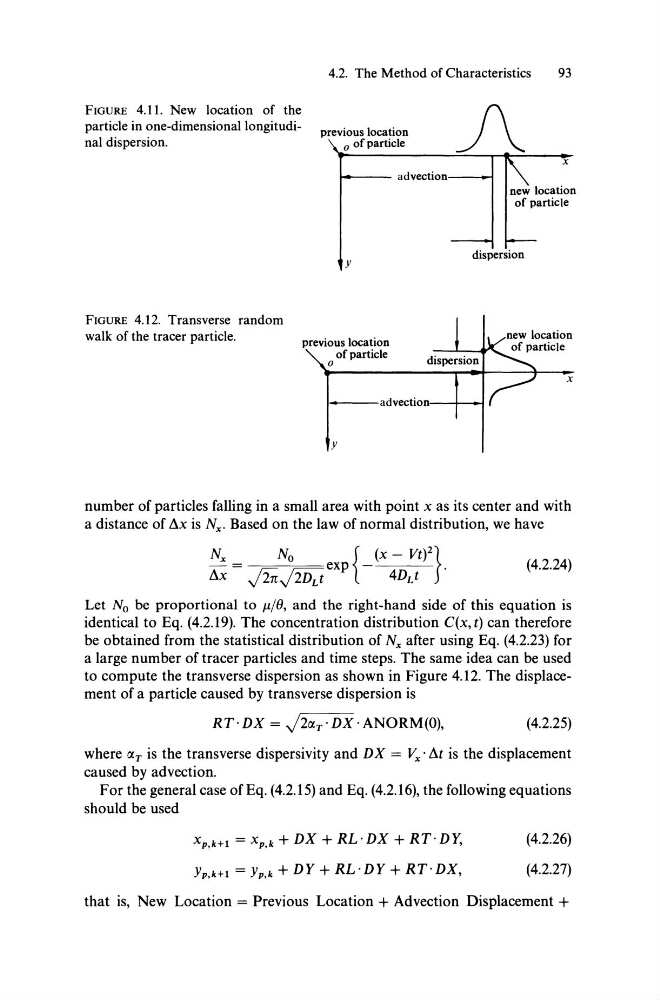
FIGURE 4.11. New location of the
particie in one-dirnensionallongitudinal dispersion.
FIGURE 4.12. Transverse randorn
walk of the tracer particle.
previous location
o of particle
..... - - advection.----o~
y
previous location
ofparticle
o
dispersion
I----advection--+----t
y
x
x
number of particles falling in a small area with point x as its center and with
a distance of L1x is N x • Based on the law of normal distribution, we have
Nx
No
{ (x - Vt)2}
L1x = J2nJ2D L t exp - 4D L t
.
(4.2.24)
Let No be proportional to Jl/O, and the right-hand side of this equation is
identical to Eq. (4.2.19). The concentration distribution C(x, t) can therefore
be obtained from the statistical distribution of N x after using Eq. (4.2.23) for
a large number of tracer particles and time steps. The same idea can be used
to compute the transverse dispersion as shown in Figure 4.12. The displacement of a particle caused by transverse dispersion is
(4.2.25)
where IXT is the transverse dispersivity and DX = V x ' L1t is the displacement
caused by advection.
For the general case ofEq. (4.2.15) and Bq. (4.2.16), the following equations
should be used
X p,k+l = Xp,k + DX + RL·DX + RT'DY,
Y p,k+l = Yp,k + DY + RL·DY + RT'DX,
(4.2.26)
(4.2.27)
that is, New Location = Previous Location + Advection Displacement +
93
FIGURE 4.11. New location of the
particie in one-dirnensionallongitudinal dispersion.
FIGURE 4.12. Transverse randorn
walk of the tracer particle.
previous location
o of particle
..... - - advection.----o~
y
previous location
ofparticle
o
dispersion
I----advection--+----t
y
x
x
number of particles falling in a small area with point x as its center and with
a distance of L1x is N x • Based on the law of normal distribution, we have
Nx
No
{ (x - Vt)2}
L1x = J2nJ2D L t exp - 4D L t
.
(4.2.24)
Let No be proportional to Jl/O, and the right-hand side of this equation is
identical to Eq. (4.2.19). The concentration distribution C(x, t) can therefore
be obtained from the statistical distribution of N x after using Eq. (4.2.23) for
a large number of tracer particles and time steps. The same idea can be used
to compute the transverse dispersion as shown in Figure 4.12. The displacement of a particle caused by transverse dispersion is
(4.2.25)
where IXT is the transverse dispersivity and DX = V x ' L1t is the displacement
caused by advection.
For the general case ofEq. (4.2.15) and Bq. (4.2.16), the following equations
should be used
X p,k+l = Xp,k + DX + RL·DX + RT'DY,
Y p,k+l = Yp,k + DY + RL·DY + RT'DX,
(4.2.26)
(4.2.27)
that is, New Location = Previous Location + Advection Displacement +