

Heat Gain in the Eastern North Atlantic Subtropical Gyre
J. 1. Pelegri, P. Sangra and A. Hernandez-Guerra
Facultad de Ciencias del Mar, U niversidad de Las Palmas de Gran Canaria
35017 Las Palmas de Gran Canaria, Spain
1 Heat Storage and Advection
It is well recognized that successful modeling of seasonal and long term climate variability requires a good representation of atmosphere-ocean heat exchange, as well as oceanic
heat storage and transport. This has motivated the analysis of the main elements of heat
transfer in the ocean during the last decades. In this review we look at heat transfer and
formation of Warm Water Mass (WWM) in the eastern North Atlantic Subtropical Gyre
(NASG), approximately between Cape Vert (15°N) and the Strait of Gibraltar (36°N)
and between the African coast and 30 o W.
The annual average ocean heat transfer in the NASG can be approximately divided
in two regions by a NE-SW diagonal line. The eastern portion of this gyre is characterized by heat gain, while the western part experiments net heat loss to the atmosphere.
The latter process, produced through vertically convective cold wind events coming from
inland regions, has received considerable attention in the past, possibly because of their
fundamental importance in moderating local climate at high latitudes (eg. Worthington
1959). The opposite process, however, consisting in oceanic heat gain and WWM formation is less understood: heat input will tend to estabilize the water column and inhibit
further heat transfer (Csanady 1984,1990). All mechanisms of WWM formation require
the advection of relatively cold waters, which then gain substantial amounts of heat from
the atmosphere. A discussion of these mechanisms for the eastern N ASG will be done
in Section 2 below. Before going into this analysis, however, we will briefly review some
calculations on oceanic heat storage and transfer, particularly for eastern boundary currents. This is important not only because it controls the rates of WWM formation, but
also because it forces the circulation in the permanent thermocline, which determines the
rate of heat escape into deeper layers (rate of net heat retention). Some implications of
this aspect on climate change will be discussed in Section 3.
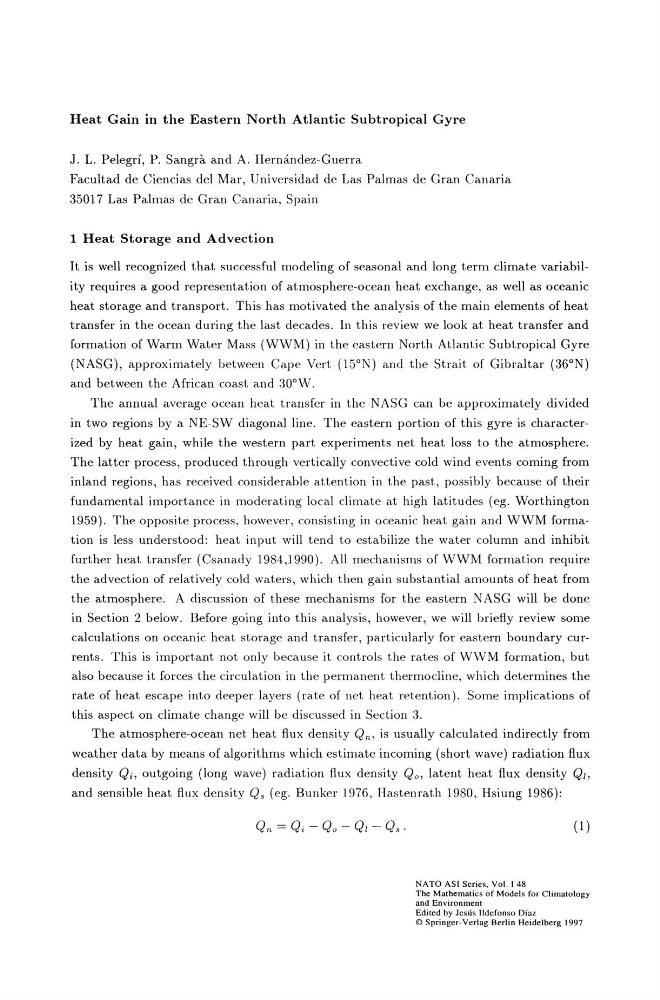
The atmosphere-ocean net heat flux density Qn, is usually calculated indirectly from
weather data by means of algorithms which estimate incoming (short wave) radiation flux
density Qi, outgoing (long wave) radiation flux density Qo, latent heat flux density QI,
and sensible heat flux density Qs (eg. Bunker 1976, Hastenrath 1980, Hsiung 1986):
(1)
NATO ASI Series. Vol. I48
The Mathematics of Models for Climatology
and Environment
Edited by Jesus Ildefonso Diaz
© Springer- Verlag Berlin Heidelberg 1997
J. 1. Pelegri, P. Sangra and A. Hernandez-Guerra
Facultad de Ciencias del Mar, U niversidad de Las Palmas de Gran Canaria
35017 Las Palmas de Gran Canaria, Spain
1 Heat Storage and Advection
It is well recognized that successful modeling of seasonal and long term climate variability requires a good representation of atmosphere-ocean heat exchange, as well as oceanic
heat storage and transport. This has motivated the analysis of the main elements of heat
transfer in the ocean during the last decades. In this review we look at heat transfer and
formation of Warm Water Mass (WWM) in the eastern North Atlantic Subtropical Gyre
(NASG), approximately between Cape Vert (15°N) and the Strait of Gibraltar (36°N)
and between the African coast and 30 o W.
The annual average ocean heat transfer in the NASG can be approximately divided
in two regions by a NE-SW diagonal line. The eastern portion of this gyre is characterized by heat gain, while the western part experiments net heat loss to the atmosphere.
The latter process, produced through vertically convective cold wind events coming from
inland regions, has received considerable attention in the past, possibly because of their
fundamental importance in moderating local climate at high latitudes (eg. Worthington
1959). The opposite process, however, consisting in oceanic heat gain and WWM formation is less understood: heat input will tend to estabilize the water column and inhibit
further heat transfer (Csanady 1984,1990). All mechanisms of WWM formation require
the advection of relatively cold waters, which then gain substantial amounts of heat from
the atmosphere. A discussion of these mechanisms for the eastern N ASG will be done
in Section 2 below. Before going into this analysis, however, we will briefly review some
calculations on oceanic heat storage and transfer, particularly for eastern boundary currents. This is important not only because it controls the rates of WWM formation, but
also because it forces the circulation in the permanent thermocline, which determines the
rate of heat escape into deeper layers (rate of net heat retention). Some implications of
this aspect on climate change will be discussed in Section 3.
The atmosphere-ocean net heat flux density Qn, is usually calculated indirectly from
weather data by means of algorithms which estimate incoming (short wave) radiation flux
density Qi, outgoing (long wave) radiation flux density Qo, latent heat flux density QI,
and sensible heat flux density Qs (eg. Bunker 1976, Hastenrath 1980, Hsiung 1986):
(1)
NATO ASI Series. Vol. I48
The Mathematics of Models for Climatology
and Environment
Edited by Jesus Ildefonso Diaz
© Springer- Verlag Berlin Heidelberg 1997