

414
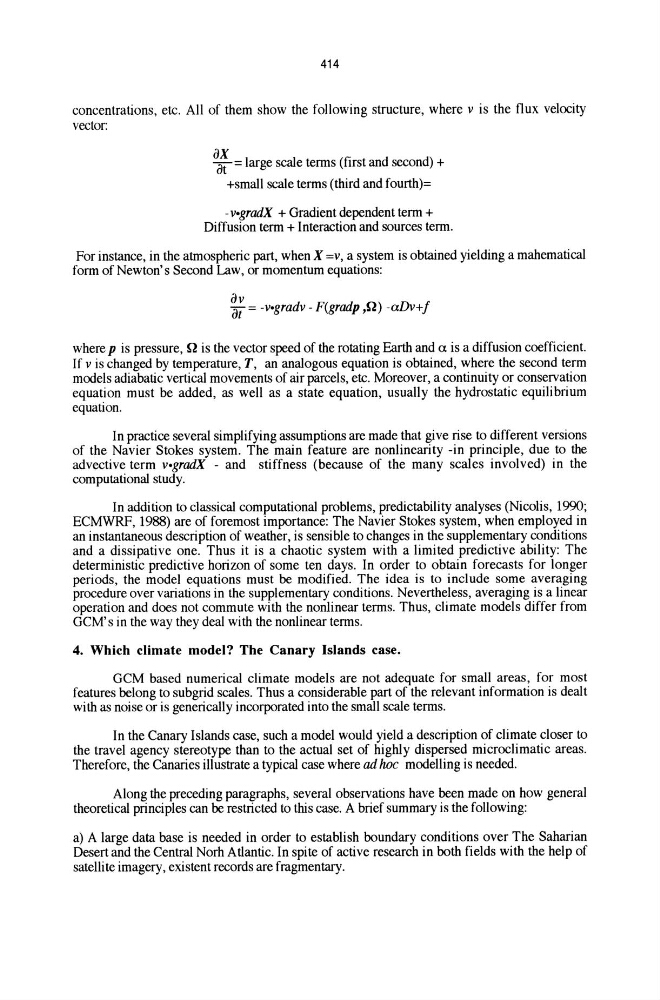
concentrations, etc. All of them show the following structure, where v is the flux velocity
vector:
aa7 = large scale terms (first and second) +
+small scale terms (third and fourth)=
-vogradX + Gradient dependent term +
Diffusion term + Interaction and sources term.
For instance, in the atmospheric part, when X =v, a system is obtained yielding a mahematical
form of Newton's Second Law, or momentum equations:
av
at = -vogradv - F(gradp ,0) -aDv+/
where p is pressure, 0 is the vector speed of the rotating Earth and a is a diffusion coefficient.
If v is changed by temperature, T, an analogous equation is obtained, where the second term
models adiabatic vertical movements of air parcels, etc. Moreover, a continuity or conservation
equation must be added, as well as a state equation, usually the hydrostatic equilibrium
equation.
In practice several simplifying assumptions are made that give rise to different versions
of the Navier Stokes system. The main feature are nonlinearity -in principle, due to the
advective term vogradX - and stiffness (because of the many scales involved) in the
computational study.
In addition to classical computational problems, predictability analyses (Nicolis, 1990;
ECMWRF, 1988) are of foremost importance: The Navier Stokes system, when employed in
an instantaneous description of weather, is sensible to changes in the supplementary conditions
and a dissipative one. Thus it is a chaotic system with a limited predictive ability: The
deterministic predictive horizon of some ten days. In order to obtain forecasts for longer
periods, the model equations must be modified. The idea is to include some averaging
procedure over variations in the supplementary conditions. Nevertheless, averaging is a linear
operation and does not commute with the nonlinear terms. Thus, climate models differ from
GCM's in the way they deal with the nonlinear terms.
4. Which climate model? The Canary Islands case.
GCM based numerical climate models are not adequate for small areas, for most
features belong to subgrid scales. Thus a considerable part of the relevant information is dealt
with as noise or is generically incorporated into the small scale terms.
In the Canary Islands case, such a model would yield a description of climate closer to
the travel agency stereotype than to the actual set of highly dispersed microclimatic areas.
Therefore, the Canaries illustrate a typical case where ad hoc modelling is needed.
Along the preceding paragraphs, several observations have been made on how general
theoretical principles can be restricted to this case. A brief summary is the following:
a) A large data base is needed in order to establish boundary conditions over The Saharian
Desert and the Central Norh Atlantic. In spite of active research in both fields with the help of
satellite imagery, existent records are fragmentary.
concentrations, etc. All of them show the following structure, where v is the flux velocity
vector:
aa7 = large scale terms (first and second) +
+small scale terms (third and fourth)=
-vogradX + Gradient dependent term +
Diffusion term + Interaction and sources term.
For instance, in the atmospheric part, when X =v, a system is obtained yielding a mahematical
form of Newton's Second Law, or momentum equations:
av
at = -vogradv - F(gradp ,0) -aDv+/
where p is pressure, 0 is the vector speed of the rotating Earth and a is a diffusion coefficient.
If v is changed by temperature, T, an analogous equation is obtained, where the second term
models adiabatic vertical movements of air parcels, etc. Moreover, a continuity or conservation
equation must be added, as well as a state equation, usually the hydrostatic equilibrium
equation.
In practice several simplifying assumptions are made that give rise to different versions
of the Navier Stokes system. The main feature are nonlinearity -in principle, due to the
advective term vogradX - and stiffness (because of the many scales involved) in the
computational study.
In addition to classical computational problems, predictability analyses (Nicolis, 1990;
ECMWRF, 1988) are of foremost importance: The Navier Stokes system, when employed in
an instantaneous description of weather, is sensible to changes in the supplementary conditions
and a dissipative one. Thus it is a chaotic system with a limited predictive ability: The
deterministic predictive horizon of some ten days. In order to obtain forecasts for longer
periods, the model equations must be modified. The idea is to include some averaging
procedure over variations in the supplementary conditions. Nevertheless, averaging is a linear
operation and does not commute with the nonlinear terms. Thus, climate models differ from
GCM's in the way they deal with the nonlinear terms.
4. Which climate model? The Canary Islands case.
GCM based numerical climate models are not adequate for small areas, for most
features belong to subgrid scales. Thus a considerable part of the relevant information is dealt
with as noise or is generically incorporated into the small scale terms.
In the Canary Islands case, such a model would yield a description of climate closer to
the travel agency stereotype than to the actual set of highly dispersed microclimatic areas.
Therefore, the Canaries illustrate a typical case where ad hoc modelling is needed.
Along the preceding paragraphs, several observations have been made on how general
theoretical principles can be restricted to this case. A brief summary is the following:
a) A large data base is needed in order to establish boundary conditions over The Saharian
Desert and the Central Norh Atlantic. In spite of active research in both fields with the help of
satellite imagery, existent records are fragmentary.