

375
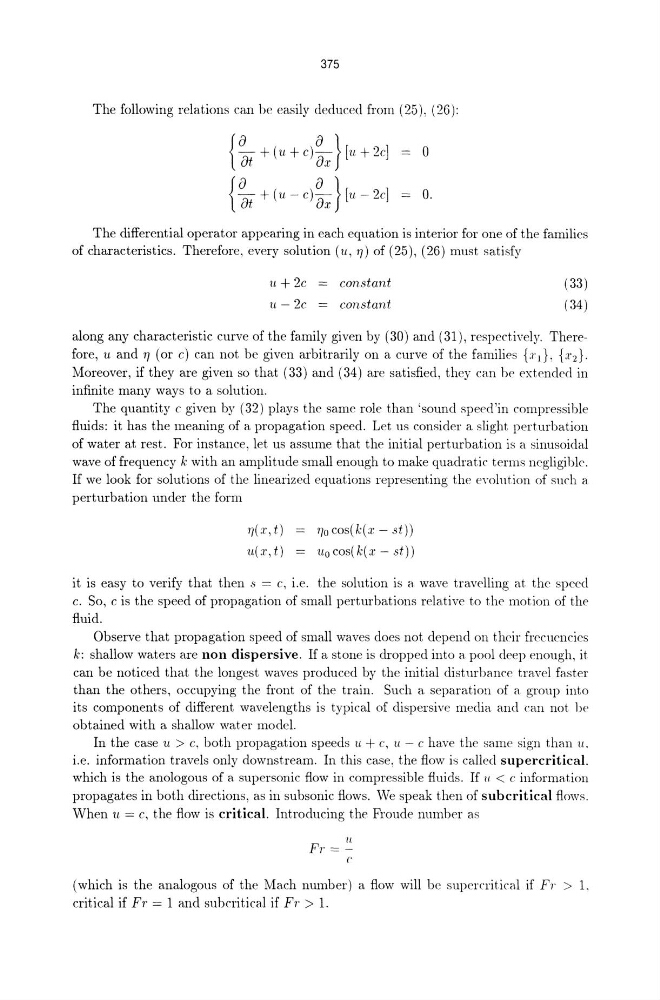
The following relations can be easily deduced from (25), (26):
{~t +(u+C)~x}[u+2cl = 0
{ ~+(U-c)~}[u-2cl = o.
at
ax
The differential operator appearing in each equation is interior for one of the families
of characteristics. Therefore, every solution (u, '1/) of (25), (26) must satisfy
u + 2c
u - 2c
constant
constant
(33)
(34)
along any characteristic curve of the family given by (30) and (31), respectively. Therefore, u and ' 1/ (or c) can not be given arbitrarily on a curve of the families {xd, {X2}'
Moreover, if they are given so that (33) and (34) are satisfied, they can be extended in
infinite many ways to a solution.
The quantity c given by (32) plays the same role than 'sound speed'in compressible
fluids: it has the meaning of a propagation speed. Let us consider a slight perturbation
of water at rest. For instance, let us assume that the initial perturbation is a sinusoidal
wave offrequency k with an amplitude small enough to make quadratic terms negligible.
If we look for solutions of the linearized equations representing the evolution of such a
perturbation under the form
'I/(x, t)
u( x,t)
'I/o cos(k(x - st))
Uo cos(k(x - st))
it is easy to verify that then s = c, i.e. the solution is a wave travelling at the speed
c. So, c is the speed of propagation of small perturbations relative to the motion of the
fluid.
Observe that propagation speed of small waves does not depend on their frecuencies
k: shallow waters are non dispersive. If a stone is dropped into a pool deep enough, it
can be noticed that the longest waves produced by the initial disturbance travel faster
than the others, occupying the front of the train. Such a separation of a group into
its components of different wavelengths is typical of dispersive media and can not be
obtained with a shallow water model.
In the case u > c, both propagation speeds u + c, u - c have the same sign than u.
i.e. information travels only downstream. In this case, the flow is called supercritical.
which is the anologous of a supersonic flow in compressible fluids. If 11 < c information
propagates in both directions, as in subsonic flows. We speak then of subcritical flows.
When u = c, the flow is critical. Introducing the Froude number as
Fr = "!:.
c
(which is the analogous of the Mach number) a flow will be supercritical if Fr > 1.
critical if Fr = 1 and subcritical if Fr > 1.
The following relations can be easily deduced from (25), (26):
{~t +(u+C)~x}[u+2cl = 0
{ ~+(U-c)~}[u-2cl = o.
at
ax
The differential operator appearing in each equation is interior for one of the families
of characteristics. Therefore, every solution (u, '1/) of (25), (26) must satisfy
u + 2c
u - 2c
constant
constant
(33)
(34)
along any characteristic curve of the family given by (30) and (31), respectively. Therefore, u and ' 1/ (or c) can not be given arbitrarily on a curve of the families {xd, {X2}'
Moreover, if they are given so that (33) and (34) are satisfied, they can be extended in
infinite many ways to a solution.
The quantity c given by (32) plays the same role than 'sound speed'in compressible
fluids: it has the meaning of a propagation speed. Let us consider a slight perturbation
of water at rest. For instance, let us assume that the initial perturbation is a sinusoidal
wave offrequency k with an amplitude small enough to make quadratic terms negligible.
If we look for solutions of the linearized equations representing the evolution of such a
perturbation under the form
'I/(x, t)
u( x,t)
'I/o cos(k(x - st))
Uo cos(k(x - st))
it is easy to verify that then s = c, i.e. the solution is a wave travelling at the speed
c. So, c is the speed of propagation of small perturbations relative to the motion of the
fluid.
Observe that propagation speed of small waves does not depend on their frecuencies
k: shallow waters are non dispersive. If a stone is dropped into a pool deep enough, it
can be noticed that the longest waves produced by the initial disturbance travel faster
than the others, occupying the front of the train. Such a separation of a group into
its components of different wavelengths is typical of dispersive media and can not be
obtained with a shallow water model.
In the case u > c, both propagation speeds u + c, u - c have the same sign than u.
i.e. information travels only downstream. In this case, the flow is called supercritical.
which is the anologous of a supersonic flow in compressible fluids. If 11 < c information
propagates in both directions, as in subsonic flows. We speak then of subcritical flows.
When u = c, the flow is critical. Introducing the Froude number as
Fr = "!:.
c
(which is the analogous of the Mach number) a flow will be supercritical if Fr > 1.
critical if Fr = 1 and subcritical if Fr > 1.