

problem,
359
{
A(b(O) + A X) = b.'O, III Q, X E H(O) a.e. in Q,
ao
- = o:(h - 0) on aw x R,
an
0lt=o = 0° on wx ]0, S[, 01.=0 = (Jl on wx ]0, T[ .
(3.7)
where h is given on aw x R, 0: on aw is bounded from below by a positive constant 0:0,
(J0 and 0 1 are prescribed on wx]O,S[ and on wx]O,T[, respectively, with OO(x,z,O) =
(Jl(X, z, 0).
Defining, as in [R1] for the one-phase problem, the integral transformation
u(x,z,s,t) = is (J(X,Z,T,T+ (t - s)) dT,
(s-t)+
(3.8)
we have, for its inverse,
Au = (ad as) u = 0 .
(3.9)
Integrating the first equation of the problem (3.7) in order to the variable T, between
(s - t)+ and s, we obtain
b(Au) + AX = b.'u + f ,
(3.10)
where
f(x, z, s, t) = b(7i(x, z, s, t)) + A X{8(x,z,s,t»0} ,
(3.11 )
and
_
{ (JO(x,z,s -t) if s;:: t,
O(x, z, s, t) = Ol(x,z,t - s) ift;:: s.
(3.12)
Notice that
'v'o:,,BER'v'tpEH(,B) o:+-,e+;::tp{o:-,B),
where 0:+ = max(o:,O). Then, since Au = (J, we have
'v'v E L2(w) v+ - (Au(s,t))+ ;:: X(v - Au(s,t)), a.e. in w.
Defining J(v) = AJwV+, for v E L2(w), we obtain
J(v)-J(Au(s,t));::,\Lx(v-Au(s,t)), 'v'VEL2(w).
(3.13)
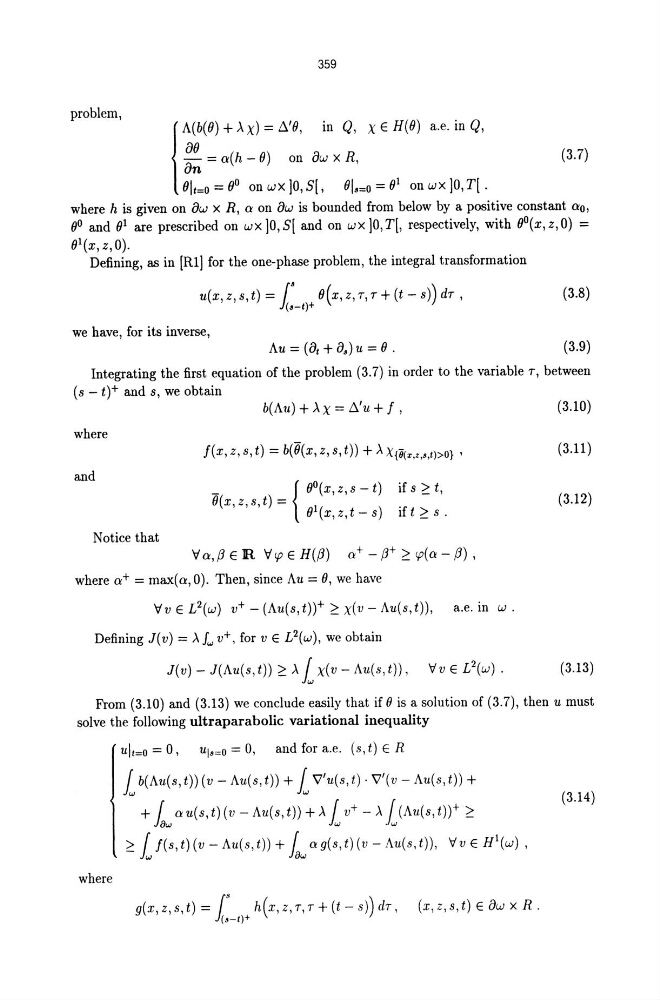
From (3.10) and (3.13) we conclude easily that if B is a solution of (3.7), then u must
solve the following ultraparabolic variational inequality
where
Ult=o = 0, uls=o = 0, and for a.e. (s, t) E R
L b(Au(s, t)) (v - Au(s, t)) + 1 V"u(s, t)· V"(v - Au(s, t)) +
+ [ o:u(s,t)(v-Au(s,t))+Al v+- Al(Au(s,t))+;::
Jaw
w
w
;::I f (s,t)(v-Au(s,t))+ [ o:g(s,t)(v-Au(s,t)), 'v'VEHl(w),
w
Jaw
g(x,z,s,t)=i
S
h(X,Z,T,T+(t-s))dT, (x,z,s,t)EawxR.
(s-t)+
(3.14)
359
{
A(b(O) + A X) = b.'O, III Q, X E H(O) a.e. in Q,
ao
- = o:(h - 0) on aw x R,
an
0lt=o = 0° on wx ]0, S[, 01.=0 = (Jl on wx ]0, T[ .
(3.7)
where h is given on aw x R, 0: on aw is bounded from below by a positive constant 0:0,
(J0 and 0 1 are prescribed on wx]O,S[ and on wx]O,T[, respectively, with OO(x,z,O) =
(Jl(X, z, 0).
Defining, as in [R1] for the one-phase problem, the integral transformation
u(x,z,s,t) = is (J(X,Z,T,T+ (t - s)) dT,
(s-t)+
(3.8)
we have, for its inverse,
Au = (ad as) u = 0 .
(3.9)
Integrating the first equation of the problem (3.7) in order to the variable T, between
(s - t)+ and s, we obtain
b(Au) + AX = b.'u + f ,
(3.10)
where
f(x, z, s, t) = b(7i(x, z, s, t)) + A X{8(x,z,s,t»0} ,
(3.11 )
and
_
{ (JO(x,z,s -t) if s;:: t,
O(x, z, s, t) = Ol(x,z,t - s) ift;:: s.
(3.12)
Notice that
'v'o:,,BER'v'tpEH(,B) o:+-,e+;::tp{o:-,B),
where 0:+ = max(o:,O). Then, since Au = (J, we have
'v'v E L2(w) v+ - (Au(s,t))+ ;:: X(v - Au(s,t)), a.e. in w.
Defining J(v) = AJwV+, for v E L2(w), we obtain
J(v)-J(Au(s,t));::,\Lx(v-Au(s,t)), 'v'VEL2(w).
(3.13)
From (3.10) and (3.13) we conclude easily that if B is a solution of (3.7), then u must
solve the following ultraparabolic variational inequality
where
Ult=o = 0, uls=o = 0, and for a.e. (s, t) E R
L b(Au(s, t)) (v - Au(s, t)) + 1 V"u(s, t)· V"(v - Au(s, t)) +
+ [ o:u(s,t)(v-Au(s,t))+Al v+- Al(Au(s,t))+;::
Jaw
w
w
;::I f (s,t)(v-Au(s,t))+ [ o:g(s,t)(v-Au(s,t)), 'v'VEHl(w),
w
Jaw
g(x,z,s,t)=i
S
h(X,Z,T,T+(t-s))dT, (x,z,s,t)EawxR.
(s-t)+
(3.14)