

358
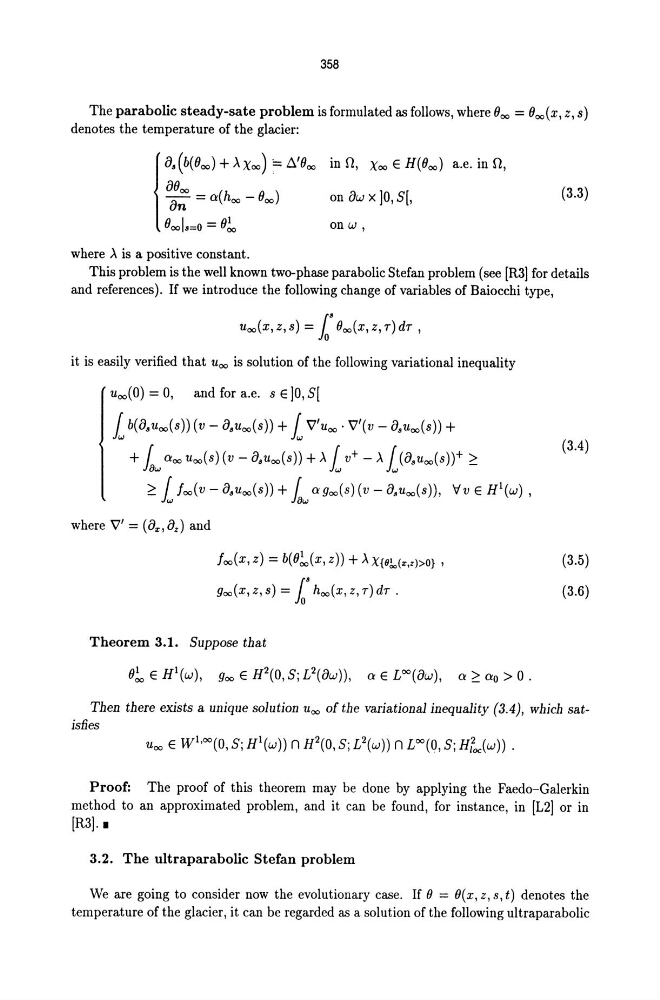
The parabolic steady-sate problem is formulated as follows, where Boo = Boo ( x, z, s)
denotes the temperature of the glacier:
{
o,(b(Boo) + A Xoo) ::::; .6.'Boo in n, Xoo E H(Boo) a.e. in n,
~:: = o:(hoo - Boo)
on ow X ]0,5[,
Bool,=o = B~
on w ,
(3.3)
where A is a positive constant.
This problem is the well known two-phase parabolic Stefan problem (see [R3] for details
and references). If we introduce the following change of variables of Baiocchi type,
uoo(x, z, s) = 10' Boo(x, z, r) dr ,
it is easily verified that U oo is solution of the following variational inequality
uoo(O) = 0, and for a.e. s E ]0, S[
L b(o,uoo(s)) (v - osuoo(s)) + 1 V'uoo · V'(v - osuoo(s)) +
+ r 0:00 uoo(s)(v - osuoo(s)) + Ai v+ - Ai(o,uoo(s))+ ~
Jaw
w
w
~ifoo(v-o,uoo(s))+ r o:goo(s)(v-osuoo(s)), VVEH1(w),
w
Jaw
where V' = (ox,oz) and
foo(x, z) = b(B~(x, z)) + A X{o1x,(x,z»O} ,
goo (x, z, s) = 10' hoo(x, z, r) dr .
Theorem 3.1. Suppose that
(3.4)
(3.5)
(3.6)
Then there exists a unique solution Uoo of the variational inequality (3.4), which satisfies
Proof: The proof of this theorem may be done by applying the Faedo-Galerkin
method to an approximated problem, and it can be found, for instance, in [L2] or in
[R3] .•
3.2. The ultraparabolic Stefan problem
We are going to consider now the evolutionary case. If B = B(x, z, s, t) denotes the
temperature of the glacier, it can be regarded as a solution of the following ultraparabolic
The parabolic steady-sate problem is formulated as follows, where Boo = Boo ( x, z, s)
denotes the temperature of the glacier:
{
o,(b(Boo) + A Xoo) ::::; .6.'Boo in n, Xoo E H(Boo) a.e. in n,
~:: = o:(hoo - Boo)
on ow X ]0,5[,
Bool,=o = B~
on w ,
(3.3)
where A is a positive constant.
This problem is the well known two-phase parabolic Stefan problem (see [R3] for details
and references). If we introduce the following change of variables of Baiocchi type,
uoo(x, z, s) = 10' Boo(x, z, r) dr ,
it is easily verified that U oo is solution of the following variational inequality
uoo(O) = 0, and for a.e. s E ]0, S[
L b(o,uoo(s)) (v - osuoo(s)) + 1 V'uoo · V'(v - osuoo(s)) +
+ r 0:00 uoo(s)(v - osuoo(s)) + Ai v+ - Ai(o,uoo(s))+ ~
Jaw
w
w
~ifoo(v-o,uoo(s))+ r o:goo(s)(v-osuoo(s)), VVEH1(w),
w
Jaw
where V' = (ox,oz) and
foo(x, z) = b(B~(x, z)) + A X{o1x,(x,z»O} ,
goo (x, z, s) = 10' hoo(x, z, r) dr .
Theorem 3.1. Suppose that
(3.4)
(3.5)
(3.6)
Then there exists a unique solution Uoo of the variational inequality (3.4), which satisfies
Proof: The proof of this theorem may be done by applying the Faedo-Galerkin
method to an approximated problem, and it can be found, for instance, in [L2] or in
[R3] .•
3.2. The ultraparabolic Stefan problem
We are going to consider now the evolutionary case. If B = B(x, z, s, t) denotes the
temperature of the glacier, it can be regarded as a solution of the following ultraparabolic