

353
also along the characteristics in a standard way, yielding (2.21) by integration in < and
the same change of variables. I
Theorem 2.12. Suppose r -+ f in L 2 (Q), when v -+ 0 and let u" and u be the
solution of (2.14) and (2.21), respectively. Then we have
u" ----t u when v -+ 0
in L2(R;HJ(a,b))-weak and in LOO(0,T;L 2 (O))-weak*.
(2.25)
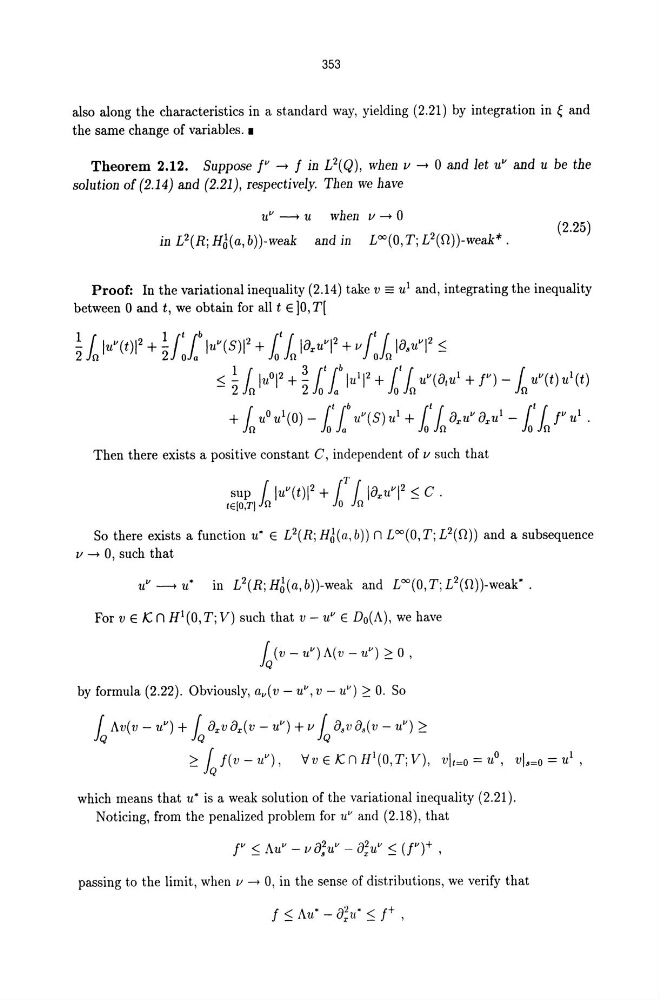
Proof: In the variational inequality (2.14) take v == u 1 and, integrating the inequality
between ° and t, we obtain for all t E ]0, T[
Then there exists a positive constant C, independent of v such that
So there exists a function u* E L2(R;HJ(a,b)) n L'x'(0,T;L 2 (O)) and a subsequence
v -+ 0, such that
U" ----t u* in L 2 (R;HJ(a,b))-weak and LOO(0,T;L2(O))-weak* .
For v E K n Hl(O, T; V) such that v - u" E Do(i\), we have
by formula (2.22). Obviously, a,,( v - u", v - u") ~ 0. So
h i\v(v - u") + h axvax(v - u") + v h a,va,(v - u") ~
~kf(v-u")' VVEKnH1(0,T;V), vlt=o=uo, vl,=o=u 1 ,
which means that u* is a weak solution of the variational inequality (2.21).
Noticing, from the penalized problem for u" and (2.18), that
passing to the limit, when v -+ 0, in the sense of distributions, we verify that
also along the characteristics in a standard way, yielding (2.21) by integration in < and
the same change of variables. I
Theorem 2.12. Suppose r -+ f in L 2 (Q), when v -+ 0 and let u" and u be the
solution of (2.14) and (2.21), respectively. Then we have
u" ----t u when v -+ 0
in L2(R;HJ(a,b))-weak and in LOO(0,T;L 2 (O))-weak*.
(2.25)
Proof: In the variational inequality (2.14) take v == u 1 and, integrating the inequality
between ° and t, we obtain for all t E ]0, T[
Then there exists a positive constant C, independent of v such that
So there exists a function u* E L2(R;HJ(a,b)) n L'x'(0,T;L 2 (O)) and a subsequence
v -+ 0, such that
U" ----t u* in L 2 (R;HJ(a,b))-weak and LOO(0,T;L2(O))-weak* .
For v E K n Hl(O, T; V) such that v - u" E Do(i\), we have
by formula (2.22). Obviously, a,,( v - u", v - u") ~ 0. So
h i\v(v - u") + h axvax(v - u") + v h a,va,(v - u") ~
~kf(v-u")' VVEKnH1(0,T;V), vlt=o=uo, vl,=o=u 1 ,
which means that u* is a weak solution of the variational inequality (2.21).
Noticing, from the penalized problem for u" and (2.18), that
passing to the limit, when v -+ 0, in the sense of distributions, we verify that