

352
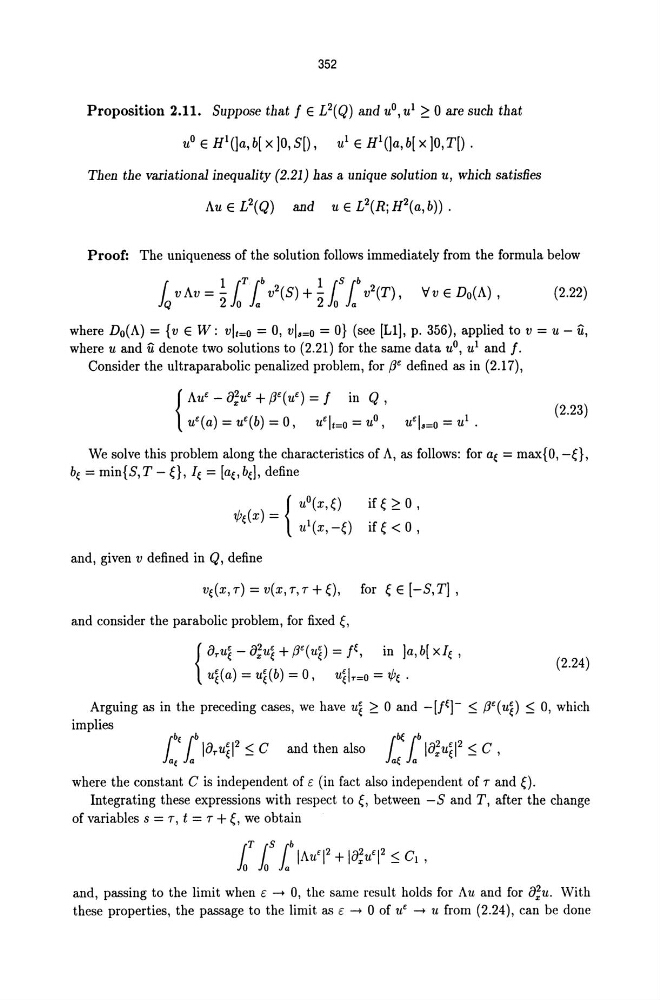
Proposition 2.11. Suppose that f E L2( Q) and uo, u l ~ ° are such that
uo E HI (la, b[ X 10, S[) , u l E HI (la, b[ X 10, T[) .
Then the variational inequality (2.21) has a unique solution u, which satisfies
Proof: The uniqueness of the solution follows immediately from the formula below
k vAv = ~ foTt v2(S) + ~ foS t v 2 (T) , 'Vv E Do(A) , (2.22)
where Do(A) = {v E W: Vlt=o = 0, vl.=o = O} (see [Llj, p. 356), applied to v = u - U,
where u and U denote two solutions to (2.21) for the same data uO, u l and f.
Consider the ultraparabolic penalized problem, for f3' defined as in (2.17),
{
Au' - a~u' + f3'(u') = f in Q,
u'(a) = u'(b) = 0, U'lt=o = uO, u'I.=o = u l .
(2.23)
We solve this problem along the characteristics of A, as follows: for a{ = max{O, -0,
b{ = min{S, T - 0, h = [a{, bd, define
{
uO(x,~)
if ~ ~ ° ,
' !he x ) = u1(x, -~) if ~ < 0 ,
and, given v defined in Q, define
v{(x, T) = vex, T, T + ~), for ~ E [-S, Tj ,
and consider the parabolic problem, for fixed ~,
{
aTU~ - a~u~ + f3'(uV = /{, in ja,b[ xh ,
u{(a) = u{(b) = 0, U~IT=O = ' !/J{ •
(2.24)
Arguing as in the preceding cases, we have u{ ~ 0 and -[t{j- ::s; f3'(uV ::s; 0, which
implies
where the constant C is independent of c (in fact also independent of T and ~).
Integrating these expressions with respect to ~, between -S and T, after the change
of variables s = T, t = T +~, we obtain
and, passing to the limit when c --+ 0, the same result holds for Au and for a~u. With
these properties, the passage to the limit as c --+ 0 of u' --+ u from (2.24), can be done
Proposition 2.11. Suppose that f E L2( Q) and uo, u l ~ ° are such that
uo E HI (la, b[ X 10, S[) , u l E HI (la, b[ X 10, T[) .
Then the variational inequality (2.21) has a unique solution u, which satisfies
Proof: The uniqueness of the solution follows immediately from the formula below
k vAv = ~ foTt v2(S) + ~ foS t v 2 (T) , 'Vv E Do(A) , (2.22)
where Do(A) = {v E W: Vlt=o = 0, vl.=o = O} (see [Llj, p. 356), applied to v = u - U,
where u and U denote two solutions to (2.21) for the same data uO, u l and f.
Consider the ultraparabolic penalized problem, for f3' defined as in (2.17),
{
Au' - a~u' + f3'(u') = f in Q,
u'(a) = u'(b) = 0, U'lt=o = uO, u'I.=o = u l .
(2.23)
We solve this problem along the characteristics of A, as follows: for a{ = max{O, -0,
b{ = min{S, T - 0, h = [a{, bd, define
{
uO(x,~)
if ~ ~ ° ,
' !he x ) = u1(x, -~) if ~ < 0 ,
and, given v defined in Q, define
v{(x, T) = vex, T, T + ~), for ~ E [-S, Tj ,
and consider the parabolic problem, for fixed ~,
{
aTU~ - a~u~ + f3'(uV = /{, in ja,b[ xh ,
u{(a) = u{(b) = 0, U~IT=O = ' !/J{ •
(2.24)
Arguing as in the preceding cases, we have u{ ~ 0 and -[t{j- ::s; f3'(uV ::s; 0, which
implies
where the constant C is independent of c (in fact also independent of T and ~).
Integrating these expressions with respect to ~, between -S and T, after the change
of variables s = T, t = T +~, we obtain
and, passing to the limit when c --+ 0, the same result holds for Au and for a~u. With
these properties, the passage to the limit as c --+ 0 of u' --+ u from (2.24), can be done