

322
10'
10'
10'
.5
C1
.. 0
- 10 '
10'
10°
0
100
200
300
400
500
600
700
lime step number i
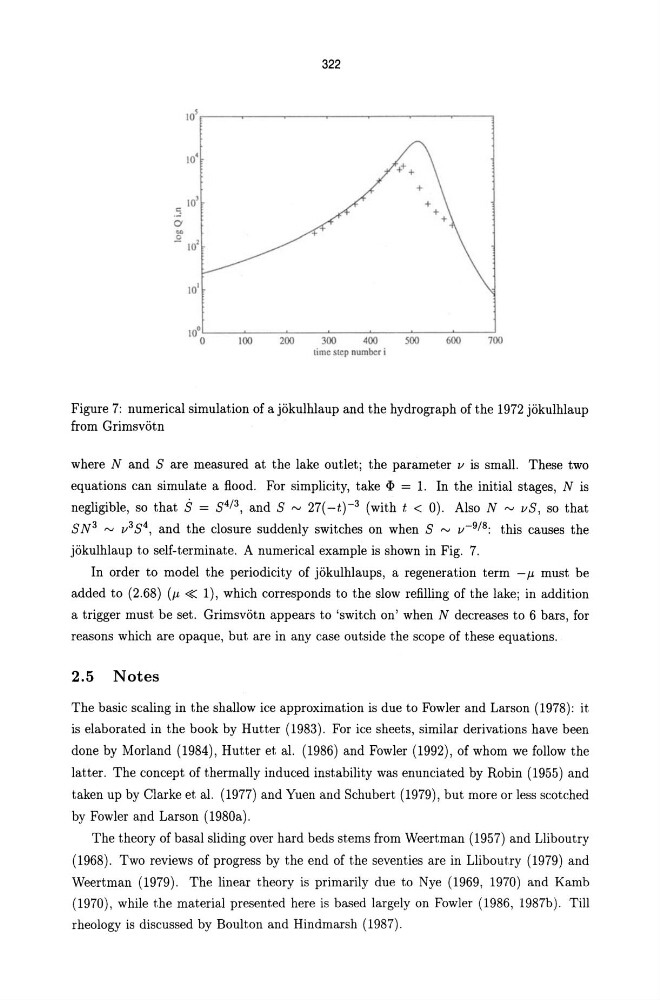
Figure 7: numerical simulation of a jokulhlaup and the hydrograph of the 1972 jokulhlaup
from Grimsvotn
where Nand S are measured at the lake outlet; the parameter v is small. These two
equations can simulate a flood. For simplicity, take = 1. In the initial stages, N is
negligible, so that S = S4/3, and S rv 27( _t)-3 (with t < 0). Also N rv vS, so that
S N 3 rv v 3 S4, and the closure suddenly switches on when S rv v- 9 / 8 : this causes the
jokulhlaup to self-terminate. A numerical example is shown in Fig. 7.
In order to model the periodicity of jokulhlaups, a regeneration term - J.t must be
added to (2.68) (J.t ~ 1), which corresponds to the slow refilling of the lake; in addition
a trigger must be set. Grimsvot.n appears t.o 'switch on' when N decreases to 6 bars, for
reasons which are opaque, but are in any case outside the scope of these equations.
2.5 Notes
The basic scaling in the shallow ice approximation is due to Fowler and Larson (1978): it
is elaborated in the book by Hut.ter (1983). For ice sheets, similar derivations have been
done by Morland (1984) , Hutter et. al. (1986) and Fowler (1992) , of whom we follow the
latter. The concept of thermally induced instability was enunciated by Robin (1955) and
taken up by Clarke et al. (1977) and Yuen and Schubert (1979), but more or less scotched
by Fowler and Larson (1980a) .
The theory of basal sliding over hard beds stems from Weertman (1957) and Lliboutry
(1968). Two reviews of progress by the end of the seventies are in Lliboutry (1979) and
Weertman (1979). The linear theory is primarily due to Nye (1969 , 1970) and Kamb
(1970) , while the mat.erial presented here is based largely on Fowler (1986, 1987b). Till
rheology is discussed by Boulton and Hindmarsh (1987).
10'
10'
10'
.5
C1
.. 0
- 10 '
10'
10°
0
100
200
300
400
500
600
700
lime step number i
Figure 7: numerical simulation of a jokulhlaup and the hydrograph of the 1972 jokulhlaup
from Grimsvotn
where Nand S are measured at the lake outlet; the parameter v is small. These two
equations can simulate a flood. For simplicity, take = 1. In the initial stages, N is
negligible, so that S = S4/3, and S rv 27( _t)-3 (with t < 0). Also N rv vS, so that
S N 3 rv v 3 S4, and the closure suddenly switches on when S rv v- 9 / 8 : this causes the
jokulhlaup to self-terminate. A numerical example is shown in Fig. 7.
In order to model the periodicity of jokulhlaups, a regeneration term - J.t must be
added to (2.68) (J.t ~ 1), which corresponds to the slow refilling of the lake; in addition
a trigger must be set. Grimsvot.n appears t.o 'switch on' when N decreases to 6 bars, for
reasons which are opaque, but are in any case outside the scope of these equations.
2.5 Notes
The basic scaling in the shallow ice approximation is due to Fowler and Larson (1978): it
is elaborated in the book by Hut.ter (1983). For ice sheets, similar derivations have been
done by Morland (1984) , Hutter et. al. (1986) and Fowler (1992) , of whom we follow the
latter. The concept of thermally induced instability was enunciated by Robin (1955) and
taken up by Clarke et al. (1977) and Yuen and Schubert (1979), but more or less scotched
by Fowler and Larson (1980a) .
The theory of basal sliding over hard beds stems from Weertman (1957) and Lliboutry
(1968). Two reviews of progress by the end of the seventies are in Lliboutry (1979) and
Weertman (1979). The linear theory is primarily due to Nye (1969 , 1970) and Kamb
(1970) , while the mat.erial presented here is based largely on Fowler (1986, 1987b). Till
rheology is discussed by Boulton and Hindmarsh (1987).