

309
2 Mathematical models
2.1 The basic shallow ice approximation
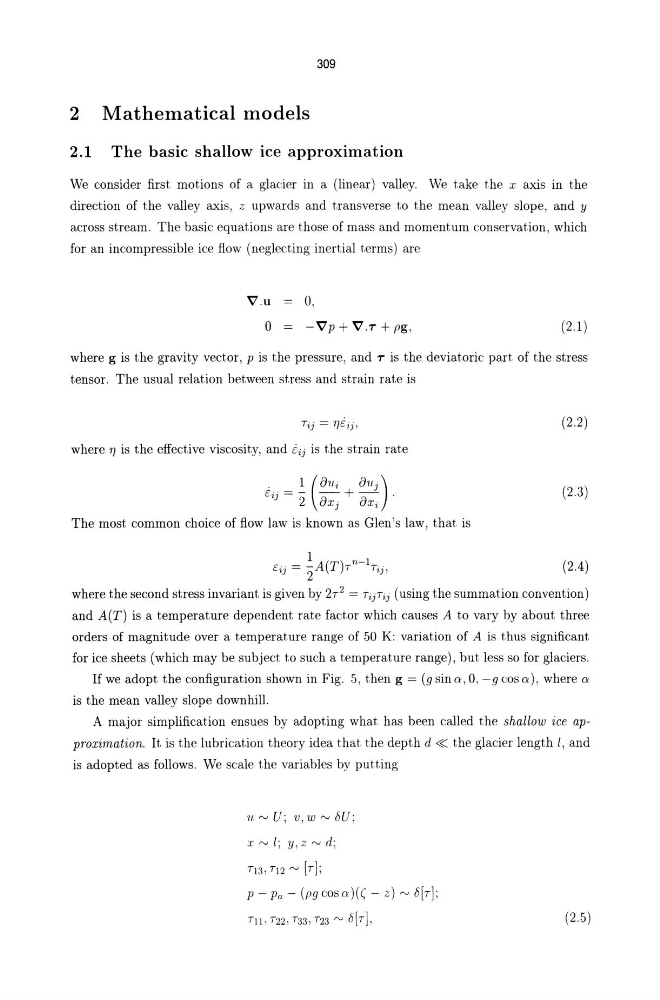
We consider first motions of a glacier in a (linear) valley. We take the x axis in the
direction of the valley axis, z upwards and transverse to the mean valley slope, and y
across stream. The basic equations are those of mass and momentum conservation, which
for an incompressible ice flow (neglecting inertial terms) are
V.u
0,
o
-Vp + V:r + pg,
(2.1)
where g is the gravity vector, p is the pressure, and T is the deviatoric part of the stress
tensor. The usual relation between stress and strain rate is
(2.2)
where TJ is the effective viscosity, and iij is the strain rate
iij = ~ (ani + aUj) .
2 aXj aXi
(2.3)
The most common choice of flow law is known as Glen's law, that is
1 ( ) n-l
E" = -A T T T
',J
2
'oJ'
(2.4)
where the second stress invariant is given by 2T2 = TijTij (using the summation convention)
and A(T) is a temperature dependent rate factor which causes A to vary by about three
orders of magnitude over a temperature range of 50 K: variation of A is thus significant
for ice sheets (which may be subject to such a temperature range), but less so for glaciers.
If we adopt the configuration shown in Fig. 5, then g = (g sina, 0, -g cos a), where a
is the mean valley slope downhill.
A major simplification ensues by adopting what has been called the shallow ice approximation, It is the lubrication theory idea that the depth d « the glacier length I, and
is adopted as follows, We scale the variables by putting
U",U; v,w",8U;
x '" I; y,z '" d;
T13, T12 '" [T];
P - Pa - (pgcosa)(( - z) '" 8[T];
(2.5)
2 Mathematical models
2.1 The basic shallow ice approximation
We consider first motions of a glacier in a (linear) valley. We take the x axis in the
direction of the valley axis, z upwards and transverse to the mean valley slope, and y
across stream. The basic equations are those of mass and momentum conservation, which
for an incompressible ice flow (neglecting inertial terms) are
V.u
0,
o
-Vp + V:r + pg,
(2.1)
where g is the gravity vector, p is the pressure, and T is the deviatoric part of the stress
tensor. The usual relation between stress and strain rate is
(2.2)
where TJ is the effective viscosity, and iij is the strain rate
iij = ~ (ani + aUj) .
2 aXj aXi
(2.3)
The most common choice of flow law is known as Glen's law, that is
1 ( ) n-l
E" = -A T T T
',J
2
'oJ'
(2.4)
where the second stress invariant is given by 2T2 = TijTij (using the summation convention)
and A(T) is a temperature dependent rate factor which causes A to vary by about three
orders of magnitude over a temperature range of 50 K: variation of A is thus significant
for ice sheets (which may be subject to such a temperature range), but less so for glaciers.
If we adopt the configuration shown in Fig. 5, then g = (g sina, 0, -g cos a), where a
is the mean valley slope downhill.
A major simplification ensues by adopting what has been called the shallow ice approximation, It is the lubrication theory idea that the depth d « the glacier length I, and
is adopted as follows, We scale the variables by putting
U",U; v,w",8U;
x '" I; y,z '" d;
T13, T12 '" [T];
P - Pa - (pgcosa)(( - z) '" 8[T];
(2.5)